Anhui Feichun Special Cable Co.,Ltd Email: Li.wang@feichuncables.com
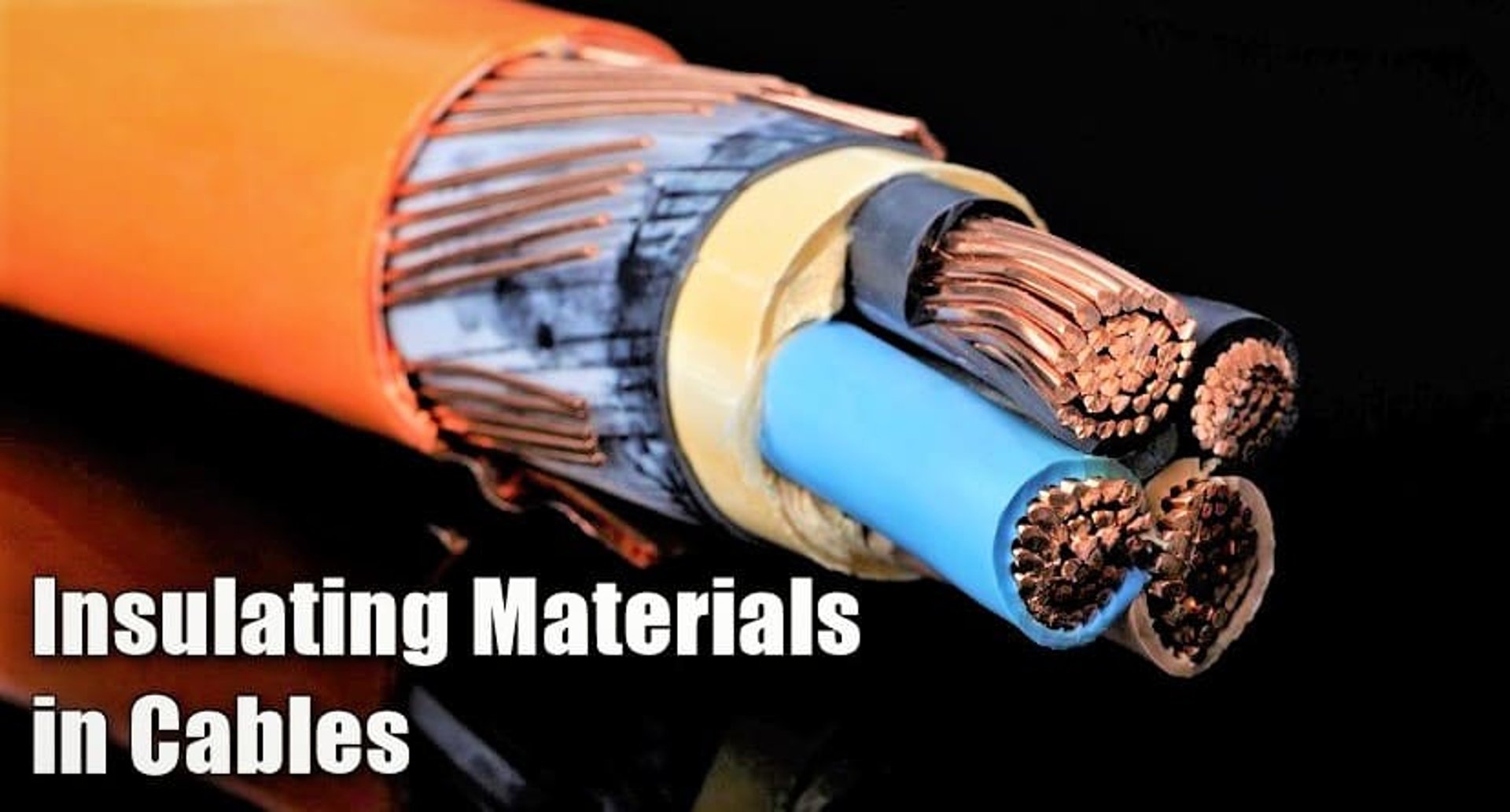
Why Cable Insulation Materials Matter More Than You Think — The Hidden Science Behind Safer, Longer-Lasting Cables in South Africa
Discover the science behind Cable Insulation Materials, including PVC, XLPE, PE, EPR, TPU, and Silicone. Learn how each performs under South Africa’s harsh mining, industrial, and outdoor conditions. Deep comparisons, case studies, and expert insights included.
Li.Wang
12/9/20255 min read
Why Cable Insulation Matters in South Africa
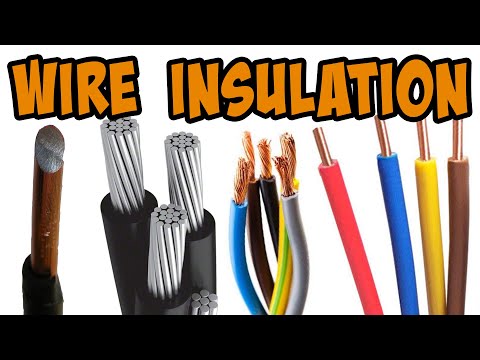
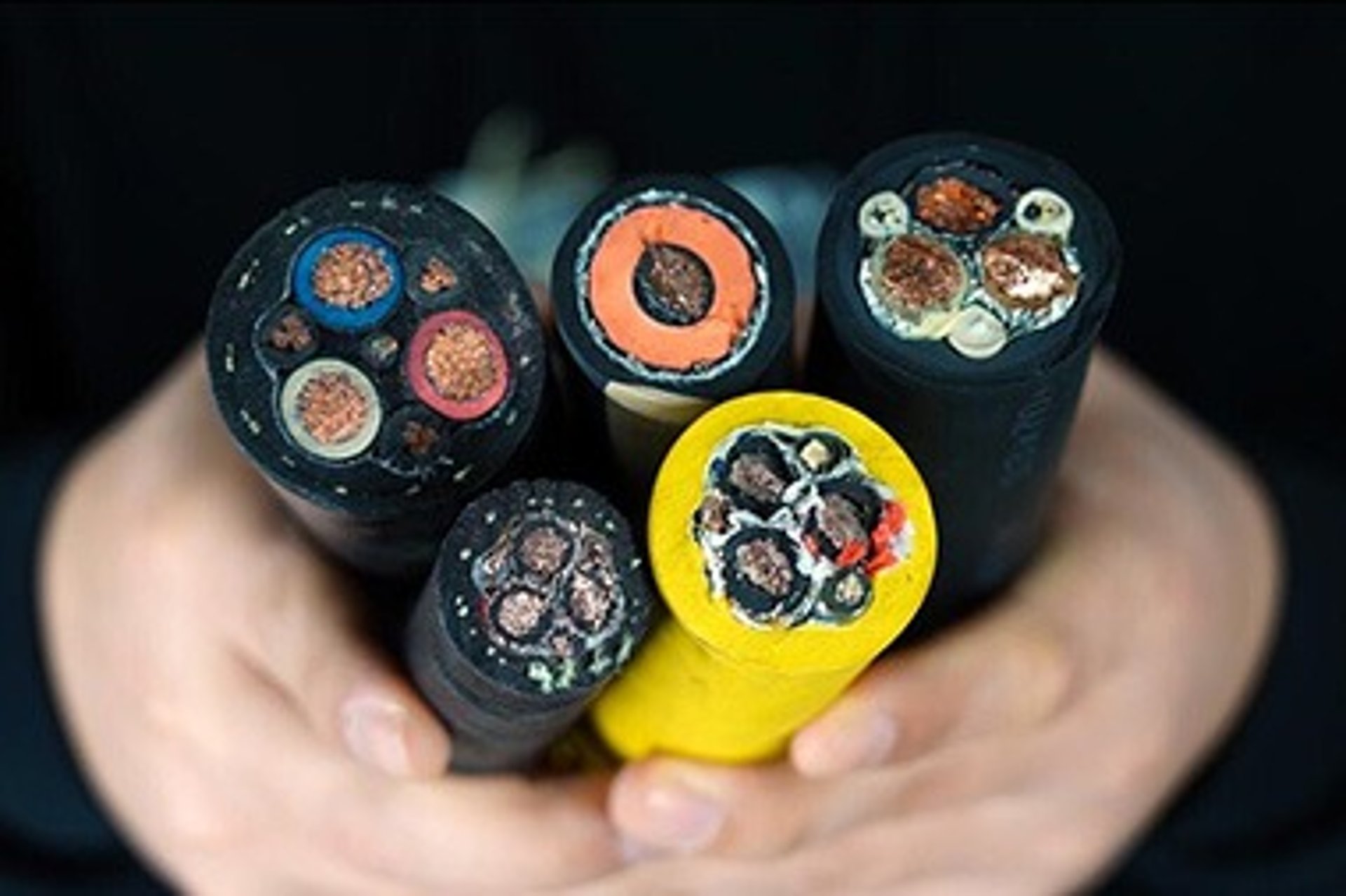
When most people think about cables, they imagine copper conductors, voltage ratings, or current-carrying capacity. Yet, one of the most crucial components of any cable is often overlooked—the insulation material. In South Africa, where cables operate in some of the world’s harshest environments—deep-level mines, high-UV desert regions, corrosive coastal zones, and high-heat industrial plants—the choice of insulation can be the difference between a safe installation and a catastrophic failure.
Insulation is not just a “protective plastic layer.” It is the heart of cable performance, directly affecting:
electrical safety,
fire risk reduction,
mechanical durability,
environmental resistance, and
long-term operational costs.
In South Africa, these factors are amplified by:
High UV radiation in Northern Cape solar farms
Extreme heat in Mpumalanga industrial smelters
Dust, vibration, and mechanical abuse in Gauteng and Rustenburg mining operations
Salt-laden moisture along the Durban and Gqeberha coastlines
Frequent load-shedding events, which create electrical surges that stress insulation layers
For these reasons, understanding Cable Insulation Materials is not just a technical topic—it is a practical necessity for engineers, electricians, and procurement teams across the country. Throughout this article, we dive deep into the science, performance, and real-world case studies behind six major insulation materials used in South Africa’s electrical and mining sectors.
What Exactly Is Cable Insulation?
Cable insulation is a non-conductive dielectric material applied around a conductor to:
Prevent electrical leakage
Withstand operating voltage and transient overvoltage
Protect against mechanical impacts
Resist environmental exposure
Maintain long-term stability
Insulation vs. Sheath
It is important to distinguish:
Insulation: Directly surrounds each conductor
Sheath/Jacket: Protects the entire cable externally
Multi-core cables may have a combination of insulation and multiple protective layers.
Link to South African Standards
High-performance insulation must comply with requirements under:
SANS 1520-1 (mining cables)
SANS 1507 (LV cables)
SANS 1339 / 60502 (MV cables)
NRCS LOA requirements (for regulated cable categories)
Failing insulation is one of the most common reasons cables are rejected in local compliance inspections.
Key Performance Indicators for Insulation Materials
Cable insulation materials are evaluated across seven major KPIs:
Dielectric Strength
This determines how well insulation prevents electrical breakdown.
XLPE and PE have some of the highest dielectric strengths.
PVC is adequate for LV systems but not ideal for MV settings.
Temperature Range
South Africa’s climate varies widely:
Northern Cape mines can drop below freezing
Highveld industrial zones regularly operate above 50°C
For high-heat settings (like furnaces), silicone is unmatched.
Mechanical Flexibility & Wear Resistance
Mines require insulation that tolerates:
constant dragging
sharp rocks
repetitive bending
blasting vibrations
EPR and TPU strongly outperform PVC under these conditions.
Chemical Resistance
Especially important in:
refinery plants
automotive factories
fertilizer plants
coastal salt exposure
TPU excels in oil resistance, while PE excels in moisture resistance.
Fire Performance
Fire safety is critical given South Africa’s tight SANS fire rating requirements:
PVC, EPR, TPU, and silicone offer high flame performance
PE performs poorly in fire
UV & Weather Resistance
Solar farms, outdoor substations, and mines rely heavily on:
XLPE
EPR
TPU
These materials resist cracking, chalking, and embrittlement.
Cost vs. Lifespan
Total cost of ownership (TCO) matters more than upfront cost.
A cheaper PVC cable replaced annually is more expensive long-term than an XLPE cable that lasts 10–15 years outdoors.
Six Core Cable Insulation Materials — Deep Technical Comparison
Below is an industry-grade, experience-based analysis of each major insulation material used in South Africa.
PVC (Polyvinyl Chloride)
Key Properties
Good flame retardancy
Easy to process
Moderate dielectric performance
Low cost
Good chemical resistance
Limitations
Brittle below –20°C
Limited heat resistance (70°C continuous)
Poor UV resistance—ages and cracks outdoors
Hardens over time
Typical Applications
Domestic wiring
LV building installations
Appliance cords
Fixed indoor wiring (SANS 1507-3 PVC cables)
XLPE (Cross-Linked Polyethylene)
Key Properties
High dielectric strength
Excellent heat resistance (90°C continuous, 250°C short-circuit)
Outstanding moisture resistance
High UV resistance
Long lifespan (>25 years outdoors)
Limitations
Higher cost
Non-recyclable (thermoset material)
Stiffer compared to rubber materials
Applications
MV and LV power distribution
Solar PV cables
Industrial feeders
Underground and outdoor installations
PE (Polyethylene)
Key Properties
Excellent dielectric performance
Very low signal loss
Exceptional moisture barrier
Lightweight
Limitations
Poor flame resistance
Low mechanical strength
Limited flexibility
Applications
Coaxial cables
Fibre and telecom cables
Submarine/underground moisture-proof cables
EPR / EPDM (Rubber Family)
Key Properties
Extremely flexible
High mechanical toughness
Outstanding thermal stability
Excellent weather and ozone resistance
Very good fire performance
Limitations
Heavier than PE and PVC
Higher cost
Requires precise manufacturing control
Applications
Mining trailing cables (SANS Type 41/61A)
Industrial flexible cables
Welding cables
Portable machinery cables
TPE/TPU (Thermoplastic Elastomers / Polyurethane)
Key Properties
Extreme cold flexibility (down to –50°C)
Recyclable
Exceptional abrasion resistance
Excellent oil and chemical resistance
High elasticity for robotics
Limitations
Higher cost
Not suited for very high temperatures
Applications
Robotic arm cables
Automotive cables
Automation systems
Drag chain applications
Silicone Rubber
Key Properties
Unmatched temperature range (–60°C to +180°C)
Highly flexible
Flame-resistant
Biocompatible
Electrically stable across temperatures
Limitations
Very high cost
Low mechanical abrasion strength
Not ideal for mining, dragging, or impact zones
Applications
Aerospace wiring
Furnace cables
Medical equipment
High-temperature industrial installations
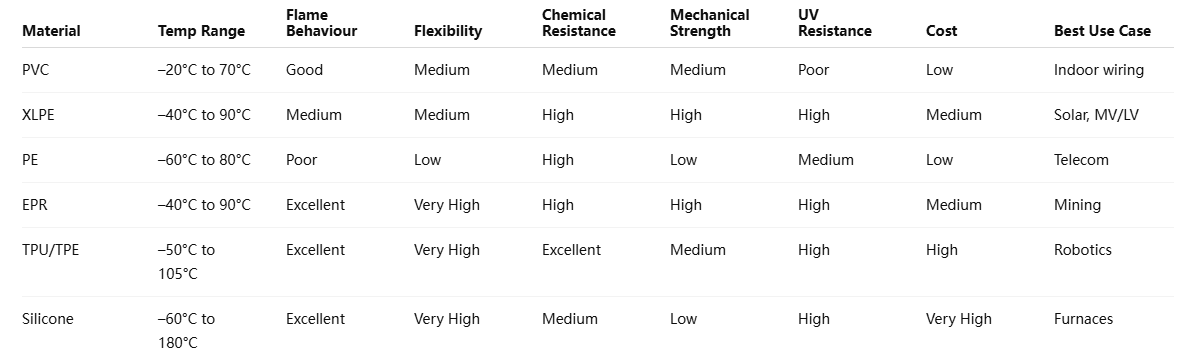
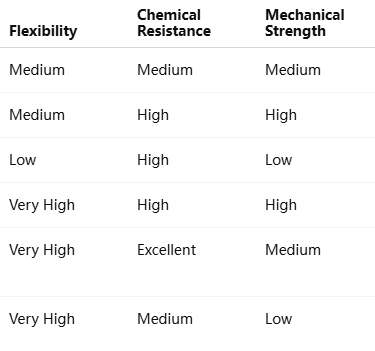
Expanded Comparison Table
Material Performance Overview
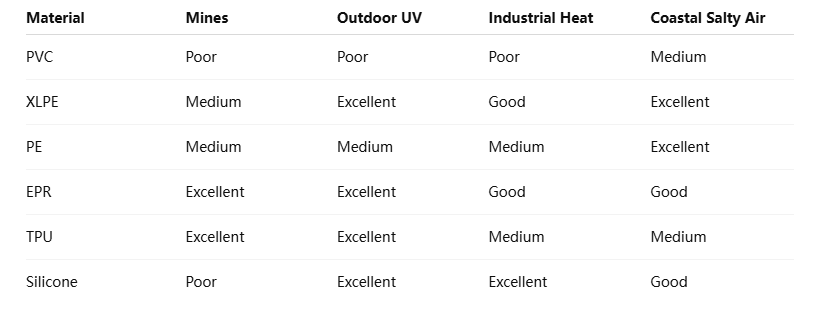
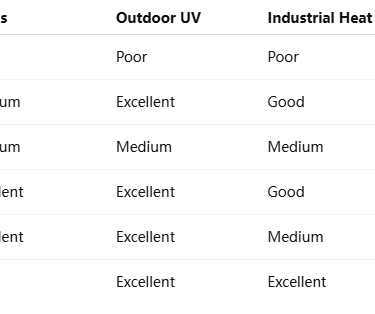
Lifetime Expectancy Under Harsh Conditions
How to Choose the Right Insulation Material (A Practical Guide)
Choosing insulation is not about selecting the “best” material—it is about selecting the right material for your application.
Understand the Application Scenario
Indoor Fixed Wiring → PVC
Cost-effective and safe for SANS 1507 LV systems.
Outdoor UV-Exposed → XLPE or EPR
Long lifespan and slow aging rate.
Constant Flexing or Movement → TPU or EPR
Mining equipment, automation lines, festoon systems.
High-Temperature Environments → Silicone
Steel plants, smelters, furnace control cables.
Check Temperature Requirements
Extreme heat: Silicone
Extreme cold (Karoo nights): PE or TPU
Standard LV power: PVC or XLPE
Assess Mechanical or Chemical Conditions
Heavy impact & vibration (mining): EPR
Oil-rich environments (factories): TPU
Water exposure (coastal): PE or XLPE
Balance Cost vs. Performance
Budget-sensitive: PVC
Long-term reliability: XLPE
Harsh industrial: EPR
Extreme conditions: Silicone
South African Case Studies
Rustenburg Platinum Mine — EPR Insulation Tripled Cable Lifespan
Mining machinery repeatedly damaged PVC and XLPE insulated trailing cables, causing:
conductor exposure
electrical faults
downtime
Switching to EPR resulted in:
3× longer cable lifespan
fewer shutdowns
reduced maintenance cost
Northern Cape Solar Farm — XLPE Outperforms Under Extreme UV
Temperatures reached 52°C at cable surfaces.
After 8 years, XLPE insulation showed:
minimal cracking
no chalking
excellent dielectric retention
Durban Coastal Fibre Network — PE Solves Moisture Problems
Salt-laden air caused failures in PVC-insulated communication cables.
Switching to PE insulation improved:
water resistance
corrosion protection
long-term stability
Mpumalanga Steel Plant — Silicone Survives Furnace Heat
Where PVC and XLPE melted within hours, silicone-insulated furnace cables remained operational.
Outcome:
5-year failure-free operation
stable performance near 160–180°C
Johannesburg Automotive Plant — TPU Extends Robotic Cable Life
Robotic arm cables undergo millions of flexing cycles.
PVC and XLPE cracked within months.
TPU insulation delivered:
10× cycle life
improved automation reliability
reduced maintenance time
Frequently Asked Questions (FAQ)
Q1: Which insulation is safest for South African home wiring?
PVC, due to its flame retardancy, affordability, and good performance indoors.
Q2: Why do mines prefer EPR insulation?
Because EPR handles mechanical abuse, heat, vibration, and torsion far better than PVC or XLPE.
Q3: Is XLPE better than PVC?
Not always.
XLPE = best for outdoor/UV/industrial/high-voltage
PVC = best for low-voltage indoor cost-sensitive installations
Q4: Which material lasts longest outdoors?
XLPE and EPR.
Q5: Which insulation is ideal for robotic arms?
TPU, thanks to extreme flexibility and abrasion resistance.
Q6: Can silicone be used in mines?
Not recommended—its mechanical abrasion resistance is too low.
Q7: Which insulation gives the lowest electrical loss?
PE, commonly used in telecom and high-frequency cables.
Conclusion
Selecting the right Cable Insulation Material is not a minor detail—it is a core engineering decision that directly affects safety, compliance, lifespan, replacement frequency, and total system reliability.
In South Africa’s demanding environments—mines, solar farms, industrial plants, and coastal regions—the wrong insulation can fail in months, while the right one can last decades.
PVC, XLPE, PE, EPR, TPU, and Silicone each offer unique strengths and weaknesses. Understanding these allows engineers and buyers to make informed, cost-effective, and safety-oriented choices.
The more extreme the environment, the more critical insulation becomes.
Cable insulation is not just a protective layer—
it is the core of electrical safety, performance, and long-term value.
Contact Anhui Feichun Special Cable Co., Ltd.
For comprehensive technical specifications and quotations, please contact our specialized mining cable engineering team:
Technical Engineering Support:
Sales Engineering Department:
WhatsApp Contact:
Manufacturer: Anhui Feichun Special Cable Co., Ltd. (安徽飞纯特种电缆有限公司)
Manufacturing Headquarters: Building A, Private Science and Technology Park, Hefei Economic and Technological Development Zone, Anhui Province, People’s Republic of China
+86 17333223430
Email Address: Li.wang@feichuncables.com
© 2025. All rights reserved.
One-click to Quickly Contact
Products
Contact
Company
Location:
Building A Private Science and Technology Park, Hefei Economic and Technological Development Zone, Anhui Province, China
Heat Resistant Cable
WhatsApp: +86 17333223430
Social Media: