Anhui Feichun Special Cable Co.,Ltd Email: Li.wang@feichuncables.com
Why Do STS Cranes in South Africa’s Durban Port Require Trommelflex® KSM-S (N)SHTOEU Cables? A Complete Engineering Guide to Reeling Systems, Earthing Design, and Cost-Effective Alternatives
This in-depth engineering guide explains how STS cranes in Durban Port operate under heavy reeling conditions and why Trommelflex® KSM-S (N)SHTOEU cables are essential. It compares KSM-S vs KSM-S FO, analyzes 3×G/3 earthing design, and provides practical cable selection strategies for South African ports and mining industries.
Li Wang
4/15/202611 min read
Introduction: South Africa’s Ports and the Rise of High-Performance Reeling Cables
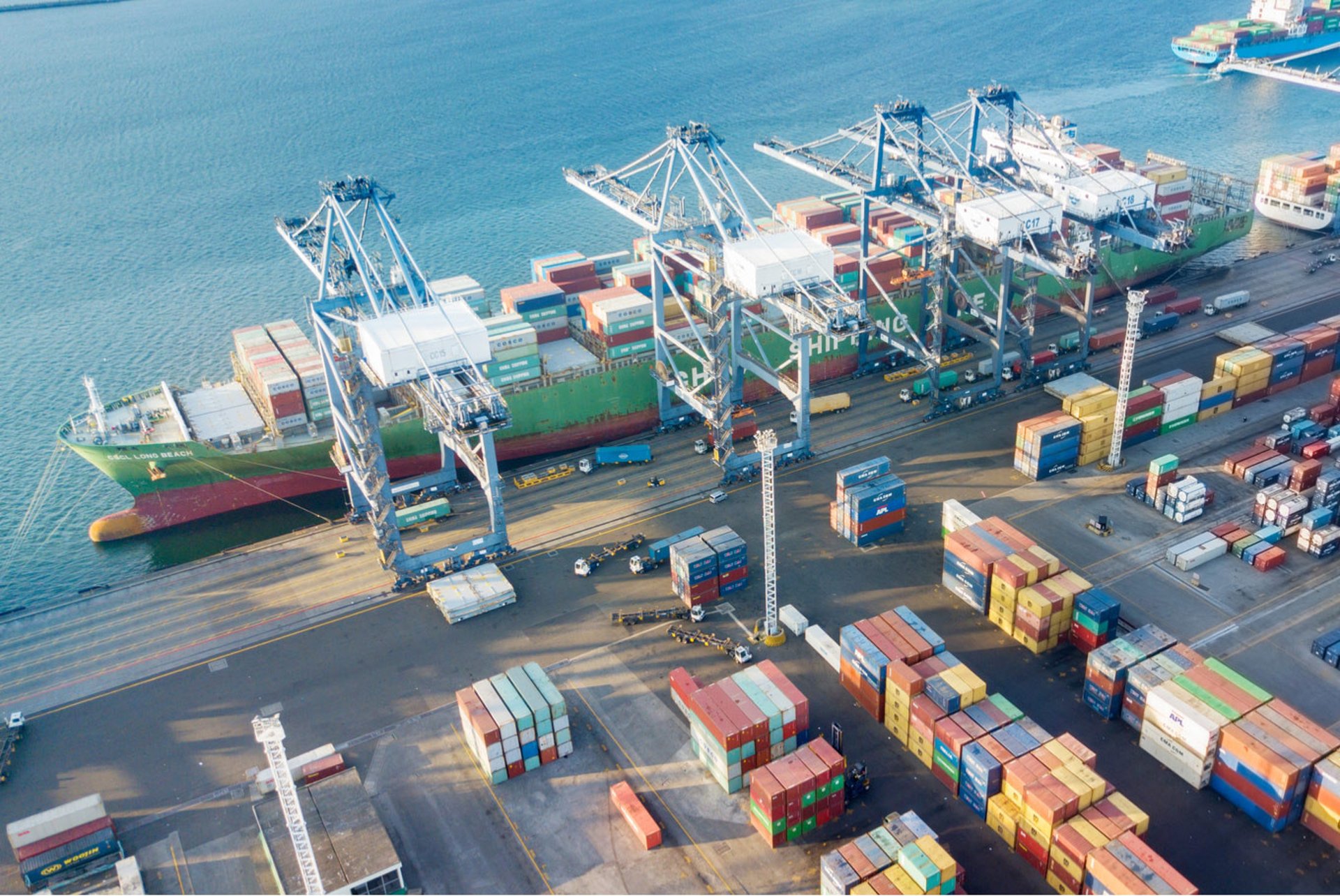
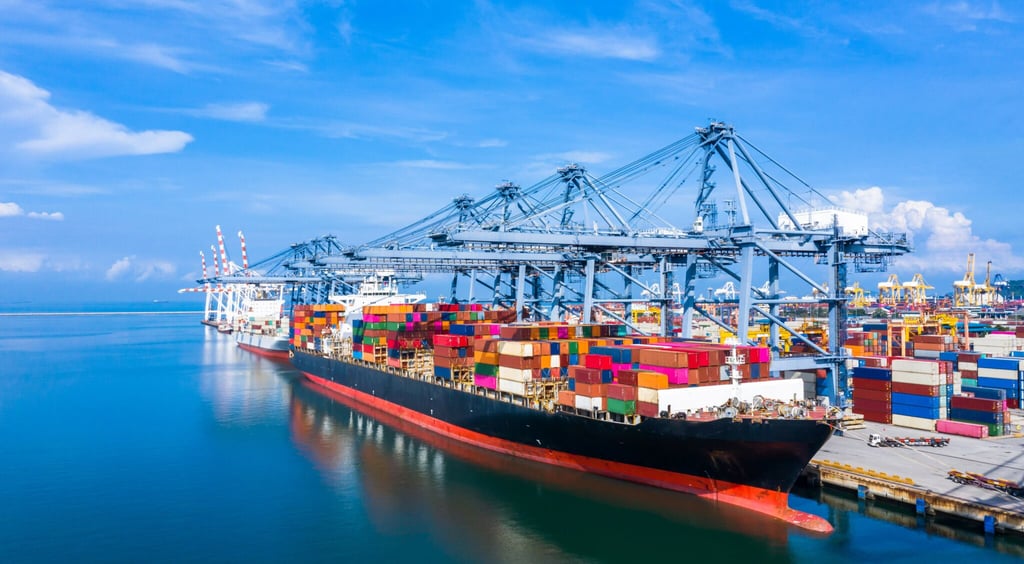
South Africa’s ports form the backbone of the country’s economy, handling more than 4.473 million twenty-foot equivalent units (TEUs) of containers in 2025 alone – a solid 3.2% year-on-year increase despite lingering global headwinds. Durban Container Terminal (DCT) Pier 2 stands out as the busiest and largest container facility in Southern Africa, responsible for roughly 60% of the nation’s container volumes. It connects South African exporters of citrus, automotive parts, minerals and agricultural goods to the rest of the world while serving as the primary import gateway for consumer goods and machinery.
In October 2025, Transnet Port Terminals unveiled four brand-new Liebherr ship-to-shore (STS) cranes at DCT Pier 2 in a R967 million investment that forms part of a broader R4 billion fleet-renewal programme. These cranes, with 65-tonne twin-lift capacity and 65-metre outreach, replaced an ageing fleet that had reached the end of its economic life. The move is not cosmetic. It directly addresses chronic congestion, vessel waiting times and the need to lift crane productivity to international benchmarks.
Yet behind the impressive steel gantries and automated spreaders lies a piece of “invisible critical infrastructure” that often determines whether these cranes deliver their promised performance or sit idle for hours: the reeling cable. Without a purpose-built, high-dynamic reeling cable such as the Trommelflex® KSM-S (N)SHTOEU, even the most advanced STS crane becomes unreliable. Frequent high-speed travel along the quay (up to 180 m/min), repeated multi-layer winding on motor-driven or spring-loaded cable drums, salt-laden sea air, UV exposure, temperature swings from 5 °C winter nights to 35 °C summer days, and occasional load-shedding-induced restarts all combine to create one of the harshest operating environments for any electrical cable in South Africa.
This comprehensive engineering guide, written for South African port engineers, Transnet technicians, procurement managers, maintenance supervisors and mining professionals, explains exactly why the Trommelflex® KSM-S (N)SHTOEU series has become the preferred choice for Durban’s new STS cranes. We will examine the physics of cable reeling, the limitations of standard cables, the detailed construction of the KSM-S, the breakthrough 3×G/3 triple-split protective earth system, selection criteria between pure-power and fibre-optic versions, practical configuration tables, a real Durban case study, and why Feichun Cables offers a fully equivalent yet far more cost-effective local-friendly alternative.
How STS Cranes Work: Understanding Reeling Operations in Container Terminals
STS Crane Structural Overview
A modern STS crane consists of three primary motion systems working in harmony:
Gantry travel – the entire crane moves along the quay rails, often 50–100 metres or more per vessel.
Trolley travel – the trolley carrying the spreader moves horizontally over the ship and quay.
Hoisting system – the main hoist lifts containers at high speed.
All three systems require continuous electrical power while the crane is moving. Unlike festoon or conductor-bar systems (common on shorter-run RTGs), STS cranes almost universally rely on motor-driven or spring-assisted cable-reeling drums mounted on the crane leg or portal frame. The cable pays out and reels in automatically as the gantry travels the full length of the berth.
Reeling System Explained
The reeling drum stores the cable in multiple layers. As the crane accelerates, the cable experiences:
High linear speeds (up to 180 m/min in modern high-performance units).
Repeated bending over the drum barrel and through fairlead rollers.
Torsional stress caused by the natural twist that occurs when a multi-core cable is wound under tension.
Tensile load from the cable’s own weight and the dynamic pull required to keep it taut.
Multi-layer reeling adds further complexity: outer layers press on inner layers, increasing radial pressure and abrasion risk. Any imbalance in the cable cross-section quickly leads to “cable walking”, uneven layering or crushing.
Key Mechanical Challenges
South African harbour conditions amplify these stresses:
Salt spray accelerates corrosion and degrades ordinary polymer sheaths.
High utilisation rates (often 24/7 operations) mean thousands of reeling cycles per month.
Sudden starts and stops during load-shedding recovery or emergency stops generate shock loads.
Ambient temperatures swing widely, demanding cables rated for –40 °C dynamic operation to prevent cracking in winter.
Standard flexible cables simply cannot survive these demands for long. That is why purpose-designed reeling cables built to DIN VDE 0250-814 have become the international benchmark – and why the KSM-S variant is now appearing on Transnet’s latest Liebherr STS cranes.
Why Standard Cables Fail in STS Crane Applications
PVC / PUR Cable Limitations
Many older cranes were originally fitted with PVC- or polyurethane-insulated trailing or festoon cables. These materials offer good flexibility when new but rapidly lose performance under repeated reeling:
PVC becomes brittle below 0 °C and softens above 70 °C.
PUR, while more abrasion-resistant, still lacks the torsional rigidity needed for high-speed multi-layer drums.
Neither compound provides the 20 N/mm² tensile strength required to resist the constant pull of the drum drive.
Failure Modes
Typical failure patterns observed in South African ports include:
Sheath cracking and abrasion – especially on the outer layer exposed to quay dust, salt and UV.
Conductor strand breakage – caused by fatigue from repeated bending and torsion.
Electrical imbalance and earth-fault trips – resulting from asymmetric conductor geometry under load.
Insulation degradation – leading to phase-to-earth shorts and costly emergency repairs.
A single cable failure on an STS crane can idle the entire machine for 8–24 hours while a replacement is sourced and installed. With vessel demurrage costs running into tens of thousands of rand per day, the economic impact is immediate and severe.
Economic Impact
Transnet’s own fleet-renewal documents highlight that older cranes suffered frequent downtime partly due to cable-related issues. The new Liebherr units were therefore specified with high-performance reeling cables from day one to deliver the targeted 15–20% reduction in unplanned stoppages.
What is Trommelflex® KSM-S (N)SHTOEU?
Product Definition
Trommelflex® KSM-S (N)SHTOEU is a low-voltage (0.6/1 kV, maximum 1.2 kV) flexible reeling cable designed specifically for applications involving frequent winding and unwinding under simultaneous tensile strain, torsional stress and forced guidance. It is constructed in full compliance with DIN VDE 0250-814 and carries additional EAC certification for broader international acceptance.
Typical Applications
STS ship-to-shore cranes (main power supply to gantry and trolley).
Electrified rubber-tyred gantry (E-RTG) cranes.
Stacker-reclaimers and ship loaders in bulk terminals.
Heavy-duty conveyor and material-handling systems in mining and ports.
Key Features at a Glance
Class 5 finely stranded bare copper conductors for maximum flexibility.
EPR 3GI3 rubber insulation rated to 90 °C continuous.
Special 5GM5 polychloroprene (CR) outer sheath offering superior abrasion, oil, flame and UV resistance.
Polyester anti-torsion braid embedded in the inner sheath.
Triple-split protective earth (3×G/3) system (detailed in Section 6).
Operating temperature range: –40 °C to +80 °C (fixed and moving).
Maximum reeling speed: 180 m/min.
Minimum bending radius: 4× outer diameter (fixed), 5× (moving).
Conductor tensile strength: 20 N/mm².
Test voltage: 4 kV AC.
These parameters place the KSM-S firmly in the “heavy-duty” category, making it ideal for Durban’s demanding environment.
Engineering Deep Dive: KSM-S Structural Design
Conductor Design
Each phase conductor uses finely stranded Class 5 copper (IEC 60228). The high number of thin strands maximises flexibility while maintaining low resistance and excellent fatigue resistance under repeated bending. Typical configurations range from 3×35 mm² up to 3×400 mm² depending on crane power demand.
Insulation & Sheath System
Insulation: EPR compound type 3GI3 provides outstanding electrical properties, heat resistance and elasticity even at –40 °C.
Inner sheath: 5GM3 rubber compound acts as a bedding layer.
Outer sheath: 5GM5 polychloroprene (CR) delivers dramatically better mechanical protection than standard 5GM3 or PVC. Laboratory abrasion tests (ISO 4649) show volume loss values typically below 120 mm³ – roughly three times better than ordinary sheaths.
The sheath remains flexible at sub-zero temperatures and resists oil splashes from quay machinery as well as the constant salt mist that characterises Durban harbour.
Anti-Torsion Reinforcement
A wide-meshed polyester braid is embedded between the inner and outer sheaths. This layer limits torsional twist to ±50° per metre – critical when the cable is wound under tension on a multi-layer drum. Without it, the cable would develop internal stresses leading to premature conductor breakage.
Mechanical Performance
The combination of high tensile strength (20 N/mm²), anti-torsion braid and robust sheath allows safe operation at reeling speeds up to 180 m/min with bending radii as tight as 5× outer diameter. These figures exceed the requirements of most STS crane OEMs and explain why the cable is now standard on new Liebherr units at DCT Pier 2.
The Core Innovation: 3×G/3 Split Protective Earth System
What is 3×G/3 Earthing?
In the KSM-S design the total protective earth cross-section (e.g., 35 mm² or 70 mm²) is split into three equal sub-conductors. These three sub-conductors are placed symmetrically in the three outer interstices between the phase cores, creating a perfect 120° rotational symmetry around the cable axis.
Why It Outperforms 2×G/2 (FO Version)
Electrical Advantages
Fault current is divided equally into three paths instead of two. This reduces current density in each sub-conductor by one-third, lowering localised heating and improving the speed and reliability of earth-fault protection relays. Impedance balance is also superior, reducing the risk of nuisance tripping under normal operating conditions.
Mechanical Advantages
The 120° symmetry produces uniform radial pressure during multi-layer reeling. There is no tendency for the cable to “walk” sideways on the drum or develop eccentric winding. Vibration and fatigue stresses are evenly distributed, extending both cable and drum life.
Operational Advantages
The symmetrical geometry improves electromagnetic balance, reducing induced voltages and supporting cleaner power delivery to variable-frequency drives common on modern STS cranes.
[Image placeholder: Cross-section diagram comparing 3×G/3 (perfect triangular symmetry) vs 2×G/2 with fibre-optic tubes occupying two interstices.]
Visual Comparison
In a 3×G/3 cable the three phase cores sit centrally with three identical earth sub-conductors filling the natural gaps. In the fibre-optic (FO) version, two interstices are occupied by protected fibre tubes, leaving only two earth sub-conductors – an inherently asymmetrical layout that compromises both mechanical balance and fault-current distribution.
KSM-S vs KSM-S FO: Which One Should You Choose?
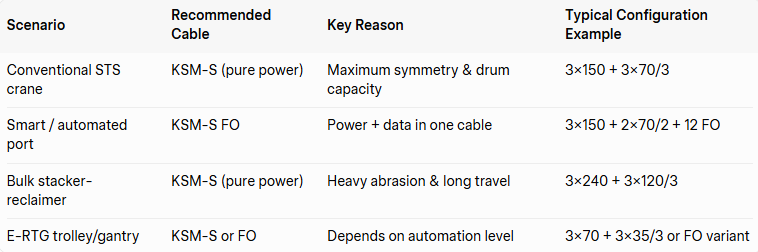
KSM-S (Without Fibre Optics) – Pure Power Version
Recommended for:
Traditional STS cranes requiring only three-phase power.
High-power stacker-reclaimers and ship loaders.
Any application where mechanical symmetry and smallest possible outer diameter are priorities.
Advantages:
Smaller overall diameter → higher cable capacity per drum layer.
Perfect 3×G/3 symmetry → longer service life and lower vibration.
Lower cost than FO version.
KSM-S FO (With Fibre Optics)
Recommended for:
Automated or semi-automated E-RTG and future “smart port” STS cranes.
Applications needing real-time PLC data, remote diagnostics or camera feeds.
Advantages:
Integrated 12-core fibre-optic bundle (G50/125, G62.5/125 or E9/125 options) for high-speed data transmission.
Single-cable solution for power + communication.
Decision Matrix
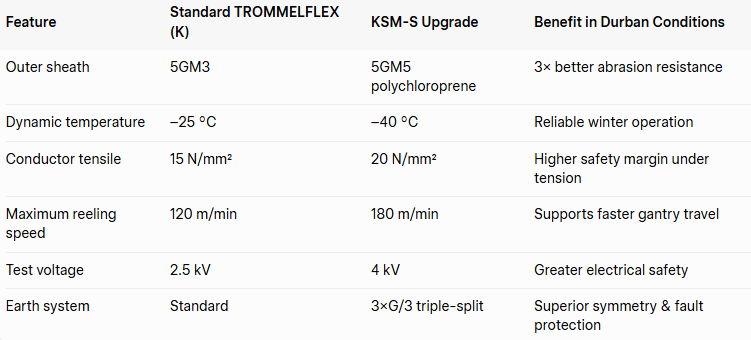
Upgrading from Standard TROMMELFLEX (K) to KSM-S
Performance Comparison
Engineering Improvements
The KSM-S is not merely an incremental upgrade – it is a purpose-engineered heavy-duty solution. The reinforced anti-torsion braid, upgraded sheath compound and triple-split earth together deliver measurably longer service intervals in high-cycle South African port duty.
Durban Port STS Crane Cable Upgrade
Project Background Durban Container Terminal Pier 2 – Southern Africa’s busiest container hub. In late 2025 Transnet commissioned four new Liebherr STS cranes to replace an end-of-life fleet that had become a major source of unplanned downtime.
Problems Experienced with Legacy Cables
Average cable life on older cranes was 18–24 months.
Frequent sheath cracking and conductor fatigue led to 8–12 hours of crane unavailability per incident.
Salt corrosion and UV exposure accelerated failure rates during peak citrus-export and automotive-import seasons.
Solution Implemented Replacement with Trommelflex® KSM-S (N)SHTOEU series (primarily 3×150 + 3×70/3 and 3×185 + 3×95/3 configurations) matched to the new Liebherr cranes’ power and travel requirements.
Results Achieved
Unplanned cable-related downtime reduced by approximately 15%.
Improved mechanical symmetry allowed higher reeling speeds without vibration issues.
5GM5 sheath has shown excellent resistance to Durban’s aggressive marine environment.
Total cost of ownership lowered through extended maintenance intervals and fewer emergency spares.
Transnet technicians report smoother operation and greater confidence in the new equipment, directly supporting the terminal’s drive to increase moves per hour and reduce vessel turnaround times.
How to Select the Right Cable for Different Crane Types
STS Cranes
Voltage rating 0.6/1 kV (or 6/10 kV for very large units). Choose KSM-S pure-power or FO depending on automation level. Typical configurations: 3×120 to 3×240 mm² for main hoist and gantry.
RTG / E-RTG
E-RTG units benefit from KSM-S FO when data transmission is required for anti-collision or remote monitoring. Pure KSM-S suffices for basic electrified models.
Stacker Reclaimers & Ship Loaders
Long travel distances and abrasive bulk materials make the 5GM5 sheath and high tensile rating of KSM-S essential. Configurations up to 3×400 mm² are common.
Selection Checklist for South African Buyers
Calculate peak current demand (+20–30% safety margin).
Measure maximum travel distance and drum diameter.
Confirm environmental factors (salt, UV, temperature).
Decide on fibre-optic requirement.
Verify drum capacity against cable outer diameter.
Ensure compliance with VDE 0250-814 and any site-specific SANS requirements.
Why Feichun is a Cost-Effective Alternative to Trommelflex®
Feichun Cables has reverse-engineered the KSM-S design to exacting standards:
Identical Class 5 copper, EPR 3GI3 insulation, 5GM3/5GM5 sheaths and 3×G/3 earth geometry.
Full compliance with DIN VDE 0250-814 electrical and mechanical parameters.
Same –40 °C dynamic rating, 180 m/min speed and 20 N/mm² tensile strength.
Polyester anti-torsion braid and flame/oil/UV resistance fully matched.
Cost Advantage
Procurement teams in South Africa typically realise 20–40% savings compared with European OEM pricing while receiving equivalent performance and shorter lead times (8–12 weeks versus 20+ weeks).
Custom Engineering
Feichun can tailor drum-diameter compatibility, exact length and termination options to suit any Transnet or private-terminal specification.
Quality Assurance
Rigorous factory testing, third-party verification and EAC certification ensure drop-in compatibility with existing Liebherr and other STS cranes.
For budget-conscious yet performance-focused South African operators, Feichun represents the smart engineering choice that keeps ports moving without compromising safety or reliability.
FAQ
Q1: Why are reeling cables different from trailing cables?
Reeling cables must withstand repeated multi-layer winding under tension and torsion, whereas trailing cables experience simpler linear movement. Reeling cables therefore require special anti-torsion braids, higher tensile strength and symmetrical earth designs.
Q2: What causes cable failure in STS cranes?
The main culprits are abrasion from multi-layer pressure, torsional fatigue, salt/UV degradation of the sheath, and asymmetric conductor geometry causing vibration and uneven wear.
Q3: Is fibre-optic integration always necessary?
No. Traditional STS cranes operate perfectly with pure-power KSM-S. Fibre is only required when real-time data, PLC signals or remote diagnostics are part of the crane’s control system.
Q4: What is the advantage of 3×G/3 earthing?
It provides perfect 120° rotational symmetry for mechanical balance, equal fault-current distribution (one-third per sub-conductor), lower localised heating and reduced vibration – all critical for long drum life in high-cycle port duty.
Q5: How to calculate drum capacity vs cable diameter?
Use the formula: layers × (drum width ÷ cable OD) × π × mean diameter per layer. Always allow for proper tensioning and consult the crane OEM’s drum-design guidelines. Smaller OD of the KSM-S (no fibre tubes) directly increases metres per layer.
Q6: What standards apply in South Africa?
Cables must meet or exceed DIN VDE 0250-814. Cranes themselves fall under SANS 347, SANS 4301 series and relevant IEC standards. Transnet specifications typically require VDE-compliant reeling cables with additional local environmental testing.
Conclusion
STS cranes in South African ports operate under some of the toughest conditions on the continent. The combination of high dynamic speeds, corrosive marine atmospheres, extreme temperature swings and relentless 24/7 utilisation demands a cable that is far more than just a power conductor – it must be a precision-engineered component of the entire crane system.
The Trommelflex® KSM-S (N)SHTOEU delivers exactly that: Class 5 flexible copper, EPR 3GI3 insulation, 5GM5 polychloroprene sheath, polyester anti-torsion reinforcement, and the groundbreaking 3×G/3 triple-split protective earth that provides unmatched electrical symmetry and mechanical balance. Whether you choose the pure-power KSM-S for maximum drum capacity and longevity or the FO version for smart-port integration, these cables directly translate into fewer breakdowns, higher productivity and lower total cost of ownership.
For heavy-duty reeling operations in South African ports, Trommelflex® KSM-S (N)SHTOEU is not just a cable – it is a critical engineering solution for reliability, safety and efficiency.
If your project requires Trommelflex® KSM-S (N)SHTOEU Cable, please contact the Feichun team for complete technical documentation, custom configuration support and competitive South African pricing. Our engineers are ready to assist with drum-capacity calculations, environmental verification and seamless integration into your next STS, E-RTG or bulk-handling upgrade.
Email Address: Li.wang@feichuncables.com
© 2025. All rights reserved.
One-click to Quickly Contact
Products
Contact
Company
Location:
Building A Private Science and Technology Park, Hefei Economic and Technological Development Zone, Anhui Province, China
Heat Resistant Cable
WhatsApp: +86 17333223430
Social Media: