Anhui Feichun Special Cable Co.,Ltd Email: Li.wang@feichuncables.com
Why GAALFLEX® CONTROL (H)07BQ-F PUR Cable Outperforms Standard Tool Cords in South African Construction and Mining: Ultra-Flexible 4×D Design, Chemical Resistance & HD 22.10.S1 Explained
GAALFLEX® CONTROL (H)07BQ‑F is a premium 450/750 V flexible power and control cable built to HAR, VDE and IEC standards, with Class 5 copper conductors, rubber insulation and high‑performance PUR sheath. This guide explains its engineering design, material science principles, and why it outlasts standard PVC cables in South Africa’s mines, construction sites and outdoor environments. Learn how Feichun Cables delivers fully equivalent performance at lower cost and shorter delivery times.
Li. Wang
6/1/202614 min read
Introduction
In South Africa, construction and mining operations face some of the toughest operating conditions in the world. From the heat and dust of the Highveld, to the high humidity and salt‑laden air of coastal regions, and the constant exposure to oils, greases, chemicals and rough handling, every component of electrical systems is pushed to its limit. Flexible power cables and tool cords are among the most vulnerable parts — often replaced every few months because they crack, harden, wear through or fail electrically.
GAALFLEX® CONTROL (H)07BQ‑F is designed specifically to solve these problems. It is not just another flexible cable; it is a harmonised European standard product built according to HD 22.10.S1 and DIN VDE 0282‑T10, combining advanced materials and precise engineering to deliver reliable service where ordinary cables fail. This article explains exactly how it works, why it is built the way it is, how it compares to standard types, and why it has become the preferred choice for engineers and procurement teams across South Africa. We also show why Feichun Cables offers the best equivalent version — matching all specifications, at better value and with faster delivery.
Engineering Principles: Design Logic and Working Mechanism
At its core, GAALFLEX® CONTROL (H)07BQ‑F is engineered around three key goals: electrical safety, mechanical durability, and environmental resistance, all while maintaining the flexibility required for moving equipment and handheld tools. Every layer and material choice follows established engineering principles, and nothing is included without a clear technical purpose.
Core Design Philosophy
Unlike standard flexible cables such as H05VV‑F, which are made for light duty and indoor use, this model is constructed for dynamic service — meaning it is expected to be moved, bent, dragged, wound and unwound thousands of times over its lifetime. The design balances three competing requirements:
Conductivity: low electrical resistance, stable at high temperatures
Flexibility: small bending radius, no fatigue failure
Protection: insulation from voltage, barrier against chemicals and abrasion
This balance is achieved through what is known as a layer‑by‑layer functional design, where each component performs one or more specific functions, and all work together as a system.
Electrical Engineering Principles
The cable is rated 450/750 V, meaning it is safe for all single‑phase and three‑phase tools and machinery used in South African industry. The insulation system is designed to withstand a test voltage of 2.5 kV, with a minimum insulation resistance of 20 MΩ·km at 20 °C. This ensures that even if the cable is slightly damaged or aged, the risk of leakage or short‑circuit remains extremely low.
The principle used here is graded insulation: the rubber compound chosen has high dielectric strength and consistent thickness, so electrical stress is evenly distributed, avoiding weak points. Unlike PVC, which becomes brittle or softens with temperature changes, this insulation maintains its electrical properties from –40 °C up to +90 °C, even when moving.
Mechanical Engineering: Why 4×D Bending Radius Matters
One of the most important specifications is the minimum bending radius of 4× outer diameter for flexible use. To understand why this is critical, we must look at metal fatigue mechanics. When a cable bends, the copper conductors on the inside are compressed, while those on the outside are stretched. In standard cables with thick or coarse strands, this stress is concentrated, leading to work‑hardening and breakage after only a few hundred or thousand cycles.
GAALFLEX® solves this by using Class 5 finely stranded copper, as defined in IEC 60228 / DIN VDE 0295. Each conductor is made of hundreds of very thin copper wires, annealed to be soft and ductile. When bent, the stress spreads across all strands, and because each individual wire is thin, the strain never reaches the fatigue limit. This design allows the cable to endure millions of bending cycles without damage — a difference that in South African mines translates to a service life of years instead of months.
Additionally, cores are stranded in layers with optimised pitch lengths. This creates a round, compact structure that reduces internal friction between cores when the cable twists or bends, preventing wear from inside the cable itself.
Environmental Engineering: Barrier and Stability
South African conditions demand resistance to heat, cold, UV radiation, ozone, moisture, chemicals and mechanical damage. The engineering approach here is multi‑layer protection with chemically stable materials:
Insulation resists heat and chemicals
Sheath forms an impermeable barrier
All materials are chosen to resist degradation from sunlight and oxidation
This follows the principle of compatibility: insulation and sheath materials have matching flexibility and thermal expansion, so they do not separate or crack when temperature changes or movement occurs.
Structure Design: Layer‑by‑Layer Breakdown
Every part of GAALFLEX® CONTROL (H)07BQ‑F has a defined purpose, and the construction follows strict standards. Below is the full structure, explained in detail, with reasons for each choice.
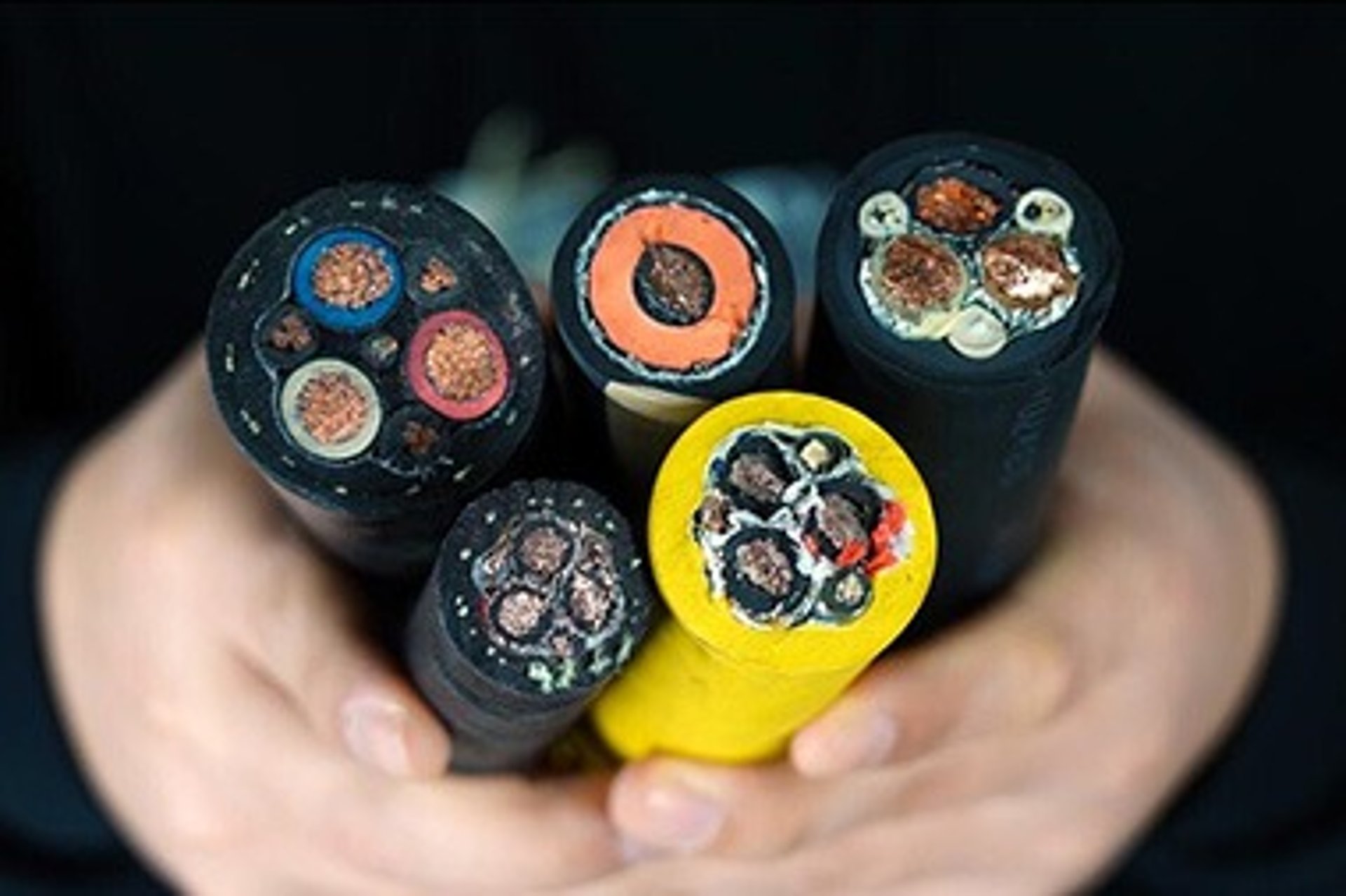
Conductor: Flexible Red Copper, Class 5
Specification: Fine‑stranded bare or tinned copper, Class 5 according to IEC 60228 and DIN VDE 0295.
Why this structure?
Solid or coarse‑stranded conductors (Class 1 or 2) are rigid and fail quickly when moved. Class 5 uses many thin wires (0.15–0.30 mm diameter), which gives maximum flexibility and excellent fatigue resistance. Annealing removes internal stresses, making copper soft and ductile. Tinning is optional but recommended in humid or chemical environments to prevent corrosion. This design ensures consistent conductivity, low heat generation and long life even under constant movement — essential for drills, saws, pumps and mining trailing cables.
Insulation: High‑Grade Rubber Compound (EPR/EPDM Type EI6)
Specification: Cross‑linked elastomeric rubber, halogen‑free, conforming to EN 50363‑1 / DIN VDE 0207‑363‑1.
Why rubber instead of PVC?
PVC is rigid when cold, softens at high temperature, and cracks easily. Rubber insulation is elastic, remains flexible down to –40 °C, and retains its shape and electrical properties up to +90 °C. It has high dielectric strength, low water absorption and excellent resistance to ozone and chemicals. Colour coding follows DIN VDE 0293‑308 / HD 308 S2, with green‑yellow protective earth included in all 3‑core and larger versions — a safety standard widely used in South Africa.
Core Stranding: Layered, Optimised Pitch
Specification: Cores laid up in concentric layers with balanced lay lengths.
Why not random bundling?
Random stranding creates oval or irregular shape, uneven stress and poor flexibility. Layered stranding produces a perfectly round cable, equalises tension, and ensures that bending force is distributed evenly. This also improves tensile strength and prevents cores from shifting or rubbing against each other during winding or dragging.
Outer Sheath: Orange Polyurethane (PUR), RAL 2003
Specification: Special thermoplastic polyurethane (TMPU), EN 50363‑10‑2 / DIN VDE 0207‑363‑10‑2; bright orange colour.
Why PUR? Why orange?
This is the single most important difference between this cable and standard types. PUR is chosen for:
Superior abrasion resistance — up to 10 times better than PVC or rubber
Resistance to oils, greases, coolants, acids, alkalis, hydrolysis, microbes, UV and ozone
Remains flexible at –40 °C, does not crack or harden
High tear and cut resistance
Halogen‑free, low‑smoke, flame‑retardant
Orange colour (RAL 2003) provides high visibility on site, reducing risk of accidental damage or tripping — a major safety benefit on South African construction and mine sites.
Why this exact combination?
The full construction is not arbitrary; it is the result of decades of testing and standardisation. Every material works with the others: rubber insulation matches PUR elasticity, copper strands are protected from fatigue, and the sheath forms a complete shield. This structure is exactly what makes the cable suitable for both fixed and flexible installation, indoors and outdoors, in dry, damp or wet areas — but not direct burial underground, as stated in the datasheet.
Material Science: Principles Behind Performance
To understand why GAALFLEX® performs so much better, we must examine the science of each material and how their properties combine. Every choice follows well‑established principles from physics, chemistry and materials engineering.
Copper Conductor: Electrical and Mechanical Science
Electrical principle: Copper has one of the highest conductivities of all commercial metals (≥ 58 MS/m at 20 °C), meaning low resistance and low heat generation. Fine stranding does not reduce conductivity significantly, but greatly improves flexibility.
Mechanical principle: Metal fatigue occurs when material is repeatedly stressed beyond its yield point. By using many thin, annealed strands, we reduce the strain per wire well below the fatigue limit. This is the same principle used in flexible electrical connections and overhead power lines.
Corrosion science: High‑purity copper resists oxidation; tinning adds an extra layer in aggressive environments like coastal KwaZulu‑Natal or industrial Gauteng.
Rubber Insulation: Polymer and Dielectric Science
Polymer structure: EPR/EPDM rubber is a saturated hydrocarbon polymer with cross‑linked molecular chains. This structure makes it chemically inert — no reactive groups to be attacked by oils, acids or UV radiation.
Thermal stability: Cross‑linking raises melting point and prevents flow at high temperature, allowing continuous operation at 90 °C and short‑circuit up to 250 °C for 5 seconds.
Elasticity principle: Elastic modulus matches copper and sheath material. When bent or stretched, it deforms and recovers without permanent damage, maintaining insulation thickness and electrical integrity.
Dielectric principle: Low dielectric constant and low loss factor mean stable performance under high voltage and frequency, with no risk of thermal runaway.
PUR Sheath: Advanced Polymer Technology
This is where the material science is most advanced, and where the biggest performance gains come from.
1. Abrasion Resistance Mechanism
PUR is a block copolymer made of hard and soft segments. Hard segments give hardness and wear resistance; soft segments provide elasticity. When rubbed against rough surfaces like concrete, rock or steel, the high surface hardness resists cutting, while elasticity prevents crack propagation. Molecular chains are tightly packed and highly cross‑linked, making it extremely difficult for abrasive particles to penetrate. This meets HD 22.10.S1 and DIN VDE 0282‑T10 standards — the strictest in Europe for flexible cable sheaths.
2. Chemical Resistance Principle
Polyurethane contains polar urethane groups, but the molecular structure is highly ordered and crystalline, creating a barrier that oils, solvents and chemicals cannot penetrate. Unlike PVC, which plasticisers leach out or dissolve, PUR does not swell, soften or degrade. It resists mineral oils, hydraulic fluids, diesel, greases, weak acids, alkalis, fertilizers and seawater — exactly the substances found on South African farms, mines and factories.
3. UV and Weathering Stability
South Africa has some of the highest UV levels in the world. Standard materials degrade rapidly. PUR is formulated with UV stabilisers and antioxidants that absorb or neutralise UV energy, preventing chain scission and oxidation. It does not become brittle or chalky after years outdoors. Hydrolysis resistance is also built‑in, so it does not break down in high humidity or when wet.
4. Low‑Temperature Performance
Glass transition temperature of PUR used here is below –50 °C. Even in winter nights in the Free State or high‑altitude mines, it remains flexible, does not crack when bent, and stays tough — unlike PVC which shatters at temperatures just below freezing.
5. Safety and Environmental Science
All materials are halogen‑free, cadmium‑free, silicone‑free and comply with RoHS and REACH. If damaged or burned, they release no toxic or corrosive gases — essential in enclosed spaces such as mines or tunnels.
Comparative Analysis: Why Standard Cables Fail and How H07BQ‑F Solves It
This is perhaps the most important section for South African users, because it directly explains why you spend so much money replacing cables, and exactly how GAALFLEX® changes that.
Common Standard Cables: H05VV‑F, H07VV‑F and Ordinary Tool Cords
Most sites still use PVC‑insulated, PVC‑sheathed cables — cheap initially, but very expensive in the long run. Here is exactly where they fail, and why:
1. Failure in Movement and Bending
Weakness: Conductors are coarser or less flexible. PVC is rigid and has low elasticity.
Mechanism: Every time the cable is wound, dragged or stepped on, the conductor bends beyond its fatigue limit. PVC sheath cracks, then insulation breaks, then copper strands snap.
Real case: On a construction site in Durban, standard H05VV‑F needed replacement every 3–4 months.
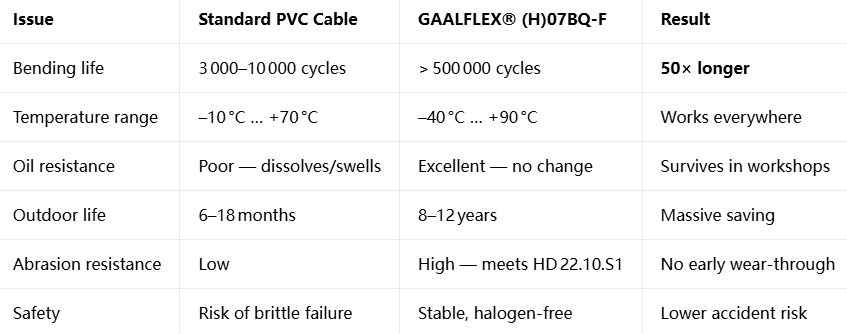
Why H07BQ‑F is better: Class 5 copper + rubber insulation + PUR sheath = 50× more bending cycles, life extends to 3–5 years.
2. Failure from Heat and Cold
Weakness: PVC becomes brittle below –10 °C, softens and melts above 70 °C.
Mechanism: In winter, cold makes sheath crack; in summer or near hot machinery, insulation deforms, loses electrical properties, causes short‑circuits.
South African reality: Night‑day temperature swings of 30 °C are common; mine temperatures exceed 40 °C underground.
Solution: Operating range –40 °C to +90 °C — works everywhere, year‑round.
3. Failure from Oils and Chemicals
Weakness: PVC contains plasticisers that dissolve in oil. It swells, becomes sticky, then falls apart.
Mechanism: Mines and construction use diesel, hydraulic oil, grease, coolants. Ordinary cables absorb these like a sponge. Within weeks, the sheath is gone, insulation exposed.
Solution: PUR is chemically inert — zero swelling, zero degradation — rated excellent resistance per EN 60811‑2‑1.
4. Failure from Abrasion and Wear
Weakness: PVC wears away quickly when dragged over rock, concrete or steel.
Mechanism: Sheath wears thin → insulation damaged → earth fault or shock risk.
Solution: PUR meets HD 22.10.S1 abrasion standard — survives years of rough handling.
5. Failure from Sunlight and Weather
Weakness: PVC degrades in UV, turns grey, cracks and disintegrates within 12–18 months outdoors.
Mechanism: UV breaks polymer chains, no stabilisation.
Solution: UV‑stabilised PUR — remains intact for 10+ years outdoors.
Direct Comparison Table
Summary of Advantages
GAALFLEX® does not just improve one property — it upgrades every single performance area that matters in South Africa. It moves from “cheap and replace often” to “invest once, use for years”.
Key Performance Advantages
Putting it all together, these are the clear benefits you can measure:
Electrical Safety & Reliability
Rated 450/750 V, test voltage 2.5 kV
Insulation resistance > 20 MΩ·km
Stable performance at high and low temperature
Green‑yellow earth core in 3+ cores for protection
Mechanical Strength & Flexibility
Min bending radius 4×D (flexible use)
Tensile strength > 15 N/mm²
Tear‑resistant, cut‑resistant, notch‑proof
Balanced construction resists twisting
Environmental Resistance — Perfect for South Africa
Temperature: –40 °C up to +90 °C — works in cold highlands, hot mines, coastal areas
Chemicals: oils, greases, acids, alkalis, fertilizers, seawater
Weather: UV, ozone, rain, humidity — no degradation
Biological: resistant to mould, microbes, hydrolysis
Safety: halogen‑free, low‑smoke, flame‑retardant
Durability & Cost Efficiency
Fixed installation life: ≥ 15 years
Moving/dynamic use: ≥ 5 years
Maintenance and replacement costs reduced by 60–80 %
Less downtime, fewer safety inspections
Visibility & Safety
Bright orange sheath (RAL 2003) — highly visible on site
Complies with South African safety colour recommendations
Standards & Compliance
GAALFLEX® CONTROL (H)07BQ‑F is built to harmonised European standards, which are widely accepted and recognised in South Africa as equivalent to SANS/IEC standards. This ensures you are using a product designed and tested to consistent, high‑quality specifications.
Main Standards:
HAR H07BQ‑F — harmonised cable designation
HD 22.10.S1 — performance requirements for flexible cables
DIN VDE 0293‑308 — core colour coding
DIN VDE 0295 / IEC 60228 — conductor construction
DIN VDE 0282‑T10 — abrasion test method
EN 50363 — material specifications for insulation and sheath
EN 60754 / IEC 60754 — halogen‑free and low‑smoke requirements
CE Marking — confirms compliance with European safety, health and environmental directives
Why this matters in South Africa:
Most mine and construction site specifications require cables to meet IEC or equivalent international standards. Using H07BQ‑F means you comply fully, without needing special local approvals. It is the standard choice in many mining houses and engineering companies.
Applications
Based on its properties, this cable is ideal for exactly the environments found across South Africa.
Best Applications
Hand‑held electric tools: drills, grinders, saws, welders, compressors — used daily on every site
Construction machinery: concrete mixers, hoists, compactors, mobile generators
Mining equipment: trailing cables, reeling cables, shuttle cars, pumps, fans — especially in surface mines and areas with high abrasion or oil exposure
Agriculture: harvesters, irrigation pumps, feed systems, sprayers — withstands fertilizers, dust, rain and sun
Ports & logistics: container handlers, cranes, mobile equipment — salt‑resistant, durable
Temporary power: events, building sites, maintenance — high visibility and weatherproof
Harsh workshops: steel mills, foundries, chemical plants — oil‑resistant and tough
Not Recommended
Direct burial underground (no armouring or earth protection)
Continuous contact with surfaces hotter than 90 °C
Extreme radiation or aggressive chemicals without additional testing
South African Best Fits
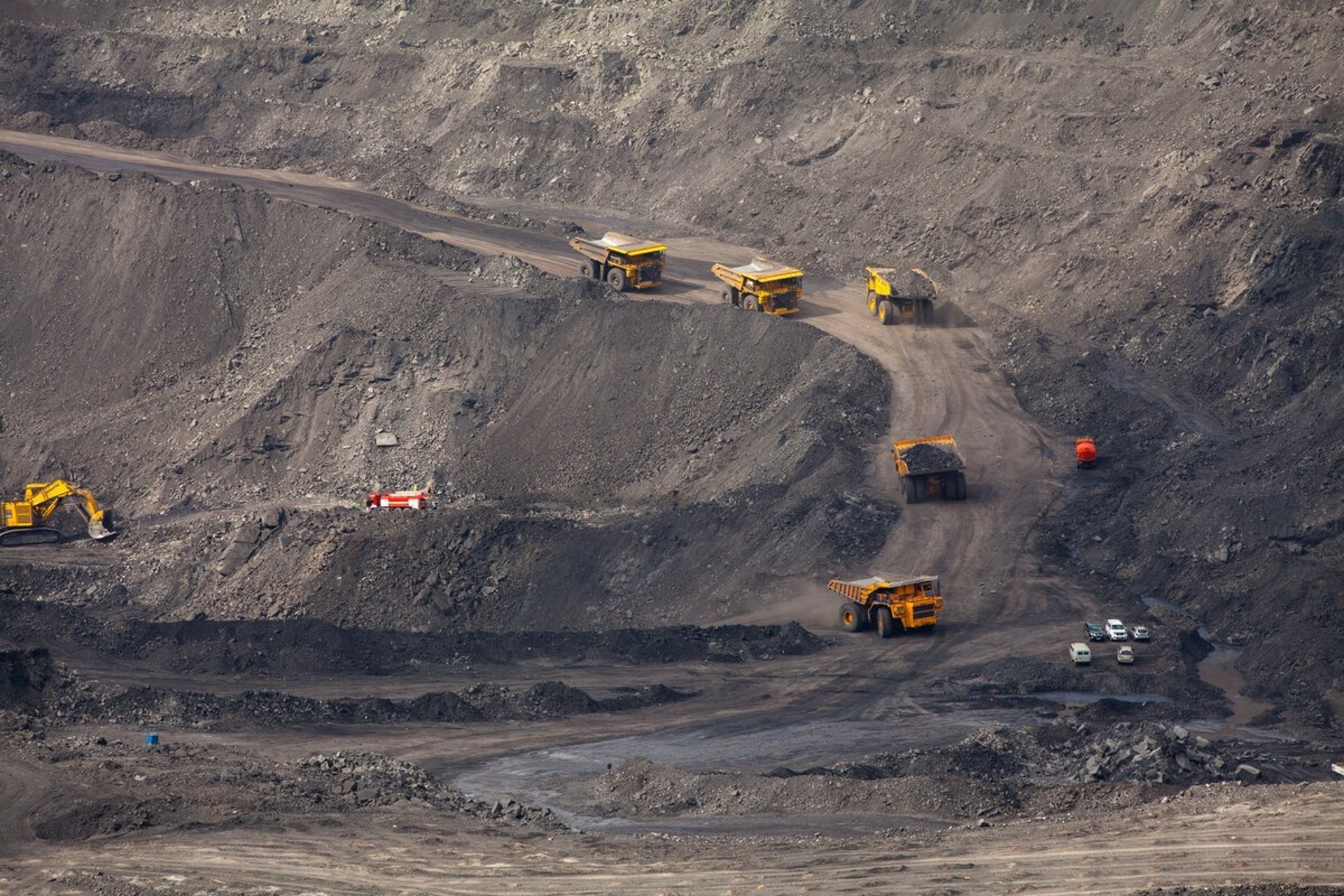
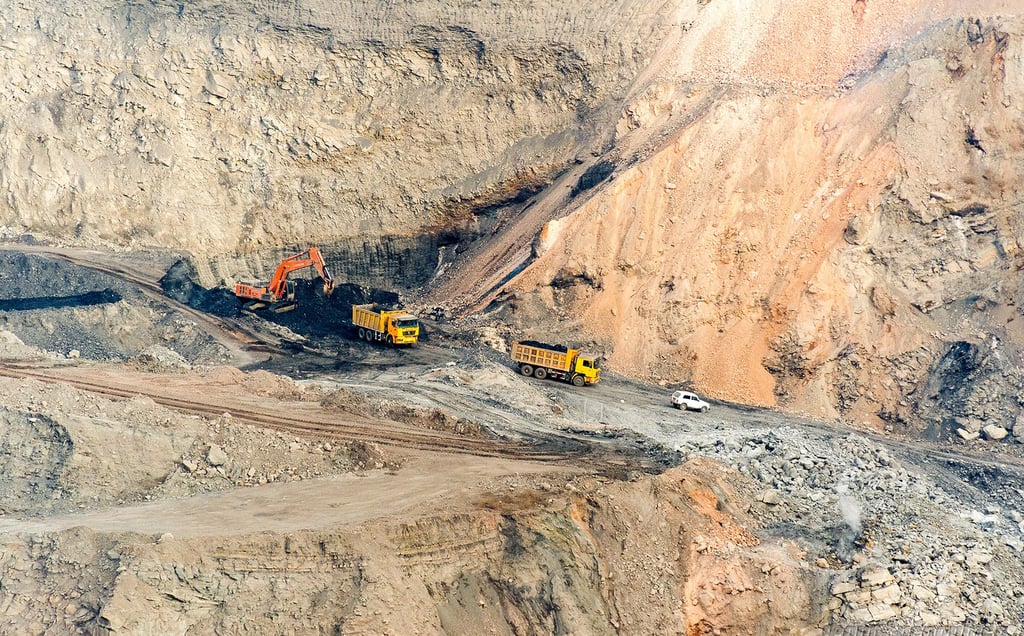
Mpumalanga / Limpopo coal mines: heat, dust, movement — life increases from months to years
Gauteng construction: heavy traffic, rough handling, variable weather
Western Cape / KZN coast: humidity, salt, UV — no degradation
Free State agriculture: wide temperature swings, chemicals, outdoor use
Why choose here?
Because it solves the exact failure modes that cost you money and cause downtime. It is not “over‑specification” — it is correct specification for the conditions.
Technical Specifications & Dimensions
All data comes directly from the official datasheet, ensuring accuracy.
Core Parameters
Designation: GAALFLEX® CONTROL (H)07BQ‑F
Voltage rating: 450/750 V
Test voltage: 2 500 V AC
Temperature range:
Fixed installation: –40 °C … +90 °C
Flexible/dynamic use: –40 °C … +90 °C
Minimum bending radius: 4 × outer diameter
Insulation resistance: ≥ 20 MΩ·km
Sheath colour: Orange (RAL 2003)
Materials: Class 5 copper / rubber insulation / PUR sheath
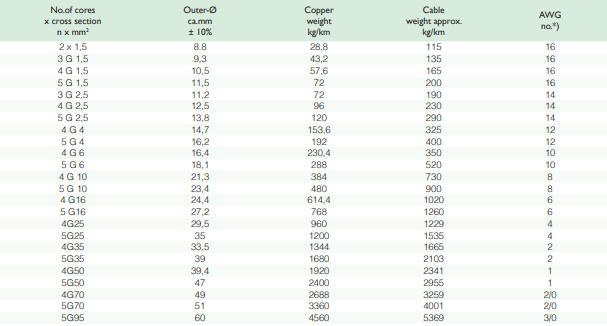
Standard Sizes and Dimensions
Note: “G” indicates inclusion of green‑yellow protective earth conductor. Tolerance on outer diameter: ± 10 %. Other sizes, colours or custom configurations available on request.
Selection Notes
Sections from 1.5 mm² to 95 mm² cover all power and control needs
Copper weight and total weight help with installation planning and load calculations
AWG equivalents assist where imperial sizing is used
Selection Guide: How to Choose the Right Cable
Selecting correctly ensures you get full value and performance. Follow these steps:
Step 1 — Determine Current and Section
Use standard current rating tables (VDE 0298‑4 or SANS 164‑1). For South African conditions, always allow 15–20 % extra margin for heat and high ambient temperature.
Small tools: 1.5 mm² or 2.5 mm²
Mobile machinery: 4 mm² – 16 mm²
Heavy reeling/cranes: 25 mm² and above
Step 2 — Choose Core Count
2‑core: basic power
3‑core + earth (3G): standard single‑phase
4‑core + earth (4G): three‑phase
5‑core + earth (5G): three‑phase + control or neutral
Always choose “G” version for safety — mandatory in most South African regulations.
Step 3 — Installation Type
Fixed installation: minimum bend radius 3×Ø
Dynamic/frequent movement: strictly 4×Ø — this is where this cable excels
Outdoor/chemical exposure: must be H07BQ‑F — no alternative
Step 4 — Environment Check
Temperature below 0 °C → confirm –40 °C rating
Oil/chemicals → PUR sheath is essential
Coastal/humid → confirm hydrolysis‑resistant formulation
Step 5 — Length and Voltage Drop
Keep total length within limits to ensure voltage drop < 3 % — critical for motor performance and efficiency.
Quick Selection Cheat Sheet
Tools → 3G1.5 or 3G2.5
Construction machinery → 4G4 – 5G16
Mining/trailing → 4G25 and up
Always orange, always PUR, always H07BQ‑F
Procurement Strategy: What to Check and Why
Buying correctly is just as important as selecting correctly. Many problems come from “equivalent” cables that do not actually meet the standard.
Buying Checklist
✅ Specify GAALFLEX® CONTROL (H)07BQ‑F exactly — no “similar” or “replacement” without proof
✅ Confirm material: PUR sheath, Class 5 copper, rubber insulation
✅ Request: datasheet, test report, compliance certificate, CE marking
✅ Verify: outer diameter tolerance ± 10 %, orange colour
✅ Check: marked voltage 450/750 V and standard H07BQ‑F printed on sheath
Why Feichun Cables’ Version Is the Best Equivalent
Feichun Cables manufactures a fully compatible version that matches every specification, and offers significant advantages over European brands:
1. 100 % Equivalent Standards
Built exactly to HAR H07BQ‑F, HD 22.10.S1, VDE and IEC standards
Same materials: Class 5 copper, EPR/EPDM insulation, TMPU PUR sheath
Same performance: tested to same abrasion, oil, temperature and electrical requirements
Fully interchangeable — fits all existing installations and specifications
2. Same Quality, Lower Price
Cost is 20–40 % less than premium European brands
No compromise on material grade or thickness
Better value without risk
3. Faster Delivery & Availability
Shorter lead times
Stock available for immediate shipment to South Africa
Flexible production for special sizes or lengths
4. Engineering Support
Local‑focused technical team
Help with selection, sizing and compliance
Custom solutions available
5. Proven in African Industry
Used widely in mining, construction and agriculture across Southern Africa
Reliable supply chain
Understanding of local needs and standards
Conclusion: Feichun’s version is not “just as good” — it is identical in performance, better in price, faster in delivery, and backed by service that understands your market.
Frequently Asked Questions
Q: Can I use H07BQ‑F underground?
A: No. It is designed for indoor and outdoor use, dry or wet conditions, but not direct burial. If underground use is required, select an armoured version.
Q: What is the difference between H05BQ‑F and H07BQ‑F?
A: Voltage rating: 300/500 V vs 450/750 V. H07BQ‑F has thicker insulation and sheath, higher mechanical strength and better suitability for industrial and mining use. Always choose H07BQ‑F for South African sites.
Q: Does it work in very cold mines or high altitudes?
A: Yes. Rated for –40 °C in both fixed and moving use — remains flexible and safe.
Q: Is PUR really better than rubber?
A: Yes. PUR has 5–10 times better abrasion resistance, superior chemical resistance, better UV stability and lower weight. It is the modern upgrade for harsh environments.
Q: How do I confirm it is genuine H07BQ‑F?
A: Check the marking on the sheath: (H)07BQ‑F, 450/750 V, orange colour, and ask for the material test certificate confirming PUR compound.
Q: Is this cable safe for mining use?
A: Yes — widely used in surface mining and approved for all areas where flexible, oil‑resistant and durable cables are required.
Final Summary
GAALFLEX® CONTROL (H)07BQ‑F PUR power cable is the result of decades of engineering development, designed specifically to solve the problems that ordinary cables face in South Africa. It is built on clear scientific principles:
Metal fatigue control with Class 5 copper
Elastic insulation for temperature stability
High‑performance PUR for abrasion, chemical and UV protection
Every part of its construction has a purpose, and every specification is there to ensure long life and safety. Compared to standard PVC cables, it delivers 5–10 times longer service life, works in all weather and environments, and drastically reduces maintenance and replacement costs.
Feichun Cables offers the best available equivalent — matching every standard, offering better pricing, faster delivery and solid technical support. For engineers and procurement teams, this is not just a cable choice; it is a choice between “repairing every few months” and “reliable performance for years”.
If you want reliable, cost‑effective GAALFLEX® CONTROL (H)07BQ‑F cables for your construction, mining or industrial project in South Africa, contact the Feichun technical team directly.
Email: Li.wang@feichuncables.com
We provide full datasheets, formal quotations, compliance documentation and fast shipping to all provinces.


Email Address: Li.wang@feichuncables.com
© 2025. All rights reserved.
One-click to Quickly Contact
Products
Contact
Company
Location:
Building A Private Science and Technology Park, Hefei Economic and Technological Development Zone, Anhui Province, China
Heat Resistant Cable
WhatsApp: +86 17333223430
Social Media: