Anhui Feichun Special Cable Co.,Ltd Email: Li.wang@feichuncables.com
Why Is BS 6708 Type 11 the Lifeblood of South African Mining?
Everything you need to know about BS 6708 Type 11 mining cable – the tough, screened, 640/1 100 V trailing cable that powers continuous miners, LHDs and shuttle cars in South Africa’s platinum, gold, coal and diamond mines. Structure, materials, electrical parameters, real SA case studies and FAQ included.
Li.Wang
11/17/20256 min read
Why BS 6708 Type 11 Really Matters in South African Mining?
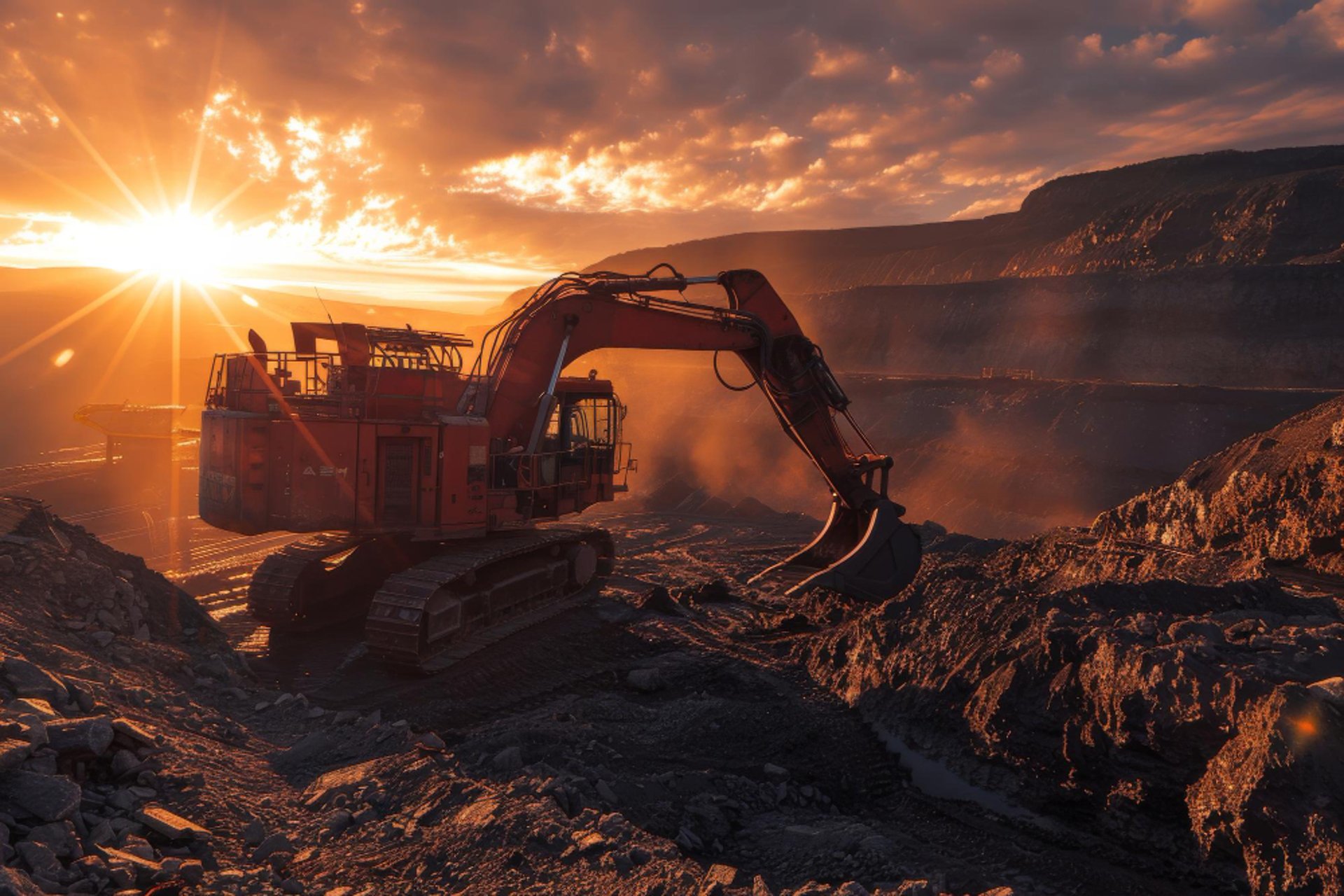
Every year, South Africa’s underground and opencast mines lay and re-lay thousands of kilometres of flexible trailing cables. In the platinum belt alone, estimates put the figure at well over 2 500 km of trailing cable in active use at any one time, with coal mines adding another 1 500–2 000 km. These black, heavy-duty cables are the arteries that feed power to the machines that actually dig the ore and coal.
Among all the different specifications, one cable reigns supreme on the coal faces, in platinum stopes and on opencast shovels: the BS 6708 Type 11 640/1 100 V semi-conductive screened cable with heavy-duty chloroprene (HOFR) outer sheath. In South Africa we simply call it “Type 11” or “eleven cable”. Ask any underground electrician from Rustenburg to Secunda and they’ll tell you the same thing: if the machine moves and needs more than a few hundred metres of cable, it’s running on Type 11.
The 2019 Impala Platinum 17 Shaft cable fire remains a stark reminder of why correct specification is non-negotiable. A damaged, incorrectly specified trailing cable ignited, filled the intake airway with thick black smoke and forced a full section evacuation. The subsequent investigation highlighted fatigue cracking of an unscreened cable and the absence of proper phase-to-phase fault monitoring – problems that a genuine Type 11 cable is specifically designed to prevent.
What Exactly Is a BS 6708 Type 11 Cable?
British Standard BS 6708 was written for flexible cables used in coal mines and quarries in the UK, but it has become the de-facto international benchmark for tough mining trailing cables. The standard is divided into different “types” according to voltage, screening and sheath material.
Type 7 – 380/660 V, usually unscreened, lighter duty.
Type 10 – 640/1 100 V collective screened (one screen over all phase cores), mainly for auxiliary equipment.
Type 11 – 640/1 100 V individually semi-conductive screened phase cores + screened pilot, heavy-duty HOFR sheath – the king for face machinery.
Type 16 – 3.3 kV and higher, collective metallic screen, used on larger continuous miners and draglines.
In South Africa, SANS 1520 Part 2 (Flexible cables for use in mines) explicitly accepts cables manufactured to BS 6708 provided they carry valid SABS mark or NRF Letter of Authority (LOA). That is why you will see genuine Type 11 cables stamped “BS 6708 Type 11” and “SANS 1520” on the same sheath.
Cable Structure – The Anatomy of a Type 11 Cable
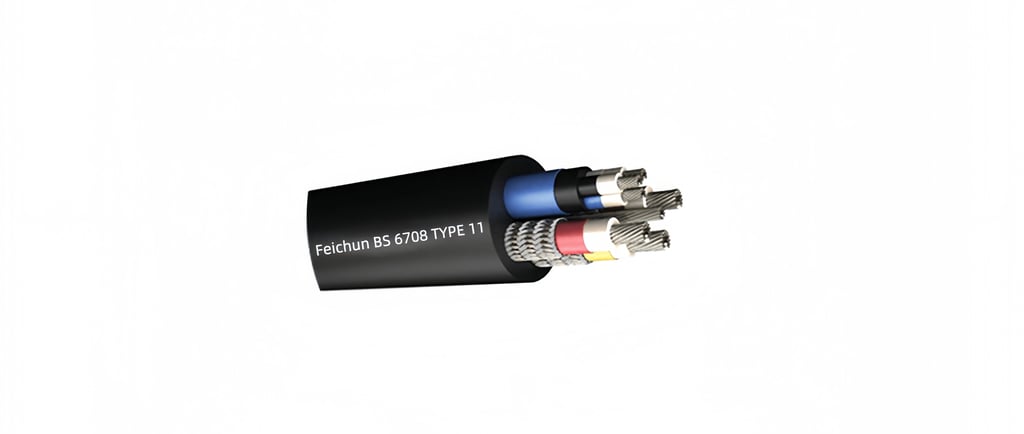
Let’s walk through a typical 3×16 + 16 mm² Type 11 cable layer by layer (the exact cable in your pasted specification).
At the heart are three phase conductors and one pilot conductor, each 16 mm². Every conductor is made from electrolytic tinned copper, highly flexible Class 5 stranding (126 strands of 0.40 mm diameter). The nominal conductor diameter is 5.5 mm. Tinning is critical in South African coal and gold mines where acidic fissure water would eat plain copper in months.
Each conductor is insulated with Ethylene Propylene Rubber (EPR), 90 °C continuous rating, excellent dielectric strength and outstanding water resistance. The insulation thickness pushes the diameter to about 8.6 mm.
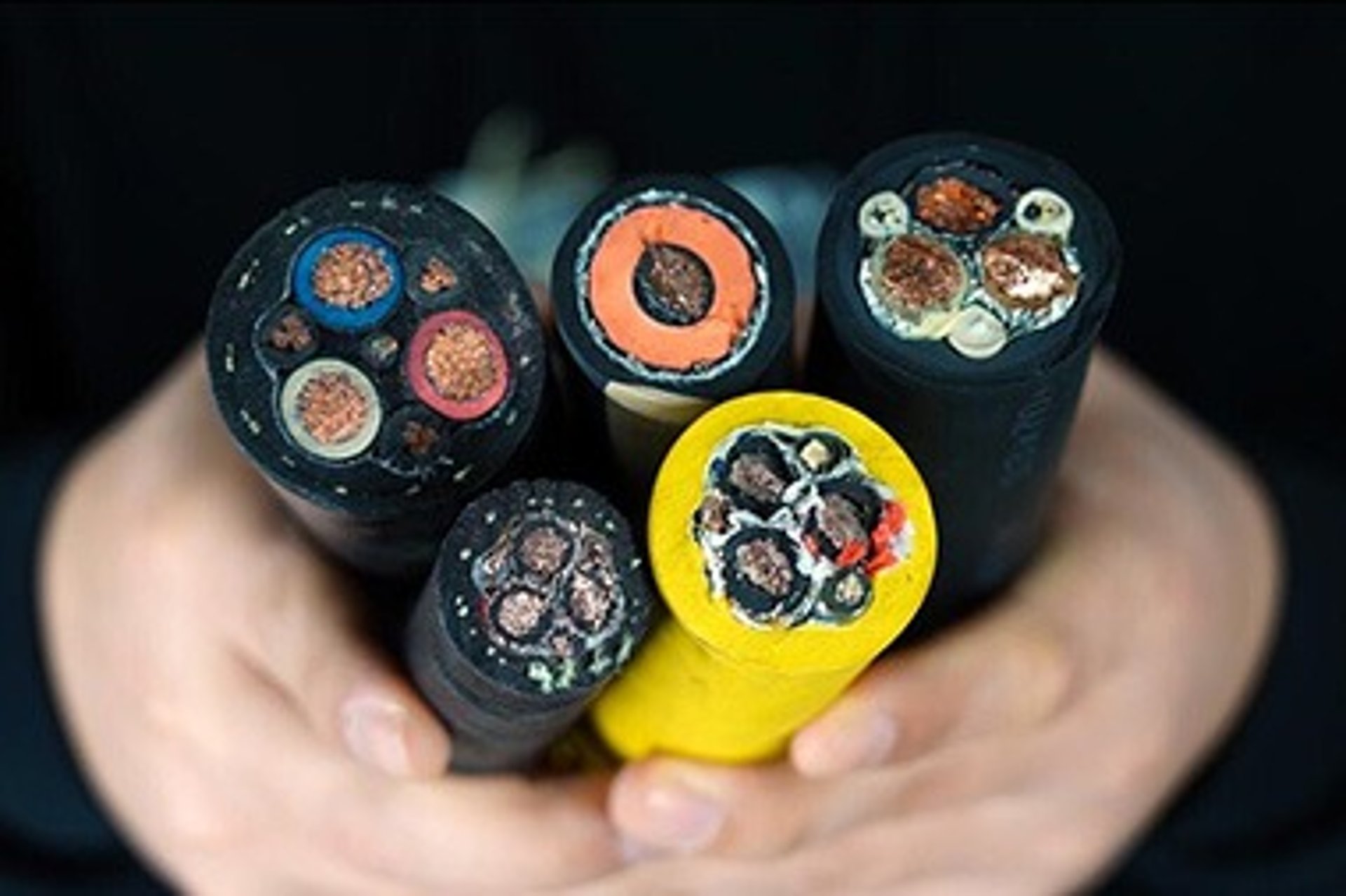
Over every phase core and the pilot core sits an individual tinned copper + nylon braided screen with semi-conductive tape underneath and over the insulation. This is the defining feature of Type 11: every power core and the pilot is individually screened so that a phase-to-phase insulation failure or a phase-to-pilot fault can be detected instantly by the earth-fault and pilot monitoring system.
Cores are identified by coloured textile tapes (usually red, yellow, blue for phases and black or green/yellow for pilot/earth) and laid up together in contact, giving the classic “clover-leaf” shape when you cut the cable.
A rubber-based bedding compound is extruded over the laid-up cores to fill the interstices and provide a round base for the armour or sheath.
Finally, the famous heavy-duty chloroprene (CR) outer sheath – often called PCP or CM – gives the cable its trademark matt black appearance and legendary toughness. In South Africa miners affectionately call it the “black donkey” because it refuses to die even when run over by 60-ton LHDs.
Why These Materials Were Chosen for African Conditions
Tinned copper – Acidic mine water in Witbank coal or Western Bushveld platinum would corrode bare copper rapidly. Tin plating adds years of life.
EPR insulation – Remains flexible at -25 °C (perfect for Highveld winters) and can handle 90 °C continuous, 130 °C overload, 250 °C short-circuit – far better than PVC.
Chloroprene outer sheath – Outstanding resistance to oil, diesel, hydraulic fluid, flame, ozone, UV and abrasion. In chrome and platinum mines where rocks are sharp and oil spills common, nothing else lasts.
Individual screens + pilot core – Mandatory under South African Group I (coal) and metalliferous mine regulations for restricted and unrestricted earth-fault protection.
Technical Specifications You Actually Use on Site
The most common Type 11 sizes in South African mines are:
3×16 + 16 mm² (small shuttle cars, roof bolters)
3×25 + 16 mm²
3×35 + 16 mm² (most common for continuous miners)
3×50 + 25 mm²
3×70 + 25 mm²
3×95 + 25 mm² (large LHDs and drill rigs)
For the 3×16 + 16 mm² example:
Overall diameter: 30.9–33.0 mm
Minimum bending radius (installation): ≈ 396 mm (12 × OD), fixed ≈ 330 mm (10 × OD)
Maximum pulling tension: 384 kgf (limited by copper cross-section)
Approximate weight: 2 000 kg/km
Continuous current rating in air at 25 °C ambient: 85 A (derate heavily in 40 °C shafts – often to 70–75 A)
In practice, South African mines use local derating factors (typically 0.85–0.89 for 35–40 °C) and bury cables in ducts or lay them on the floor with protection plates.
Voltage drop on long runs (800–1 200 m to a continuous miner) is critical. At full load the 3×16 + 16 cable shows roughly 2.62 mV/A/m – meaning a 1 000 m run at 80 A will drop about 210 V, which is why many operations now move to 3×35 or 3×50 for longer sections.
Electrical Parameters That Keep Miners Safe
Rated voltage: 640/1 100 V (line-to-earth / line-to-line) – matches South Africa’s standard 1 000 V mining distribution.
Maximum DC resistance at 20 °C: 1.24 Ω/km (phase and pilot)
Reactance at 50 Hz: ≈ 0.109 Ω/km
Insulation resistance: minimum 435 MΩ·km at 20 °C
Screen resistance when all three screens + earth cores paralleled: ≈ 1.05 Ω/km – critical for fast earth-fault tripping under COP 7.2.5.
The individual screens and pilot wire allow modern gate-end boxes and protection relays (Pilz, Becker, Ampcontrol) to detect insulation failure long before it becomes dangerous.
Real Applications in South African Mines
You will find Type 11 cables on:
Underground coal: Joy and Sandvik continuous miners, ABM shuttle cars, feeder breakers
Platinum & chrome: Sandvik LH514 and LH621 LHDs, Atlas Copco drill rigs, Tamrock roof bolters
Opencast: Hitachi EX3600 and EX5600 shovels, Cat 785 haul trucks (reelers), large draglines
Case Study 1 – Anglo American Platinum Mogalakwena North (2022–2024) During the concentrator expansion, the mine replaced older collective-screen cables with genuine BS 6708 Type 11 3×70 + 25 and 3×95 + 25 mm² cables on 21 new Sandvik LH621E battery-electric LHDs (still needing trailing cable for charging stations). Cable damage incidents dropped by over 60 % in the first 18 months.
Case Study 2 – Exxaro Grootegeluk After repeated crushed-cable fires on shuttle cars in the early 2010s caused by unscreened cables, the mine standardised on Type 11 3×35 + 16 mm² in 2016. Electrical downtime due to cable faults fell from 38 hours per month to under 4 hours.
Common Problems and How to Fix Them – FAQ
Q: Why does my cable keep getting crushed by the shuttle car?
A: Usually because the cable is lying in the turning circle or not trained properly. Use cable rollers, hangers every 3–5 m, and train operators to “walk” the cable.
Q: Can I repair the outer sheath with cold vulcanising tape?
A: Only temporary emergency repair for 24–48 hours. Permanent repair must be hot-vulcanised or the cable section replaced.
Q: What is the correct way to terminate the braided screens?
A: Each tinned copper/nylon braid must be folded back over a support sleeve, secured with constant-force springs or tinned copper clamps, and connected to the gland earth tag. Never cut the screen short.
Q: How often must I megger test these cables?
A: Monthly visual inspection + continuity/pilot check. Full 1 000 V insulation resistance (megger) test every 6 months or after any damage incident (MHSA requirement).
Q: Is it legal to use cheap Chinese “BS 6708” copies in SA mines?
A: Only if they carry genuine SABS/NRF LOA and factory test certificates. Many imports do not – using them can invalidate insurance and attract DMR fines.
Q: What is the realistic lifespan of a Type 11 cable in a platinum mine?
A: 18–36 months on LHDs with good handling; 4–6 years on properly managed continuous miners in coal.
Maintenance, Testing and Legal Requirements in South Africa
Under the Mine Health and Safety Act Regulation 8.9 and the associated Code of Practice, trailing cables must be:
Visually examined before every use
Electrically tested monthly (pilot continuity, earth loop impedance < 2 Ω typical)
Fully insulation-tested every 6 months
Stored on reels off the ground, out of direct sun
When a cable reaches end-of-life (multiple repairs, cracked sheath, insulation resistance < 100 MΩ·km), it must be cut up and the copper recycled through registered recyclers.
Conclusion
The humble BS 6708 Type 11 cable is far more than just a black rubber hose carrying power – it is a carefully engineered safety system that has kept South African miners alive and productive for decades. From the tinned copper strands that fight corrosion in acidic water to the individual screens that detect faults in milliseconds, every detail has been proven in the toughest underground and opencast environments on earth.
Specify it correctly, handle it with respect, test it religiously, and a good Type 11 cable will reward you with years of trouble-free service and, more importantly, bring every shift home safely.
Email Address: Li.wang@feichuncables.com
© 2025. All rights reserved.
One-click to Quickly Contact
Products
Contact
Company
Location:
Building A Private Science and Technology Park, Hefei Economic and Technological Development Zone, Anhui Province, China
Heat Resistant Cable
WhatsApp: +86 17333223430
Social Media: