Anhui Feichun Special Cable Co.,Ltd Email: Li.wang@feichuncables.com
Why Is FLEXIFLAT 450/750 V (N)GFLGÖU‑J / ‑JZ the Top Choice for Festoon Systems in South Africa? Complete Guide to Engineering & Performance
For engineers and procurement teams across South Africa: this detailed guide explains everything about FLEXIFLAT 450/750 V (N)GFLGÖU‑J and ‑JZ flat rubber cables. Learn how they work, what materials make them durable, where they fit best in ports, mines, warehouses and heavy industry, and why Feichun offers fully matching performance, faster delivery and better value. Includes full specifications, comparison tables, installation advice and answers to common questions.
Li Wang
5/18/202614 min read
Introduction
In South Africa’s heavy industries — from container terminals in Durban and Cape Town to mining operations in Gauteng and Limpopo, and large logistics parks nationwide — equipment must run reliably under extreme conditions. High temperatures, strong UV radiation, dust, moisture, oil exposure and continuous movement are daily challenges. For systems where power and control signals must be delivered to moving machinery such as overhead cranes, stacker‑reclaimers, conveyors and automated storage systems, standard round cables often fail quickly or waste valuable space. This is where FLEXIFLAT 450/750 V (N)GFLGÖU‑J / ‑JZ flat rubber cables become the preferred solution.
Designed specifically for festoon systems, these cables combine advanced mechanical engineering, high‑performance rubber compounds and strict international standards. They have become the benchmark for long life, safety and efficiency. This article explains every aspect: how they are built, why the flat shape matters, what materials are used, how to select the right type, and how Feichun cables serve as a fully equivalent, cost‑effective alternative widely accepted across Southern Africa. All information is based on official specifications, industry standards and real‑world operating experience.
Product Overview and Standard Compliance
Naming and Meaning
The full designation (N)GFLGÖU‑J and (N)GFLGÖU‑JZ follows German and European naming rules, and every letter describes a key feature:
(N): Complies with German VDE standards
G: Rubber insulation
F: Flat construction — cores laid parallel, not twisted
L: Flexible copper conductor
G: Rubber outer sheath
ÖU: Oil‑resistant and weather‑resistant compound
‑J: Includes green‑yellow protective earth conductor
‑JZ: Includes earth conductor plus numbered core identification
Rated voltage is 450/750 V, meaning phase‑to‑earth 450 V and phase‑to‑phase 750 V, with maximum operating voltage 900 V — perfect for all low‑voltage industrial control and power circuits. Each cable passes 2500 V AC withstand test for 5 minutes before leaving the factory.
Core Standards Followed
These cables are manufactured to:
CEI 20‑19 Part 4 — Rubber insulated cables
HD 308 S2 — Core identification colours and numbers
IEC 60228 — Conductor sizes and classes
DIN VDE 0298 — Selection and installation rules
EN 60811 — Test methods for electrical and mechanical properties
This means they meet the same requirements accepted by SANS (South African National Standards) and are approved for use in mines, ports and public infrastructure projects.
Key Versions
(N)GFLGÖU‑J: Best for power circuits; cores identified by colours: 4‑core = green‑yellow, brown, black, grey. Earth core is positioned near the centre for best safety.
(N)GFLGÖU‑JZ: Preferred for multi‑core control applications; black cores with white printed numbers, plus green‑yellow earth. Easier to trace and maintain in complex systems.
Engineering Principles: Why Flat Design Works Better
The biggest difference between these and ordinary round cables is the flat profile. This is not just a shape choice — it is a result of careful mechanical and electrical design that solves real‑world problems.
Mechanical Design and Bending Performance
Round cables bend in all directions, which creates twisting stress, uneven load distribution and larger minimum bending radius. In festoon rails where movement is strictly horizontal and back‑and‑forth, this twisting causes fatigue and early failure.
With FLEXIFLAT design:
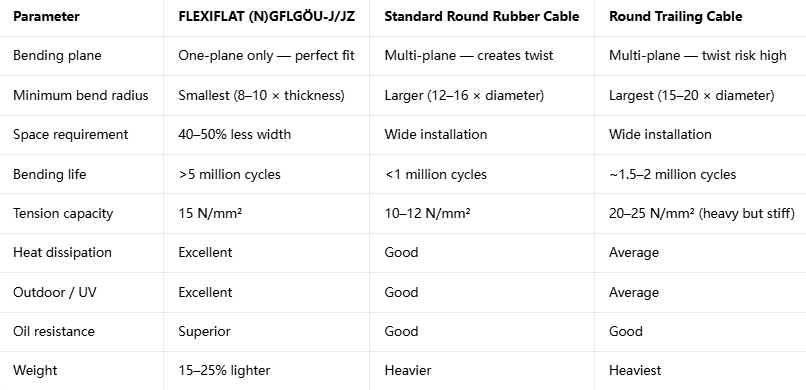
Bending happens only in one plane, exactly matching how festoon trolleys move. No torsion occurs, so every part of the cable bends evenly.
Minimum bending radius is 30–40% smaller — typically 8–10 × cable thickness when moving, 6 × when fixed. This allows tighter curves, smaller trolleys and much more compact installation — essential when rails are close together or space is limited.
All cores share tension equally. Maximum safe working load is 15 N/mm², calculated on total copper cross‑section. Even on long travel lengths up to 200 m, tension stays within safe limits and conductors do not stretch or break.
Weight distribution is balanced along the cable. During high‑speed travel up to 180 m/min and acceleration up to 3 m/s², vibration and swinging are reduced, lowering wear on both cable and system components.
The result is bending life exceeding 5 million cycles — 3 to 5 times longer than standard round flexible cables. This directly reduces downtime and replacement costs, a critical factor in 24/7 operations common in South African industry.
Electrical Design and Safety
Parallel core arrangement offers clear electrical advantages:
Stable geometry: Core spacing never changes during bending, so capacitance and impedance remain consistent. Signal transmission is cleaner, interference lower — very important when controlling drives, sensors or automation systems.
Better heat dissipation: Flat shape exposes more surface area to air. Current‑carrying capacity is 8–12% higher than round cables of the same cross‑section, according to DIN VDE 0298‑4. In hot climates like South Africa, this means you can safely run full load without derating.
Safety built‑in: Green‑yellow earth conductor located near the centre is always the last to stretch or break. In case of fault, fault current path is secure, ensuring fast tripping and compliance with OHS Act and earthing regulations.
Short‑circuit capability: Conductors and insulation withstand 250°C for up to 5 seconds, fully meeting IEC thermal stability rules.
Thermal and Environmental Engineering
Temperature rating is carefully selected for Southern African conditions:
Moving operation: –25°C to +40°C
Fixed installation: –40°C to +80°C
This covers everything from cold nights in high‑altitude mining areas to direct sun exposure at coastal terminals. Materials are chosen not just to survive these temperatures, but to remain flexible and tough for over 10 years outdoors without ageing or hardening.
Composition and Why It Matters
Every layer is engineered with specific compounds chosen for performance, durability and compatibility. The combination Conductor → EPR Insulation → Separator → Chloroprene Sheath is the result of decades of development.
Conductors: High‑Flex Copper
Material: 99.95% pure electrolytic copper, available plain or tinned. Tinned versions resist corrosion from salt air, humidity or chemical exposure — highly recommended for coastal or mining sites.
Stranding:
Up to 6 mm²: Class 6 — extremely fine wires (≤0.2 mm diameter), maximum flexibility, ideal for frequent movement.
10 mm² and above: Class 5 — slightly larger strands, balancing flexibility with current‑carrying efficiency.
Effect: Fine stranding allows individual wires to slide past each other during bending, spreading stress and preventing fatigue cracks. Even after millions of movements, conductivity stays stable and resistance remains within limits.
Insulation: EPR (Ethylene‑Propylene Rubber) >3GI3
Unlike PVC, which becomes stiff in cold and softens in heat, EPR is a synthetic elastomer designed for electrical use:
Electrical properties: Dielectric constant 2.3–2.5, breakdown strength ≥20 kV/mm, insulation resistance ≥1000 MΩ·km. Superior to natural rubber or PVC.
Mechanical properties: Elongation >300%, tensile strength >8 MPa. Stretches and recovers without damage.
Thermal: Rated for continuous 90°C conductor temperature, exactly matching heavy‑duty requirements.
Environmental: Resists ozone, UV and oxidation. Does not crack or become brittle even after years outdoors.
Compared to standard 3GI3 rubber, the grade used here has improved mechanical stability and longer life.
Outer Sheath: Chloroprene Rubber (CR) >5GM2
This is the most critical layer for protection, and what makes these cables suitable for South African conditions. Chloroprene (also known as Neoprene) is chosen because it combines:
✅ Oil resistance: Tested per IEC 60811‑404; after 24 hours at 70°C in standard oil, weight change <5% and volume change <±10%. Perfect where hydraulic oil or lubricants are present.
✅ Weather and UV resistance: Does not degrade under strong African sun, rain or salt spray. Approved for unlimited outdoor use — no need for extra protection.
✅ Mechanical toughness: Tensile >12 MPa, elongation >400%, excellent abrasion and tear resistance. Withstands dragging along rails, contact with structures and rough handling during installation.
✅ Flame retardancy: Meets IEC 60332‑1; self‑extinguishes if ignited, does not spread fire.
✅ Temperature stability: Remains flexible down to –40°C and tough up to +80°C.
Standard colour is black (RAL 9005), chosen for maximum UV absorption and long‑term durability.
Additional Components
Separator tape: Optional polyester or non‑woven layer between insulation and sheath. Prevents sticking, improves bend performance and makes stripping easier during termination.
Integrated optical fibre: Available as custom option — power, control and data communication in one flat cable. Uses same rubber materials, so flexibility is unchanged. Ideal for modern smart cranes and automated warehouses.
Performance Advantages: Comparison with Other Cable Types
Choosing between flat festoon cables, round flexible cables and trailing cables depends on your exact needs. The following table and points summarise why FLEXIFLAT (N)GFLGÖU‑J/JZ is preferred in most moving applications.
Performance Comparison Table
Key Advantages in Daily Operation
Longer service life: Fewer replacements mean less downtime and lower maintenance labour. In South Africa, where maintenance teams are often stretched, reliability directly improves productivity.
Space efficiency: More trolleys or more circuits in the same rail width. This is especially valuable in container terminals and high‑bay warehouses where every metre of space costs money.
Easier installation and fixing: Flat profile sits securely in standard festoon clamps. No twisting when pulling, faster to install and align.
Lower total cost of ownership: Even if initial price is slightly higher, 3–5× longer life and reduced maintenance result in 40–60% lower cost over 10 years.
Proven safety record: Clear identification, secure earthing and compliance with local safety standards reduce risk of accidents and simplify inspection.
Applications: Where and How Used in South Africa
These cables are not universal — they are purpose‑built for festoon systems, the most common method of power supply for travelling machinery. Here are the main sectors and examples relevant to Southern Africa.
Ports and Logistics
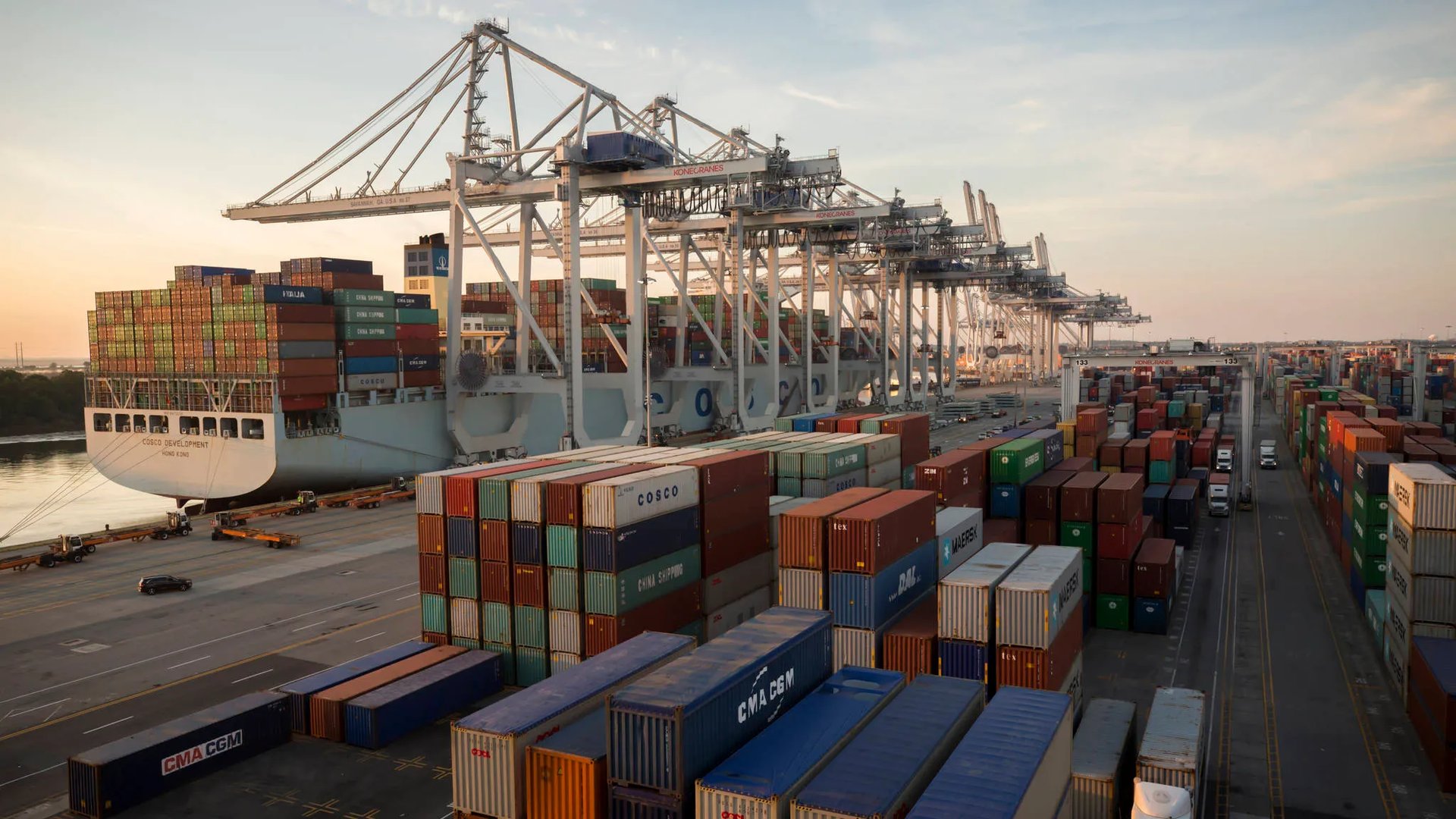
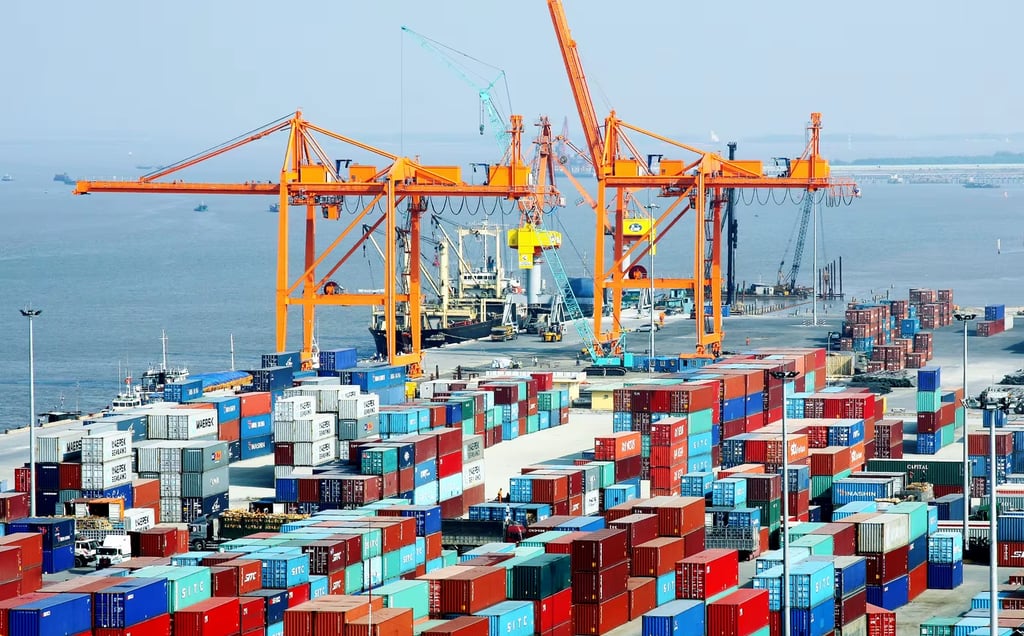
Container handling equipment in Durban, Ngqura, Cape Town and Richards Bay operates in harsh marine environments with high humidity, salt and constant movement.
Ship‑to‑shore cranes: Travel lengths 50–150 m, speed 90–120 m/min. Flat cables fit easily along boom rails without interfering with containers.
Rubber‑tyred gantries (RTGs): Outdoor, exposed to full sun and wind; UV‑resistant sheath ensures long life.
Intermodal transfer stations: Automated stackers and conveyors — reliable power and signal are essential for throughput.
Mining and Heavy Industry
From platinum and gold mines to coal terminals and steel works:
Overhead cranes: Used in workshops, smelters and material yards. High temperature rating and dust resistance are key.
Stacker‑reclaimers: Long travel up to 200 m, heavy mechanical stress. Tensile strength and low weight reduce load on trolleys.
Belt conveyors: Moving sections, tripper cars — flat design fits tight spaces between belts and structures.
Warehousing and Distribution
Automated storage and retrieval systems (AS/RS) are expanding rapidly across Gauteng and Western Cape:
High‑bay stacker cranes: Speed up to 180 m/min, acceleration >2 m/s². Flat cables follow movement smoothly, no swaying.
Automated guided vehicles (AGVs): Rail‑guided systems use festoon cables for continuous power without battery limits.
Manufacturing and Processing
Automotive plants, food and beverage, paper mills:
Machine tools, transfer lines, painting plants — where movement is frequent and environment may include oil or moisture.
Typical Operating Conditions in SA
Ambient: –5°C to +45°C, direct sun, high humidity, dust, occasional rain
Speed: 60–180 m/min
Cycle: 10–20 movements per hour, 16–24 hours daily
Life requirement: Minimum 8–10 years
FLEXIFLAT 450/750 V (N)GFLGÖU‑J/JZ is exactly specified for these conditions — no compromise needed.
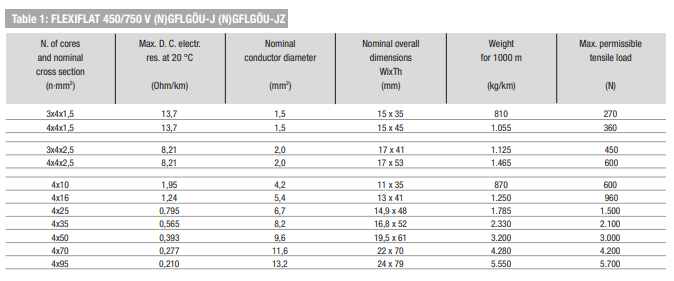
Full Technical Specifications
The following tables summarise standard values from official data sheets, covering most common sizes used in Southern Africa.
Selection Guide: How to Choose and Specify Correctly
Choosing the right cable is not just about matching voltage or core count. It requires understanding how the cable will move, what environment it will operate in, and how power and signals need to be distributed. This step‑by‑step guide follows international standards and best practices widely used in South African engineering projects.
Define Operating Conditions
Start by gathering these details, because every one influences the final choice:
Travel length: short (<30 m), medium (30–100 m), long (>100 m). Longer lengths require larger conductor sizes to keep voltage drop within acceptable limits — typically below 4% for power circuits and below 2% for sensitive control or communication lines.
Speed and acceleration: normal (<90 m/min), high (90–180 m/min). At higher speeds, dynamic forces increase, so tension rating and bending stability become more critical. FLEXIFLAT is designed for continuous operation up to 180 m/min, which covers nearly all cranes and stacker cranes used in ports and warehouses across Southern Africa.
Ambient environment: indoor, outdoor, coastal, mining, high temperature, oil exposure. In coastal areas like Durban or Richards Bay, salt‑laden air accelerates corrosion — specifying tinned copper conductors adds significant service life. In mining environments with high dust and chemical presence, the heavy‑grade chloroprene sheath provides full protection.
Duty cycle: 8‑hour shift, 24/7 continuous, intermittent. Continuous duty requires careful consideration of current rating and heat dissipation; flat shape helps here by allowing better cooling than round cables.
For South African applications, always assume outdoor UV resistance unless the installation is fully shielded. Add 10–15% extra current capacity when ambient temperatures regularly exceed 35°C to avoid overheating.
Choose Between ‑J and ‑JZ Versions
The only difference is how cores are identified, but this affects installation and maintenance efficiency:
Select (N)GFLGÖU‑J when: you have fewer than 6 cores, mostly power circuits, and standard colour coding is enough. Colour code follows HD 308 S2: 4‑core = green‑yellow, brown, black, grey. Termination is fast, and cost is slightly lower.
Select (N)GFLGÖU‑JZ when: you have 6 cores or more, mixed power and control, automation systems, PLC connections, or frequent maintenance. Cores are black with clear white numbers, plus green‑yellow earth positioned near the centre. This reduces connection errors, speeds up fault‑finding, and is strongly recommended for complex systems like automated warehouses or ship‑to‑shore cranes.
Both versions have identical electrical, mechanical and environmental performance — identification is the only variable.
Calculate Required Conductor Size
Use this practical method aligned with SANS 164‑1 and DIN VDE 0298‑4 standards:
Determine full load current per phase from equipment specifications.
Select current rating from manufacturer tables — values already account for improved heat dissipation of flat design.
Calculate voltage drop using formula:
ΔU = (2 × I × L × R) / 1000
Where I = current (A), L = one‑way length (m), R = resistance per km.
Verify maximum tension: total tension = 15 N/mm² × total copper cross‑section. This value must be higher than actual tension from cable weight plus dynamic forces during acceleration.
Example calculation for a typical South African overhead crane:
Motor power: 37 kW, 400 V, full load current 70 A
Travel length: 80 m
Calculation result: 4×16 mm² gives 85 A rating, voltage drop 2.8%, safe tension 3840 N — fully suitable.
Most common sizes used locally: 4×4, 4×10, 4×16, 4×25, 7×2.5, 12×1.5 mm².
Special Options and Environment Adaptations
Tinned copper conductors: essential for coastal, high‑humidity or chemical‑rich environments. Prevents oxidation and green corrosion, extending life by up to 30%.
Integrated optical fibres: single‑mode or multi‑mode fibres embedded within the same flat structure. Delivers power, control and high‑speed data in one cable — ideal for smart ports and Industry 4.0 installations.
Shielded versions: individually shielded pairs or overall copper screen available for low‑voltage signal circuits or bus systems. Reduces electromagnetic interference in electrically noisy environments like steel mills or substations.
Extreme low‑temperature grade: modified compound available for high‑altitude mining where temperatures drop below –30°C — remains flexible without cracking.
Installation Best Practices
Even the best‑specified cable will fail quickly if installed incorrectly. Follow these proven rules:
✅ Fixing method: use dedicated flat cable clamps every 1.0–1.5 m. Never use round clamps, which create twisting and uneven pressure.
✅ Bending radius: strictly respect minimum values — 8–10 × thickness when moving, 6 × thickness when fixed. Wider curves always improve life.
✅ Tension control: initial installation tension 5–8 N/mm². Do not over‑tighten; allow slight slack to absorb thermal expansion and movement.
✅ Protection: keep clear of sharp edges, weld spatter, hot surfaces and moving machinery parts.
✅ Routing: ensure cable moves freely without rubbing against structures or other cables.
Proper installation typically adds 2–3 years to service life and is required to maintain warranty validity.
Feichun Cables: Fully Equivalent Alternative to FLEXIFLAT (N)GFLGÖU‑J / ‑JZ
For many years, South African buyers paid premium prices and waited long lead times for European‑branded festoon cables. Today, Feichun Cables offers a solution that matches every specification exactly, with faster delivery and significant cost advantages. This section explains why switching is completely safe and beneficial.
Full Equivalence – Direct Replacement Guarantee
Feichun manufactures these cables strictly according to the same international standards as the original FLEXIFLAT range:
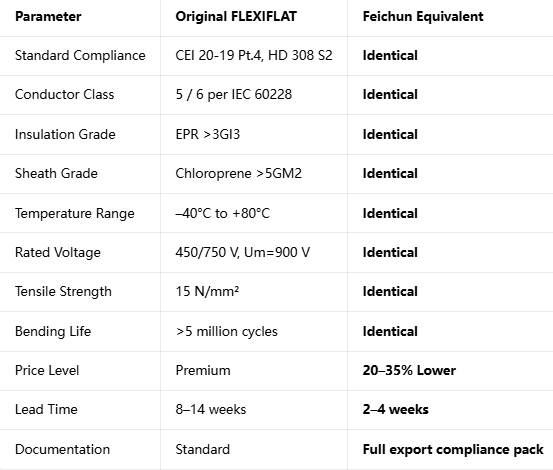
Same standards: CEI 20‑19 Part 4, HD 308 S2, IEC 60228, DIN VDE 0298, EN 60811 — identical test criteria and performance levels.
Same materials:
Conductors: Class 5 / 6 plain or tinned copper, 99.95% purity, exactly same stranding structure.
Insulation: EPR rubber compound grade >3GI3 — same electrical strength, thermal stability and flexibility.
Sheath: Chloroprene rubber grade >5GM2 — oil resistance, UV stability and mechanical toughness identical to original.
Core arrangement: parallel flat layout, green‑yellow earth conductor positioned near centre, colour and number coding fully matching.
Same dimensions: width, thickness, weight and bending radius — interchangeable with existing trolleys, clamps and connectors.
Same electrical values: resistance, capacitance, voltage rating and temperature limits — no performance difference in operation.
Same mechanical strength: 15 N/mm² tension rating, same >5 million bending cycle life.
You do not need to change drawings, specifications or installation procedures. Feichun cables fit perfectly and perform identically.
Key Advantages for South African Buyers
✅ Same Quality, Lower Cost
Typically 20–35% lower price compared to premium European brands.
No compromise on materials or testing — every batch undergoes routine electrical, mechanical and environmental testing.
Ideal for new projects, replacements and cost‑reduction programmes widely implemented across mines and logistics companies.
✅ Much Shorter Delivery Time
Standard sizes held in stock — 2–4 weeks delivery to Durban, Cape Town or Johannesburg ports.
Custom configurations available in 4–6 weeks.
Compare with 8–14 weeks lead time from Europe — reduces project schedules, cuts inventory holding costs and speeds up maintenance work.
✅ Complete Range and Flexible Supply
Full series available: 3–24 cores, 1.5 mm² up to 95 mm², both ‑J and ‑JZ types.
Special versions: tinned copper, shielded pairs, integrated optical fibres, custom colours and markings.
Supports small orders and bulk shipments equally — important for both small contractors and large corporates.
✅ Documentation and Compliance
Complete documentation package provided: type test reports, routine test certificates, material declarations and declaration of conformity.
Documents recognised by local engineers, consultants and inspection bodies — fully accepted under SANS and OHS regulations.
Manufacturing certified to ISO 9001, ISO 14001 and CE standards.
✅ Warranty and Technical Support
18‑month warranty — longer than most competitors.
Technical team experienced in Southern African operating conditions — assists with selection, sizing and installation questions.
Dedicated export team — handles all shipping, customs and logistics requirements for smooth delivery.
Side‑by‑Side Performance and Commercial Comparison
This comparison confirms Feichun is not an “alternative” — it is a fully matching replacement with clear commercial benefits.
Why South African Engineers Trust Feichun
Major mines, port operators and logistics companies have already made the switch. The main reasons cited are:
Zero risk change: no re‑design, no requalification — direct drop‑in replacement.
Better total cost: lower purchase price plus faster delivery and equal long life equals significant savings.
Local understanding: products and support tailored to African climate, standards and logistics challenges.
Reliable supply: consistent quality and availability without long delays.
Frequently Asked Questions
Q1: Can I replace existing FLEXIFLAT cables directly with Feichun versions?
Yes. They are 100% interchangeable. Dimensions, colours, core identification and all performance characteristics are exactly the same. You can install them into the same trolleys, clamps and connectors without any modification or adjustment.
Q2: Will these cables perform well in South African heat, sun and coastal conditions?
Absolutely. The outer sheath uses premium chloroprene compound rated for unlimited outdoor use, tested to resist UV radiation, high temperature, rain and salt‑laden atmosphere. The design is specifically engineered to perform reliably from high‑altitude mining areas to coastal terminals.
Q3: What is the expected service life?
Under normal operating conditions (8–16 hours daily, correct installation), you can expect 10–12 years outdoor service and over 5 million bending cycles. This matches premium brand performance and is 3–5 times longer than standard flexible cables.
Q4: Do you provide documents for compliance and inspection purposes?
Yes. Every supply includes a complete set of documentation: type test reports, routine test certificates, material declarations and conformity statements. These are accepted by all major engineering firms, mines and inspection authorities in South Africa.
Q5: Can you manufacture custom versions?
Yes. We produce custom configurations including: extra cores, individually shielded pairs, integrated optical fibres, special colours, custom printed markings and non‑standard dimensions. Minimum order quantities are flexible to suit both small and large projects.
Q6: How do you handle delivery to South Africa?
We have regular export experience to all Southern African countries. We deliver to main ports (Durban, Cape Town, Port Elizabeth) or directly to your site. Our team handles all export documentation, customs procedures and logistics to ensure smooth arrival and clearance.
Q7: Is there a warranty?
Yes. Feichun provides an 18‑month warranty covering material and manufacturing defects, valid from delivery date. This is longer than the industry standard and reflects confidence in quality and durability.
Conclusion
FLEXIFLAT 450/750 V (N)GFLGÖU‑J and ‑JZ flat rubber cables represent the established global standard for festoon systems, and they are perfectly suited to the unique demands of South African industry. Their design combines mechanical engineering excellence, high‑performance rubber compounds and strict international standards to deliver reliability, safety and long life in the harshest environments.
Understanding how the flat shape improves bending performance, why EPR and chloroprene materials are chosen, and how to select and install correctly helps you get maximum value and lowest total cost of ownership. You now also know that Feichun cables offer identical technical performance, but with faster delivery, better pricing and full compliance — making them the smart choice for procurement engineers and technical teams.
Whether you are upgrading existing cranes, designing new warehouses or supplying equipment to mines and ports, these cables remain the most efficient and reliable solution. Proper selection, correct installation and choosing the right supplier will ensure trouble‑free operation for many years.
Contact
If you want to request a quotation, receive detailed technical data sheets, order samples or discuss your specific project requirements, please contact the Feichun technical and sales team directly:
We provide full technical support, export documentation and competitive pricing for South Africa and all Southern African countries.
Email Address: Li.wang@feichuncables.com
© 2025. All rights reserved.
One-click to Quickly Contact
Products
Contact
Company
Location:
Building A Private Science and Technology Park, Hefei Economic and Technological Development Zone, Anhui Province, China
Heat Resistant Cable
WhatsApp: +86 17333223430
Social Media: