Anhui Feichun Special Cable Co.,Ltd Email: Li.wang@feichuncables.com
Why Is the Type 2S 1.1/1.1kV Collectively Screened Cable Everywhere in Heavy Industry?
Discover what makes the Type 2S 1.1/1.1kV Collectively Screened cable a trusted choice for industrial and mining applications. Learn about its construction, screening benefits, standards, applications, and South African case studies in this in-depth expert guide.
Li Wang
12/30/20256 min read
What Is a Type 2S 1.1/1.1kV Collectively Screened Cable and Where Is It Used?
If you walk through a South African mine, processing plant, or heavy industrial facility, you are surrounded by cables doing critical work quietly and reliably. Among them, the Type 2S 1.1/1.1kV Collectively Screened cable stands out as one of the most widely specified rubber-insulated cables for machine wiring, equipment interconnections, and longwall lighting circuits.
This cable is designed for low-voltage power and control applications where mechanical robustness, electrical stability, and electromagnetic compatibility (EMC) are non-negotiable. Its combination of EPR insulation, composite copper screening, and heavy-duty CPE sheathing makes it particularly suitable for harsh industrial and mining environments, including those found across South Africa’s coal, gold, and platinum sectors.
But what exactly makes this cable different, and why do engineers continue to specify it over simpler alternatives?
Why Is the Type 2S 1.1/1.1kV Collectively Screened Cable Widely Used in Industrial and Mining Systems?
Understanding the Role of Type 2S Cables
The Type 2S cable occupies a very specific position in the cable landscape. It is not a flexible trailing cable for continuous reeling, nor is it a basic PVC control cable for benign environments. Instead, it is a robust rubber cable designed for fixed or semi-flexible installations, often subject to vibration, moisture, oil exposure, and electromagnetic interference.
Typical Applications in South Africa
In South African industrial and mining operations, Type 2S cables are commonly used for:
Wiring of heavy machinery
Interconnection between machines and fixed equipment
Longwall and panel lighting circuits
Auxiliary power and control circuits
Installations requiring pilot, control, or twisted pair cores
These use cases are common in coal mines in Mpumalanga, platinum operations in the Bushveld Complex, and gold mines in Gauteng and the Free State, where reliability and safety are tightly regulated.
Why Rubber Over PVC?
While PVC cables may appear cost-effective on paper, rubber-insulated Type 2S cables offer clear advantages:
Superior thermal performance
Better flexibility at low temperatures
Higher resistance to oils, moisture, and vibration
Improved service life in harsh environments
For engineers responsible for uptime and safety, these benefits often outweigh the initial material cost difference.
What Does “Collectively Screened” Mean in a Type 2S Cable?
Collective vs Individual Screening Explained
A collectively screened cable uses a single composite copper screen that surrounds all insulated cores together. This differs from individually screened cables, where each core has its own screen.
In Type 2S cables, the collective screen is typically formed from tinned copper braiding interwoven with polyester yarn, providing both electrical and mechanical benefits.
Why Collective Screening Matters
Collective screening serves several critical functions:
Electromagnetic compatibility (EMC): Reduces electrical noise and interference between adjacent circuits.
Earth fault return path: The copper screen functions as a reliable earth conductor.
Mechanical reinforcement: The braided structure adds strength and resistance to deformation.
In electrically noisy environments such as mines, where variable-speed drives, switching equipment, and heavy motors operate side by side, collective screening significantly improves system stability.
How Is a Type 2S 1.1/1.1kV Cable Constructed?
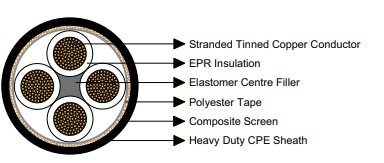
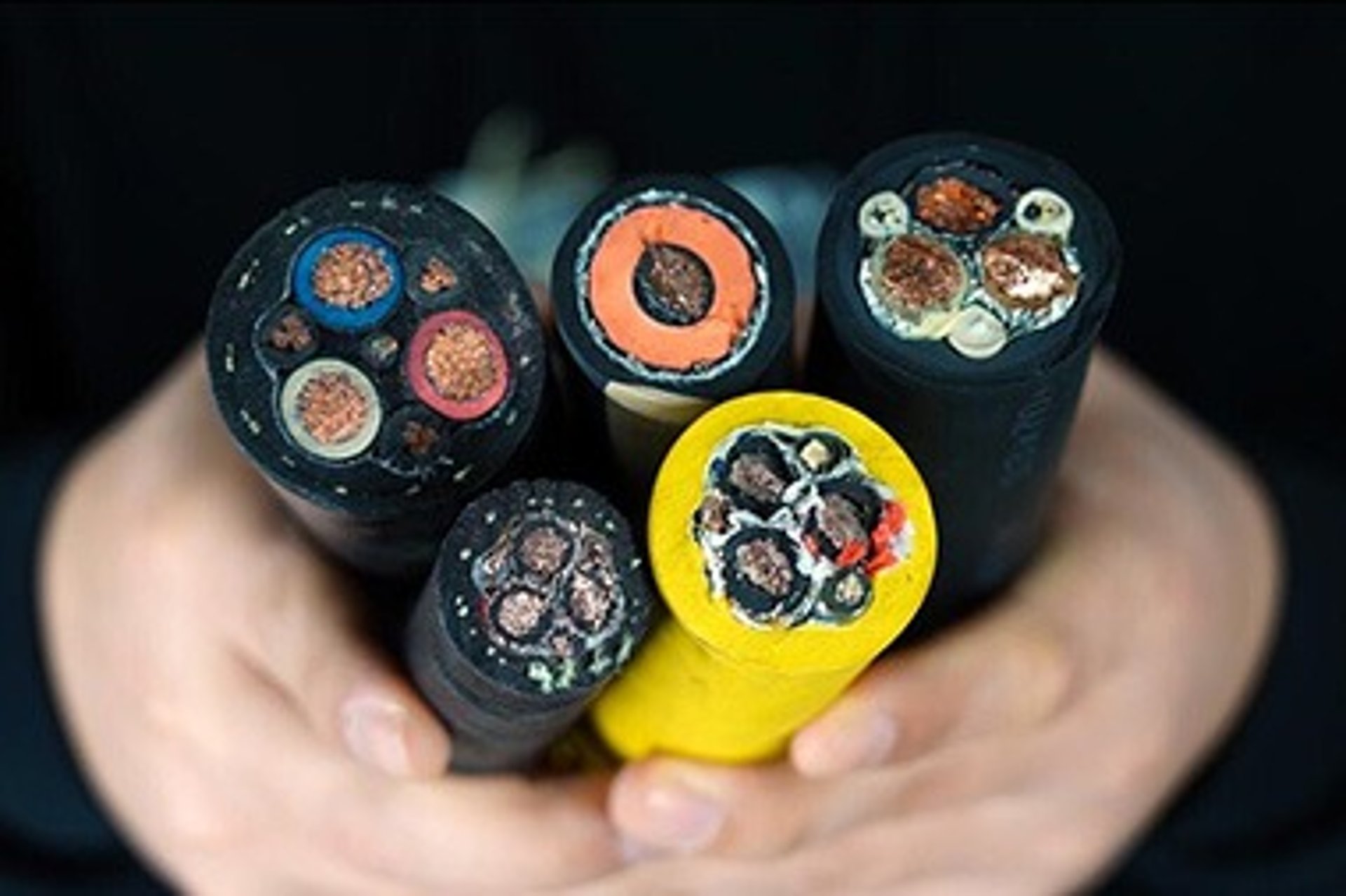
The performance of a Type 2S cable is the direct result of its carefully engineered construction.
What Type of Conductors Are Used in Type 2S Cables?
Type 2S cables use stranded, tinned, annealed copper conductors.
Why this matters:
Stranding improves flexibility and vibration tolerance.
Annealing enhances ductility and fatigue resistance.
Tinning protects against corrosion, particularly in humid or chemically aggressive environments.
This conductor design is ideal for installations where cables are exposed to movement, vibration, or long service intervals.
Why Is EPR Insulation Chosen for Type 2S 1.1/1.1kV Cables?
Ethylene Propylene Rubber (EPR) insulation is widely recognised for its performance in industrial and mining cables.
Key benefits include:
High dielectric strength
Excellent thermal stability
Resistance to moisture, oils, and chemicals
Low risk of cracking under vibration or flexing
For a rated voltage of 1.1/1.1kV, EPR provides ample electrical margin while maintaining flexibility.
What Is the Function of Elastomer Fillers and Polyester Bedding?
Inside a Type 2S cable, elastomer fillers are used to maintain consistent core geometry. This ensures:
Improved roundness
Even stress distribution
Reduced mechanical fatigue
The polyester tape bedding separates the insulated cores from the screen, providing:
Additional mechanical protection
Improved screen stability
Easier termination
How Does the Composite Copper Screen Improve Cable Safety?
The composite copper screen is one of the defining features of the Type 2S cable.
Constructed from tinned annealed copper braiding interwoven with polyester yarn, it performs a dual role:
Electrical screening and earthing
Mechanical reinforcement
The screen area increases with core count, ensuring adequate earth fault capacity even in larger multi-core designs.
Why Is a Heavy-Duty CPE Sheath Important in This Cable Design?
The outer sheath is typically made from chlorinated polyethylene (CPE).
CPE sheaths offer:
Excellent abrasion resistance
High resistance to oils, fuels, and chemicals
Good weathering and UV performance
This makes Type 2S cables suitable for both indoor and limited outdoor industrial installations.
What Are the Electrical and Technical Specifications of Type 2S 1.1/1.1kV Cables?
Understanding the 1.1/1.1kV Rating
The 1.1/1.1kV voltage rating indicates the cable’s suitability for low-voltage systems with enhanced insulation performance, providing a safety margin for transient overvoltages common in industrial networks.
Other Key Parameters
Insulation thickness: Optimised for dielectric strength and flexibility
Sheath thickness: Designed to withstand mechanical abuse
Current-carrying capacity: Dependent on installation method and ambient conditions
How Do Different Core Configurations Affect Performance and Application?
How Do 2-Core, 4-Core, 6-Core, and Multi-Core Type 2S Cables Differ?
2–4 cores: Simple power or lighting circuits
6 cores: Combined power and control
16–20 cores: Complex machine interconnections and control systems
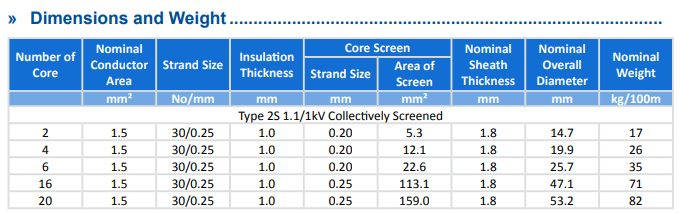
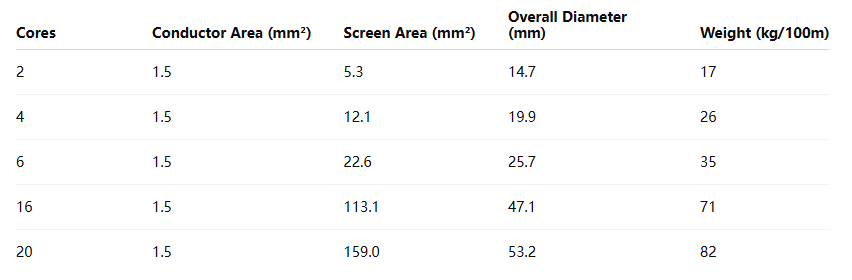
As core count increases, overall diameter and weight increase, influencing installation planning.
How Does Screen Area Scale with Core Count?
The screen cross-sectional area increases significantly with higher core counts, improving:
Earth fault performance
Mechanical robustness
EMC effectiveness
This is particularly important in mining environments with stringent safety requirements.
Type 2S 1.1/1.1kV Collectively Screened Cable – Dimensional & Weight Comparison
This table helps engineers balance space constraints, weight, and electrical performance during cable selection.
Where Is the Type 2S 1.1/1.1kV Cable Commonly Installed?
Why Is Type 2S Suitable for Longwall Lighting Circuits?
Longwall lighting requires:
Reliable power delivery
Resistance to vibration
Robust earthing
Type 2S cables meet these demands while remaining flexible enough for confined underground spaces.
Can Type 2S Cables Be Used Between Machines and Fixed Equipment?
Yes. Their construction tolerates:
Continuous vibration
Minor movement
Electrical noise
This makes them ideal for conveyors, crushers, and processing equipment.
When Are Pilot, Control, or Twisted Pair Cores Required?
Advanced mining and industrial systems increasingly integrate:
Monitoring
Automation
Safety interlocks
Type 2S cables can be customised to include pilot, control, twisted pair, or screened cores to support these functions.
Which Standards Govern Type 2S 1.1/1.1kV Collectively Screened Cables?
Type 2S cables are commonly manufactured in accordance with:
AS/NZS 1972:2006
AS/NZS 1125
AS/NZS 3808
Compliance ensures:
Electrical safety
Mechanical reliability
Acceptance by inspectors, insurers, and procurement teams
How Does Type 2S Compare with Other Industrial Rubber Cables?
Type 2S vs Individually Screened Control Cables
Type 2S: Cost-effective, robust, suitable for most industrial EMC needs
Individually screened: Higher cost, better for highly sensitive signals
Type 2S vs Standard Unscreened Rubber Cables
Unscreened cables lack:
EMC protection
Reliable earth return
In electrically noisy environments, Type 2S offers significantly better performance and safety.
What Are the Key Installation Recommendations for Type 2S Cables?
Respect minimum bending radius
Avoid excessive pulling tension
Ensure proper screen termination and earthing
Use compatible glands and accessories
Improving Lighting Reliability in a South African Coal Mine
At a coal mine in Mpumalanga, frequent lighting outages in a longwall section were traced to premature cable failures. PVC-sheathed control cables suffered from cracking and interference-related faults.
Solution: Replacement with Type 2S 1.1/1.1kV Collectively Screened cables featuring EPR insulation and CPE sheathing.
Results:
Improved lighting reliability
Reduced maintenance interventions
Enhanced earthing continuity
Extended service life
This case highlights why Type 2S cables are trusted in demanding South African mining conditions.
Frequently Asked Questions About Type 2S 1.1/1.1kV Collectively Screened Cables
Is Type 2S Cable Suitable for Continuous Flexing Applications?
It is suitable for limited movement and vibration but not for continuous reeling.
Can Type 2S Cables Be Used Outdoors or in Damp Areas?
Yes, within design limits, thanks to EPR insulation and CPE sheathing.
What Is the Difference Between Collective Screen and Earth Core?
The collective screen provides both EMC screening and earth continuity, whereas an earth core is a dedicated conductor.
How Do I Select the Correct Core Count for My Application?
Assess power, control, and monitoring requirements, allowing for future expansion.
Are Custom Core Configurations Available?
Yes. Many manufacturers offer tailored designs for specific projects.
How Do You Choose the Right Type 2S Cable for Your Project?
Consider:
Electrical load and voltage
Mechanical stress and vibration
Environmental exposure
EMC requirements
Applicable standards
A structured evaluation ensures long-term performance and compliance.
Need Help Selecting or Sourcing Type 2S 1.1/1.1kV Collectively Screened Cables?
Choosing the correct Type 2S cable can significantly improve reliability, safety, and lifecycle cost.
Experienced technical teams can assist with:
Cable sizing and selection
Datasheets and compliance documentation
Custom core configurations
The right advice at the design stage prevents costly failures later.
Email Address: Li.wang@feichuncables.com
© 2025. All rights reserved.
One-click to Quickly Contact
Products
Contact
Company
Location:
Building A Private Science and Technology Park, Hefei Economic and Technological Development Zone, Anhui Province, China
Heat Resistant Cable
WhatsApp: +86 17333223430
Social Media: