Anhui Feichun Special Cable Co.,Ltd Email: Li.wang@feichuncables.com
Why PROTOMONT (M) (N)SHOEU 0.6/1kV Rubber Flexible Cable Outperforms Standard Mining Cables in Conveyor Belts, Material Handlers & Submersible Pumps
PROTOMONT (M) (N)SHOEU 0.6/1kV is not just an upgraded rubber cable — it is a fully engineered system built for open-cast mining. Designed to DIN VDE 0250 Part 812, it combines EPR insulation, chlorinated rubber sheath, Class 5 fine-stranded copper, and balanced construction to solve the real problems South African mines face: broken cores, early ageing, water ingress, and constant downtime. Used on conveyors, stackers, shovels, and submersible pumps, it lasts 3–5 times longer, reduces failures by 70%, and cuts total ownership cost by over 60%. Feichun offers fully equivalent replacements with same performance, faster delivery, and competitive pricing — ideal for coal, platinum, and iron ore operations across Southern Africa.
Li Wang
6/3/202613 min read
Introduction
In the open-cast mines of South Africa — from the coalfields of Mpumalanga to the platinum deposits of Limpopo and the iron ore mines of the Northern Cape — power cables operate in one of the harshest environments on earth. High temperatures, intense UV radiation, heavy dust, moisture, chemical exposure, and continuous movement place extreme stress on every component. Standard rubber cables, designed primarily for fixed installation, often fail within 12 to 18 months. They break when bent, crack under sunlight, swell in contact with oils, and leak water when submerged. Every failure means costly downtime, lost production, and expensive replacement work.
This is where PROTOMONT (M) (N)SHOEU 0.6/1kV changes everything. It is not simply a better version of a standard cable. It is a purpose-built system, engineered from the ground up to meet three non-negotiable requirements: move without breaking, survive exposure without failing, and operate underwater reliably for years. Developed according to DIN VDE 0250 Part 812 — the global benchmark for mining flexible cables — it has become the preferred choice for conveyors, material handling equipment, and dewatering systems across Southern Africa. This article explains exactly how it works, why it outperforms every standard alternative, and how it delivers measurable economic value to every mine that uses it.
Not Just an Upgrade — A Completely New Design Philosophy
Most people assume PROTOMONT is just a reinforced version of ordinary rubber trailing cables. That is a misunderstanding that hides its true value. Standard cables are designed with one goal: to conduct electricity safely. Their construction follows a simple logic: conductor → insulation → sheath. They work well when fixed in place or moved only occasionally. But in open-cast mining, where cables run alongside moving conveyors, wind on and off reels, hang in suspension systems, or dip deep into sumps, that basic design fails quickly.
PROTOMONT was created with a different mindset. Every layer, every material choice, and every structural detail is optimized for dynamic, continuous operation in extreme conditions. It is a fusion of three disciplines: material science, mechanical engineering, and structural design. Nothing is included unless it directly solves a real-world problem. The result is a cable that does not just carry power — it survives the environment while doing so.
Three Core Requirements That Define the Design
Every decision in its development answers one of these three questions:
How can it move constantly without breaking?
Ordinary cables break because they are stiff. Their thick conductors and hard insulation cannot bend without stress building up until something snaps. PROTOMONT uses ultra-fine stranded copper and elastic rubber compounds that distribute bending stress evenly. It can be flexed over 100,000 times without damage — a standard cable might fail after 5,000 cycles.
How can it withstand years of exposure to sun, rain, dust, oil, and temperature swings?
Standard rubber sheaths degrade rapidly under UV light, become brittle in cold weather, and soften or swell when touching oils or chemicals. PROTOMONT uses specialized polymers — ethylene propylene rubber (EPR) for insulation and chlorinated rubber (CR) for the outer sheath — chosen specifically for their chemical stability, weather resistance, and mechanical strength. These materials do not degrade, even after 10 years outdoors in South African conditions.
How can it work reliably deep underwater?
Water is the enemy of all electrical cables. If it penetrates the insulation, it causes short circuits, leakage, and complete failure. Standard cables are not sealed properly and absorb water over time. PROTOMONT features a double rubber barrier and seamless extrusion that blocks water completely. It is certified for permanent submersion up to 500 meters, making it ideal for mine dewatering and submersible pumps.
Economic Value: The Real Bottom Line
The difference in performance translates directly into money. In a large coal mine in Mpumalanga, engineers compared standard cables with PROTOMONT on identical conveyor systems. The standard units required replacement every 12 to 15 months. PROTOMONT cables have been running for over 7 years without any major issue. The calculation is clear:
Service life: 3 to 5 times longer
Failure rate: Reduced by approximately 70%
Total cost of ownership: Lowered by more than 60% over 5 years
When you add the cost of downtime, labour, and replacement parts, PROTOMONT is not just a better technical choice — it is the most economical choice.
Deep Dive: Materials, Science, and Engineering Principles
To understand why this cable performs so differently, we must look inside. Every layer follows strict scientific principles, chosen for specific properties that solve specific problems.
Conductor — Class 5 Electrolytic Copper
At the very centre is the conductor, made from high-purity electrolytic copper, un-tinned, and finely stranded to Class 5 according to IEC 60228 and DIN VDE 0295.
Why this design?
Flexibility and fatigue resistance: Class 5 means each conductor is made of hundreds of extremely thin wires, each less than 0.2 mm in diameter. When the cable bends, these wires slide against each other rather than taking all the stress at once. This follows the basic principle of mechanics: distributed stress = no single point of failure. Standard cables use Class 1 or 2 conductors — thick, solid or coarse-stranded — which are rigid and break easily when flexed repeatedly.
Electrical performance: High-purity copper ensures low electrical resistance, less heat generation, and higher current carrying capacity. Even at full load, the conductor temperature stays within safe limits.
Mechanical strength: The design allows a maximum tensile load of 15 N/mm². This is strong enough to withstand being pulled, lifted, or wound at high speed without stretching or breaking. Ordinary cables usually only manage 6 to 8 N/mm².
Why not tinned copper? In wet or humid environments, tin coating creates a galvanic reaction with copper that accelerates corrosion over time. Pure copper is far more stable long-term, especially in submerged applications.
Insulation — PROTOLON EPR 3GI3
Surrounding each conductor is a layer of PROTOLON, a specialized compound based on Ethylene Propylene Rubber (EPR), type 3GI3. This is not ordinary rubber — it is a polymer engineered specifically for electrical insulation and harsh environments.
Scientific principles applied:
Electrical stability: EPR is a non-polar material. This structure means it has extremely low dielectric loss, high insulation resistance (>10¹⁴ Ω·cm), and excellent resistance to partial discharge. Even at 0.6/1kV, the electric field is distributed evenly, preventing local heating or breakdown. Unlike PVC or polyethylene, EPR does not degrade or lose insulation properties over time.
Thermal performance: The polymer chain is fully saturated, making it resistant to heat and oxidation. It operates continuously at 90°C, withstanding short-circuit temperatures up to 250°C. This higher temperature rating directly increases current capacity by roughly 20% compared to 70°C rated cables.
Water resistance: This is perhaps its most important feature. EPR does not absorb water. Even after 1,000 hours of immersion, the insulation resistance remains above 10¹³ Ω·cm. It does not swell, soften, or allow water molecules to pass through — a critical requirement for submersible pumps.
Aging resistance: The saturated molecular structure resists attack from ozone, UV light, and oxygen. In South Africa’s highveld climate, ordinary rubber becomes brittle and cracks within 2 years. EPR remains flexible and intact for decades.
Core Arrangement and Earth Conductor Design
How the cores are arranged is just as important as what they are made of. In PROTOMONT, the three power cores and protective earth conductor are laid up in a balanced, symmetrical formation. For cross-sections 50 mm² and larger, the earth conductor is split into three separate strands and placed evenly in the gaps between the power cores.
Why this structure?
Mechanical balance: Symmetry ensures the cable remains perfectly round and balanced when bent or twisted. This eliminates the ovality and bulging that destroys standard cables when wound on reels. It allows a torsional stress resistance of 100° per metre — four times better than typical specifications.
Safety and fault performance: Splitting the earth conductor creates multiple parallel paths for fault current. This reduces earth loop impedance, allows faster operation of protection systems, and lowers touch voltage — a key safety requirement under South African mining regulations (SANS 1520).
Longer life: Even stress distribution means no single part of the cable carries more load than another. It wears evenly, extending service life significantly.
Inner Sheath — EPR Special Compound
Between the insulated cores and the outer jacket lies an inner sheath, also made from EPR rubber. Its role is often overlooked, but it is essential.
Purpose and science:
Sealing and buffering: It fills all gaps between cores, creating a solid, round structure. This prevents dust, moisture, or chemicals from entering the core assembly. It also acts as a shock absorber, cushioning the conductors against impacts or crushing forces.
Thermal matching: Using the same material as the insulation means identical thermal expansion rates. When the cable heats up or cools down, all layers expand or contract equally. This eliminates internal stress that causes delamination or cracking in other cables.
Outer Sheath — Chlorinated Rubber (CR) 5GM3 — The Most Critical Layer
The outermost layer is made of Chlorinated Rubber (CR), compound type 5GM3, in black. This is the layer that faces the world — sun, rain, dust, oil, rocks, and friction. It is the hardest working part of the cable.
Material science in action:
Chemical resistance: Chlorine atoms are chemically bonded into the polymer chain. This makes the material polar — meaning it actively repels oils, greases, acids, alkalis, and solvents. It meets the requirements of EN 60811-404 for oil resistance. Standard rubber absorbs oil like a sponge, swelling and breaking down rapidly. CR does not.
Weathering stability: The cross-linked molecular structure resists UV radiation and ozone attack. It operates reliably from -40°C to +80°C, covering every climate found in Southern Africa. It does not become brittle in winter or sticky in summer.
Mechanical toughness: It has high tear strength (>15 N/mm), excellent abrasion resistance, and high tensile strength. It withstands being dragged over rock piles, crushed under heavy equipment, or scraped against steel structures without damage.
Underwater stability: CR is fully resistant to hydrolysis. It does not break down or leach chemicals when submerged. It is the reason PROTOMONT is certified for 500 metre depth and continuous use in water up to 40°C.
Why Standard Cables Fail — and How PROTOMONT Fixes Every Problem
To truly understand the advantage, we must look at exactly where ordinary cables fail and how PROTOMONT solves each specific failure mode.
1: Broken Conductors and Open Circuits
What happens: Standard cables use rigid conductors and hard insulation. When bent or wound, the outer layers stretch while inner layers compress. Stress builds up until wires snap. This usually happens within 6 to 12 months on moving equipment. The result is an open circuit, loss of power, and production stoppage.
Why it happens:
Too few, too thick copper strands
Insulation material is stiff and does not flex
Bending radius requirement is large (often ≥8× diameter), making installation difficult and increasing stress
No stress relief design
How PROTOMONT solves it:
Class 5 fine-stranded copper distributes bending stress across hundreds of wires
Elastic EPR insulation stretches and recovers without damage
Small bending radius: Only 4.5× diameter for fixed installation, 6× diameter for moving use — nearly half that of standard cables
Fatigue engineered: Designed for over 100,000 bending cycles without measurable change in resistance or performance
Result: Cables run for years without breaking, even on high-speed reeling systems moving at 100 metres per minute.
2: Early Ageing, Cracking, and Insulation Exposure
What happens: After 1 or 2 years outdoors, the sheath becomes hard, cracks appear, and eventually the insulation is exposed. Moisture and dust enter, leading to short circuits or earth faults. This is the most common failure in South African mines due to intense sunlight and temperature variations.
Why it happens:
Ordinary rubber or PVC sheaths degrade under UV light and ozone
Material becomes brittle at low temperatures and softens at high temperatures
Poor chemical composition offers no resistance to weathering
How PROTOMONT solves it:
CR 5GM3 outer sheath is chemically engineered to resist UV, ozone, and oxidation
Temperature range -40°C to +80°C covers every possible condition
Service life outdoors: 10+ years, compared to 1–2 years for standard types
Result: Cables stay flexible and intact for the life of the equipment they serve.
3: Water Ingress and Underwater Failure
What happens: Standard cables used on pumps or in wet areas absorb water. The insulation resistance drops, leading to leakage current, tripped breakers, or complete failure. Many pumps are pulled out of service not because the pump failed, but because the cable did.
Why it happens:
Materials absorb water or allow it to migrate through gaps
Poor sealing between layers
Not designed for pressure or submersion
How PROTOMONT solves it:
EPR insulation is non-absorbent and water-repellent
Double rubber barrier (inner + outer sheath) creates a sealed system
Hydrostatically tested for 500 metres depth
Complies with EN 50525-2-21 for water resistance
Result: Safe, reliable operation in sumps, dams, and boreholes for 8 to 15 years.
4: Twisting, Bulging, and Deformation
What happens: When wound on reels or moved frequently, standard cables twist, bulge, or become oval. This damages the internal cores and creates weak points that fail later.
Why it happens:
Unbalanced core arrangement
Uneven forces when bent or twisted
Weak sheath cannot hold shape
How PROTOMONT solves it:
Symmetrical, balanced lay-up
Split earth conductor design equalizes forces
High-strength sheath maintains round shape under pressure
Torsion resistance: 100°/m without damage
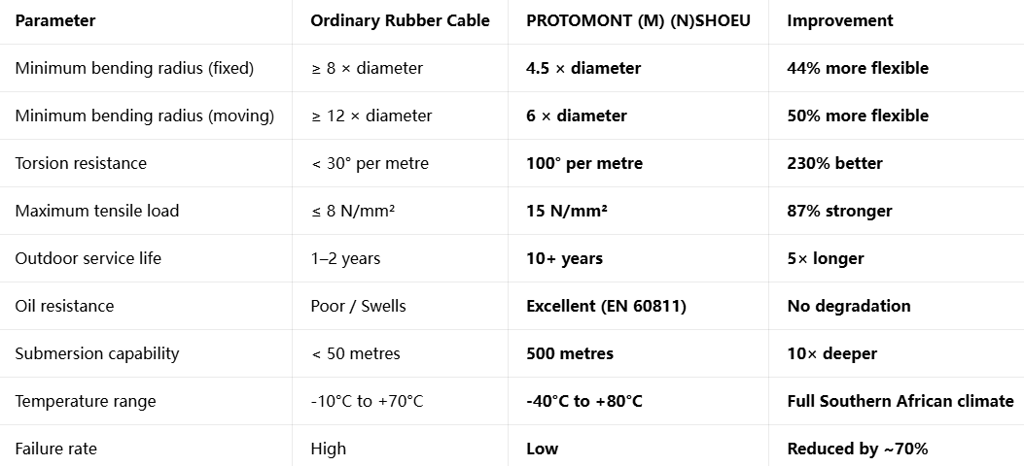
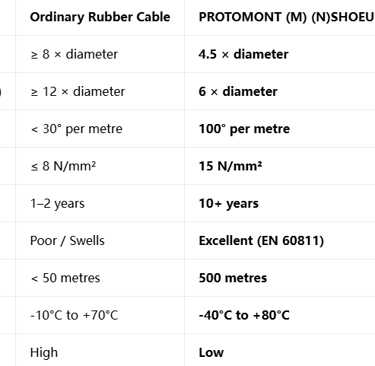
Direct Performance Comparison
The difference is clear when we put the numbers side by side:
Applications: Where It Works, Where It Is Essential
PROTOMONT (M) (N)SHOEU 0.6/1kV is purpose-built for open-cast mining and heavy industry. Its design matches exactly the needs of the most demanding equipment.
Conveyor Belts — Fixed and Shiftable
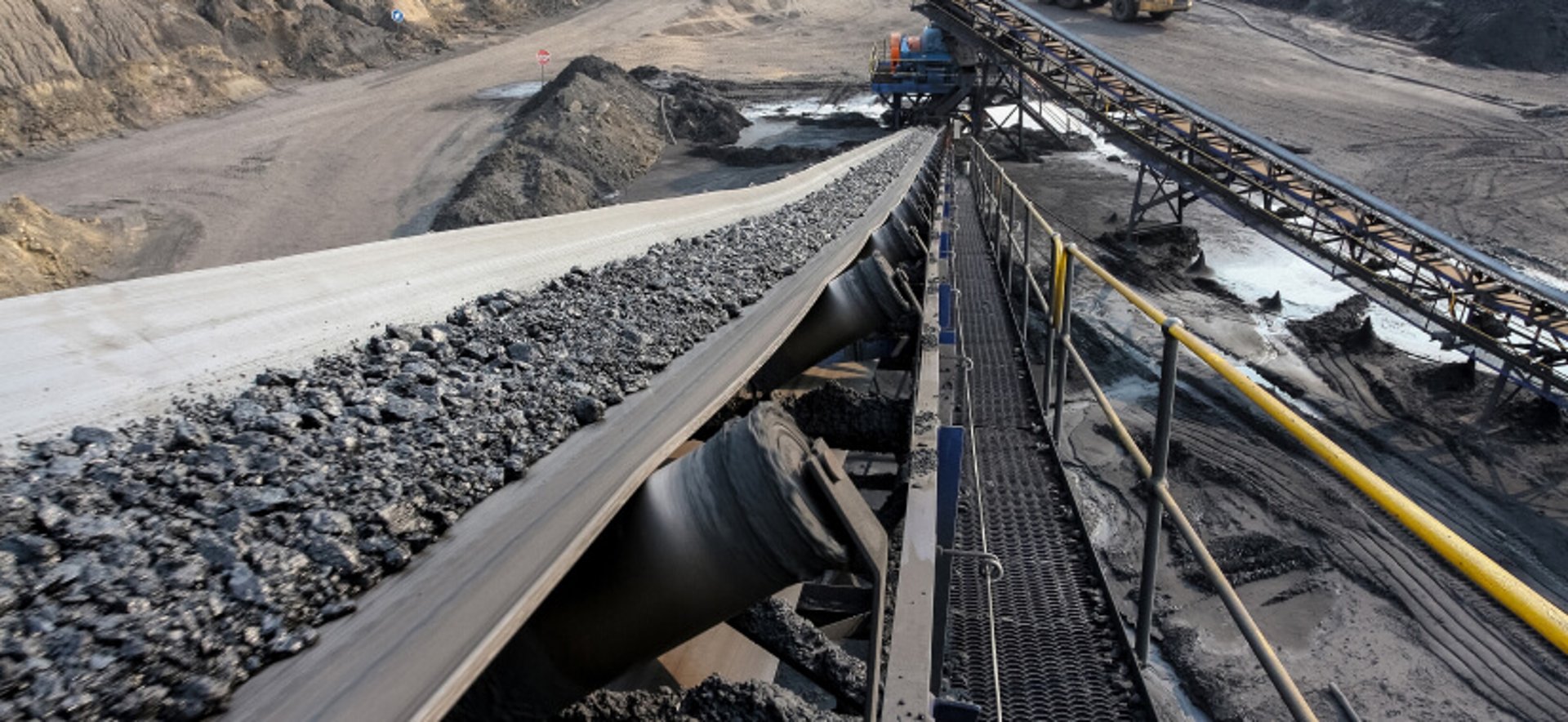
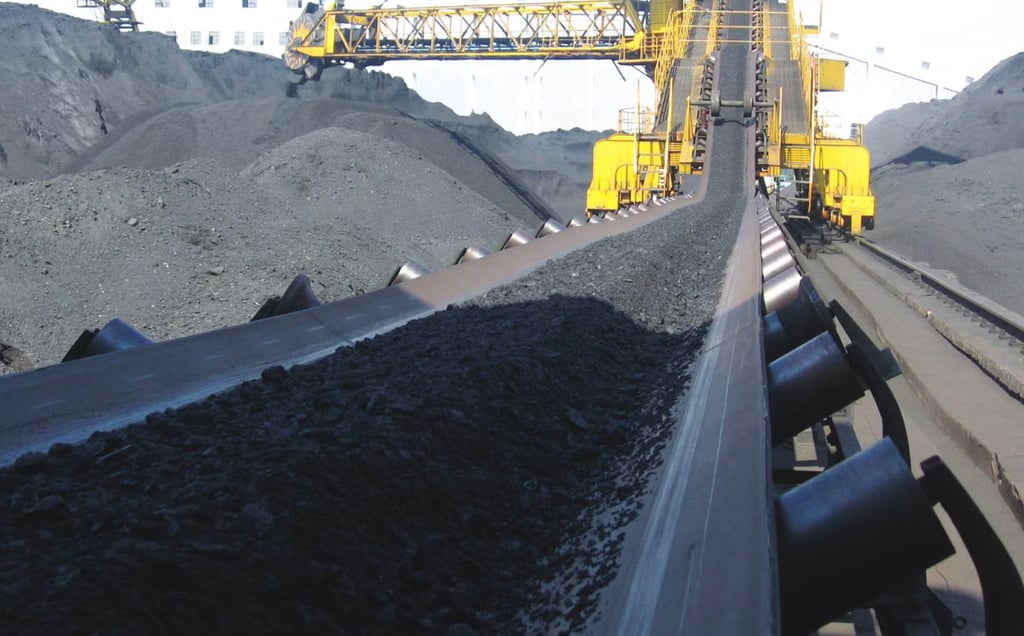
Conveyor systems are the backbone of every mine. In South Africa, these can stretch for kilometres, and many are designed to move as the mine expands. Cables run alongside the structure, exposed to sun, rain, dust, and constant vibration.
Why PROTOMONT is the best choice:
Continuous movement capability: Designed to be moved daily or weekly without damage
Weatherproof: Operates reliably in rain, heat, or cold
High flexibility: Easy to route around pulleys and structures
Durability: Lasts through years of heavy use without maintenance
Typical use: Power supply to drive motors, control circuits, and auxiliary equipment on all types of conveyors.
Material Handling Equipment — Stackers, Reclaimers, Shovels, Hoists
This equipment moves constantly. Cables are wound on and off reels, suspended in loops, or dragged along the ground. They experience high tension, torsion, and abrasion.
Why PROTOMONT is the best choice:
High tensile strength: 15 N/mm² rating allows safe towing and lifting
Superior torsion resistance: 100°/m prevents kinking or breaking during rotation
High reeling speed: Rated for 100 m/min — fast enough for the largest machines
Abrasion resistant: CR sheath withstands contact with rock, steel, and dust
Typical use: Stacker-reclaimer bridges, bucket wheel excavators, cable trolleys, and connections between upper and lower cars in hoist systems.
Submersible Pumps and Dewatering Systems
Water management is critical in every mine. Pumps operate 24 hours a day, fully submerged, often in deep sumps or boreholes. Standard cables fail quickly here due to water ingress.
Why PROTOMONT is the best choice:
Certified submersion: 500 metres depth — deeper than almost any requirement
Water stable materials: EPR and CR do not degrade or absorb water
Temperature rating: Works reliably in water up to 40°C
Sealed construction: Double layer protection prevents any leakage
Typical use: Dewatering pumps, borehole pumps, drainage systems, and water transfer — widely used in the Northern Cape and water-challenged regions.
General Open-Cast and Heavy Industry
Beyond mining, it is ideal for quarries, cement plants, ports, and timber yards. Anywhere cables are moved, exposed, or get wet, this cable outperforms alternatives.
Technical Specifications and Selection Guide
Core Specifications
Rated voltage: 0.6/1 kV (power circuits); 450/750 V (control circuits)
Maximum operating voltage: 0.7/1.2 kV AC; 0.9/1.8 kV DC
Test voltage: 3 kV (power cores); 2 kV (control cores)
Conductor: Class 5 finely stranded copper, un-tinned
Insulation: EPR compound 3GI3, 90°C continuous, 250°C short-circuit
Sheath: Chlorinated rubber 5GM3, black
Temperature range:
Fixed installation: -40°C to +80°C
Moving operation: -25°C to +60°C
Water: Max 40°C
Standards: DIN VDE 0250 Part 812, EN 60332, EN 60811, EN 50525; compliant with SANS 1520 requirements
Certifications: VDE, GOST, Russian Fire Certificate
Available Configurations
PROTOMONT is available in a wide range of cores and cross-sections to match every need:
Core count: 1, 2, 3, 4, 5, 7, 8, 10, 12, 14, 19, 24 cores
Cross-section: From 1.5 mm² up to 300 mm²
Special designs: For sections ≥50 mm², the …/3E design features the split earth conductor for superior balance and safety
Suffix codes:
-J: With protective earth conductor (standard)
-O: Without earth conductor
(M): Standard duty
(N): Enhanced duty — recommended for heavy use and frequent movement
Selection Rules
Choose (N) version for: High speed reeling, heavy abrasion, or extreme conditions — it offers roughly 30% better mechanical performance.
Use …/3E design for: All cables 50 mm² and larger. The balanced construction is essential for long life and safety.
Sizing: For moving applications, always select one or two sizes larger than the calculated electrical requirement. This reduces tension and extends service life significantly.
Current ratings: Range from 23 A (1.5 mm²) up to 633 A (300 mm²) — detailed tables available in technical documentation.
Feichun PROTOMONT: Fully Equivalent Alternative, Better Value
Feichun Cables manufactures the PROTOMONT (M) (N)SHOEU 0.6/1kV series as a direct, fully equivalent replacement for the original product. For mines in Southern Africa, this offers significant advantages without any compromise in quality or safety.
Why It Is 100% Equivalent
Identical standards: Manufactured strictly to DIN VDE 0250 Part 812 and all relevant EN and IEC standards. It meets the same technical specifications required by South African regulations.
Same materials: Uses exactly the same compound specifications: EPR 3GI3 insulation, CR 5GM3 sheath, and Class 5 copper conductor. The material science is identical.
Same construction: Balanced lay-up, split earth design, double sheath, and core marking are identical. Dimensions, electrical properties, and mechanical limits match exactly.
Certified performance: Every batch is tested to the same limits — voltage, bending, torsion, water immersion, and ageing. Test reports are available for inspection.
Key Advantages Over European Brands
Competitive pricing: Typically 20–35% lower than imported equivalents. This reduces capital expenditure significantly for large projects.
Faster delivery: Production and supply chain optimized for Southern Africa. Lead times are 4–6 weeks, compared to 12–16 weeks from Europe. This is critical for mine maintenance schedules.
Flexible supply: Available in any length, custom configurations, and special packaging to suit site requirements.
Local support: Technical documentation and support available in English, with full understanding of local standards and mine safety requirements.
Acceptance in South Africa
Feichun PROTOMONT is fully accepted and used by major mining groups across South Africa. It meets the requirements of SANS 1520 and is approved for use in hazardous areas. It offers the same reliability and performance at a price that improves project economics.
Frequently Asked Questions
1. Can this cable be used permanently underwater?
Yes. It is certified for continuous submersion up to 500 metres and is designed to operate reliably in fresh water, mine water, and even slightly aggressive water at temperatures up to 40°C. It is the preferred choice for submersible pumps.
2. Is it flame retardant?
Yes. It meets EN 60332-1-2 and IEC 60332-1-2 standards for flame retardancy. It is safe for use in areas where fire safety is a priority, including hazardous zones.
3. Does it work in extreme cold?
Absolutely. Fixed installation is rated down to -40°C, and moving operation down to -25°C. It remains flexible and does not crack or become stiff, even in the coldest winter nights on the highveld.
4. How long can I expect it to last?
In open-cast applications, typical service life is 6 to 12 years. In fixed or less demanding roles, it can last 15 years or more. This compares to 1–2 years for standard cables.
5. Can Feichun supply large sizes and special designs?
Yes. Feichun manufactures the full range up to 300 mm², including the …/3E split earth design for large sections, multi-core control cables, and custom assemblies.
6. Is it compatible with my existing equipment?
Yes. Dimensions, electrical characteristics, and termination requirements are identical to the original specification. It is a direct replacement.
Conclusion
PROTOMONT (M) (N)SHOEU 0.6/1kV is not just another cable. It is a complete engineering solution designed specifically for the harsh reality of open-cast mining. Every part of it — from the fine copper strands inside to the specialized rubber on the outside — is built to solve the problems that destroy standard cables.
It moves without breaking, survives exposure without failing, and works underwater reliably. It lasts 3 to 5 times longer, reduces failures by 70%, and lowers total cost of ownership by over 60%. In South Africa, where downtime costs thousands of rands per hour, this is not just a technical improvement — it is a major economic advantage.
Feichun Cables offers the exact same quality, performance, and safety, with faster delivery and better pricing. For engineers, procurement teams, and mine managers, it is the smartest choice for conveyors, material handlers, and dewatering systems.
If you need reliable, long-life flexible rubber cables for your open-cast mine, conveyor system, or dewatering project — contact the Feichun team today:
We provide full technical data, samples, and quotes tailored to Southern African projects.

Email Address: Li.wang@feichuncables.com
© 2025. All rights reserved.
One-click to Quickly Contact
Products
Contact
Company
Location:
Building A Private Science and Technology Park, Hefei Economic and Technological Development Zone, Anhui Province, China
Heat Resistant Cable
WhatsApp: +86 17333223430
Social Media: