Anhui Feichun Special Cable Co.,Ltd Email: Li.wang@feichuncables.com
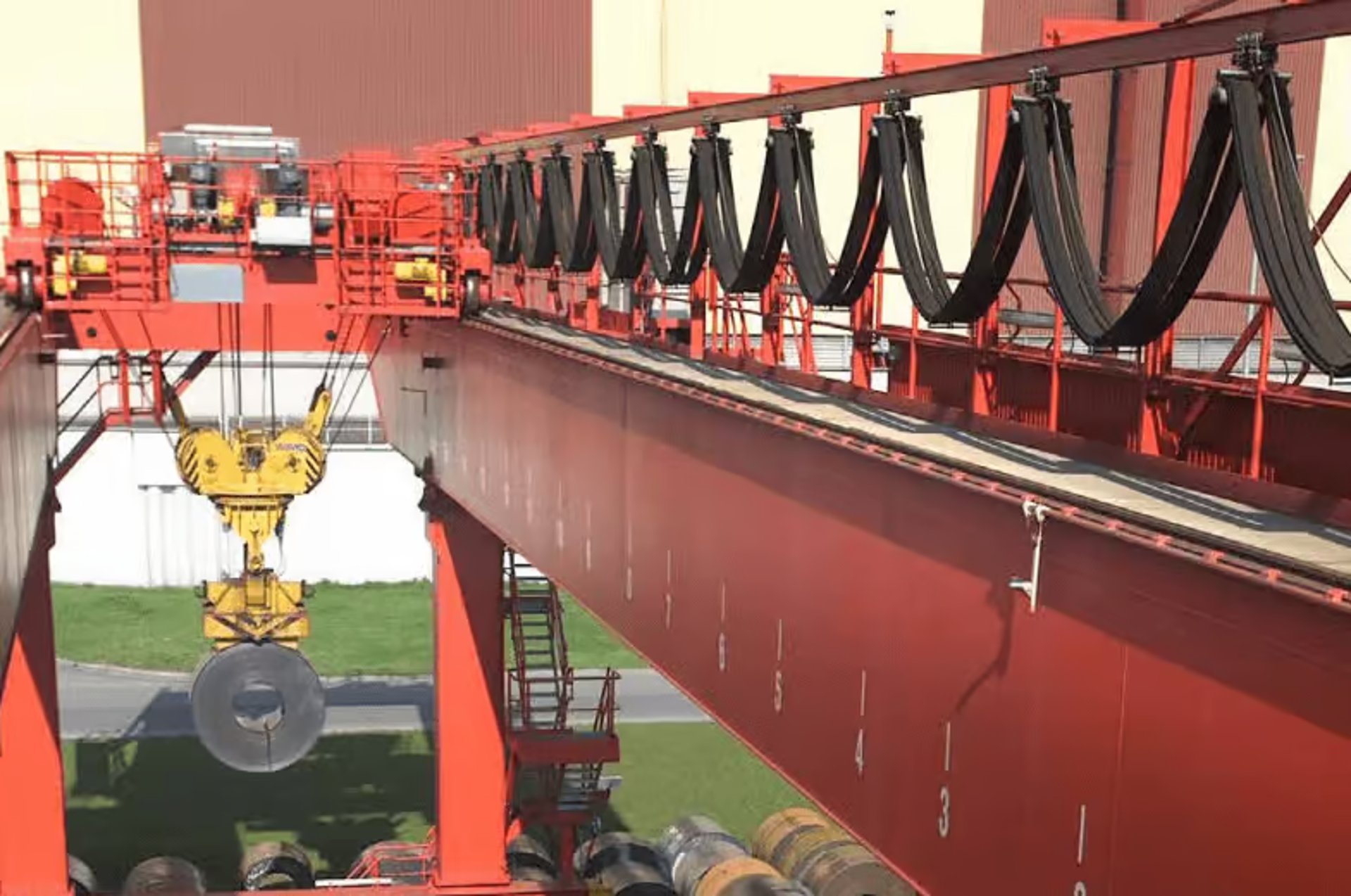
Why RHEYFLAT®-N NGFLGOEU-J Flat Festoon Cable Outperforms Round Cables in RMG Cranes and Industrial Festoon Systems
Discover why RHEYFLAT®-N NGFLGOEU-J Flat Festoon Cable outperforms round cables in RMG cranes and industrial systems. Explore the engineering behind EPR insulation, 5GM3 sheath, and 2-3x longer fatigue life. Full technical specs and performance analysis inside.
Li Wang
5/11/202611 min read
Introduction
In the demanding world of heavy industry, the reliability of every component matters. While often overlooked, the cable system is the lifeline of any machine, transmitting power and data essential for operation. In applications such as Rail Mounted Gantry (RMG) cranes, steel rolling mills, and complex conveyor systems, the environment is unforgiving. Equipment operates continuously, often under extreme weather conditions and high mechanical stress.
The RHEYFLAT®-N NGFLGOEU-J represents more than just a means of conducting electricity; it is a highly engineered solution designed to survive where standard cables fail. This article explores the science, engineering, and practical benefits that make this flat festoon cable the superior choice for critical industrial applications. We will examine how its unique geometry, advanced material chemistry, and electrical properties combine to deliver performance that far exceeds traditional round cables, offering significant advantages in durability, safety, and total cost of ownership.
The Harsh Reality of Industrial Environments
To understand why a specific cable design is necessary, we must first understand the conditions it must endure. In South Africa, major ports such as Durban, Richards Bay, and Cape Town handle massive volumes of cargo daily. Similarly, steel plants and heavy manufacturing facilities operate under intense pressure. These environments present a combination of challenges that test the limits of material science.
Climate and Atmospheric Challenges
South African ports and industrial zones are subject to intense solar radiation, high temperatures, and often high humidity. Coastal areas face the additional threat of salt spray, which is highly corrosive to metals and can accelerate the degradation of rubber compounds. The UV index is particularly high, meaning any cable used outdoors must possess exceptional resistance to sunlight cracking and ozone degradation. Materials that are not specifically formulated for these conditions will harden, crack, and fail prematurely.
Mechanical Stress and Dynamic Loading
RMG cranes and material handling systems involve constant movement. Cables are subjected to repeated bending, tension, torsion, and impact. In festoon systems, cables are dragged or carried at speeds that can exceed 180 meters per minute. This constant flexing creates fatigue within the material structure. In steel mills, the environment adds heat, heavy vibration, and the risk of physical damage from falling objects or heavy traffic. Standard cables simply cannot withstand this level of punishment without suffering from conductor breakage or insulation failure.
Chemical and Environmental Exposure
Industrial sites are rarely clean environments. Oil leaks, hydraulic fluids, chemical spills, and abrasive dust are common occurrences. A cable sheath must act as a robust barrier against these substances. If the material swells, dissolves, or loses its mechanical strength when exposed to chemicals, the internal conductors become vulnerable to short circuits and corrosion. Furthermore, the cable must be suitable for both indoor and outdoor use, capable of operating reliably across a wide temperature range from as low as -35°C up to +80°C on the surface.
Engineering Excellence Over Commodity Pricing
There is often a misconception that all cables are the same and that the primary decision factor should be the initial purchase price. However, in heavy industry, selecting a "cheap cable" often results in higher long-term costs due to frequent replacements, downtime, and safety risks. The RHEYFLAT®-N NGFLGOEU-J is not designed to be the lowest-cost option on the market; it is designed to be the most cost-effective solution over its lifecycle.
The Concept of Value Engineering
This product is the result of rigorous value engineering, where every aspect of the design is optimized for performance, reliability, and safety. It addresses specific failure modes observed in less sophisticated designs. By investing in a cable that is built to last, operators reduce maintenance hours and eliminate the costly production stoppages associated with cable failure.
The Three Pillars of Design
The superiority of this cable rests on three foundational design choices that work in harmony.
Flat Geometry
Unlike round cables, which twist and bunch up during movement, flat cables maintain a consistent orientation. They are designed for uniaxial bending, meaning they flex in only one plane. This design significantly reduces mechanical stress. Field data and laboratory tests demonstrate that this geometry extends the fatigue life by a factor of 2 to 3 times compared to round cables. The conductors are arranged side-by-side, ensuring that each core experiences similar levels of strain during movement, eliminating the uneven stress distribution that causes premature failure in round cables.
EPR Insulation
The insulation material is a critical component. The RHEYFLAT®-N NGFLGOEU-J utilizes Ethylene Propylene Rubber (EPR) compound specifically rated as 3GI3. This material offers outstanding electrical properties combined with remarkable flexibility, even at the maximum operating temperature of 90°C. Unlike PVC or other thermoplastics, EPR remains elastic and tough, resisting cracking even after millions of bending cycles.
5GM3 Halogenated Sheath
The outer sheath is formulated as 5GM3 rubber compound. While Low Smoke Halogen Free (LSHF) materials are popular in some applications, they often lack the mechanical robustness required for heavy-duty festoon systems. The 5GM3 compound, based on PCP and CPE chemistry, provides superior tear strength, abrasion resistance, and chemical resistance. It is specifically engineered to survive the rough handling and harsh environments typical of ports and steel mills.
Material Science Deep Dive
The performance of any cable is ultimately determined by the chemistry of its materials. The RHEYFLAT®-N NGFLGOEU-J employs advanced polymer science to achieve its characteristics.
EPR Insulation: Molecular Structure and Flexibility
The insulation layer is composed of EPR, or Ethylene Propylene Rubber. This is an elastomer created by copolymerizing ethylene and propylene monomers. The specific arrangement of these molecules creates what is known as an amorphous structure. Unlike crystalline polymers, this random molecular structure does not have sharp melting points or rigid zones. This allows the material to remain soft and flexible across a wide temperature range.
The molecular chains are long and intertwined, providing excellent elasticity. When the cable bends, the EPR insulation stretches and recovers without permanent deformation. This property is essential for dynamic applications where the cable shape changes thousands of times a day.
The Vulcanization Process: Achieving 90°C Stability
Raw rubber is soft and thermoplastic. To turn it into a durable insulation, it undergoes a process called vulcanization or cross-linking. During manufacturing, the EPR compound is heated with curing agents, which create chemical bonds between the molecular chains.
The RHEYFLAT®-N NGFLGOEU-J is engineered for a maximum conductor temperature of 90°C in continuous operation. The vulcanization process is precisely controlled to ensure that the cross-link density is optimal for this temperature class. This thermal engineering ensures that the insulation does not melt, soften, or flow under load, maintaining its dielectric strength and mechanical integrity even when the cable is carrying high currents.
5GM3 Sheath: Chemistry and Mechanical Strength
The outer jacket is a 5GM3 compound, based on Polychloroprene (PCP) and Chlorinated Polyethylene (CPE). The presence of chlorine atoms in the molecular structure fundamentally changes the properties of the polymer.
Chemical Resistance
The chlorinated structure makes the material highly resistant to oils, greases, and many chemicals. The polarity of the molecules prevents non-polar fluids like mineral oils from penetrating and swelling the sheath. This is vital in industrial environments where lubricants and fuels are frequently present.
Tear and Abrasion Resistance
Mechanically, this compound is exceptionally tough. It has high tensile strength and, most importantly, high tear propagation resistance. If the surface is accidentally cut or nicked, the material resists the force that would cause that cut to rip open further. This is a significant advantage over LSHF materials, which, while environmentally friendly in fire scenarios, tend to be more brittle and prone to tearing during installation and operation. The 5GM3 sheath provides a durable armor that protects the inner workings of the cable.
Mechanical Engineering and Physics of Flat Cables
The physical shape of the cable is not just for aesthetics; it is a core engineering feature that dictates how the product behaves under stress.
Uniaxial Bending and Fatigue Life
Flat cables are designed to bend in one direction only—across their narrow dimension. This is known as uniaxial bending. When a flat cable bends, the neutral axis is centrally located, and the elongation of the outer fibers is controlled and predictable. In contrast, round cables experience complex stress patterns, including torsion and bunching, especially when used in chains or festoon arms.
The result of this optimized geometry is a dramatic increase in service life. Tests show that flat cables can withstand 2 to 3 times more bending cycles before signs of fatigue appear compared to equivalent round cables. For equipment that operates 24/7, this translates directly into years of additional service life.
Conductor Stability and Fretting Prevention
Inside the cable, the copper conductors are stranded to provide flexibility. For cross-sections up to 25mm², the construction follows Class 6 stranding, offering maximum flexibility. For sizes 35mm² and above, Class 5 stranding is used.
One of the hidden enemies of cable life is "fretting" or friction wear. In round cables, the individual wires and cores can move against each other during bending, causing abrasion at the contact points. Over time, this wears away the insulation and breaks the conductor strands. In the flat cable design, the cores are held firmly in a parallel arrangement. The insulation layers are in stable contact, significantly reducing relative movement between conductors. This physical principle preserves the integrity of the copper and insulation, ensuring that electrical resistance remains stable and conductors do not break internally.
Stress Concentration Management
Every physical object has points where stress accumulates. In cable design, managing these stress concentrations is key to longevity. The flat shape distributes mechanical loads evenly across the width of the cable. The edges are designed to be smooth, avoiding sharp angles where cracks could initiate.
Engineers use this geometry to predict and extend life. By ensuring that no single point carries excessive load, the cable maintains its structural integrity. The design also allows for efficient heat dissipation, as the flat profile presents a larger surface area relative to the cross-sectional area, helping to keep operating temperatures within safe limits.
Electrical and Thermal Performance
Beyond mechanics, the cable must perform electrically with absolute reliability.
Voltage Ratings and Electrical Integrity
The RHEYFLAT®-N NGFLGOEU-J is rated for Uo/U 300/500V systems. This makes it suitable for control circuits and power distribution in industrial machinery. It can withstand maximum system voltages of 500V AC and up to 750V DC. Every cable is tested at 2.0kV AC to ensure the insulation can handle transient voltages and provide safety against breakdown.
Electromagnetic Field Distribution
As a non-shielded cable, it operates effectively in environments where high-frequency interference is not extreme. The flat arrangement of conductors creates a specific electromagnetic field pattern. Because the conductors are side-by-side, the magnetic fields interact in a way that contains the flux somewhat closer to the cable surface compared to multi-layered round cables. While not designed for high-EMC environments, this configuration provides clean signal and power transmission for standard industrial applications.
Thermal Management
Heat is the enemy of electrical insulation. The EPR insulation allows the conductor to run at 90°C continuously without degradation. Under short circuit conditions, the cable can withstand temperatures up to 250°C for a short duration, providing safety protection. The wide operating temperature range of the complete cable, from -35°C to +80°C ambient, ensures functionality whether installed in the freezing conditions of high-altitude sites or the heat of the KwaZulu-Natal coast.
Safety Standards and Fire Performance
Safety is non-negotiable in industrial design.
Flame Retardancy
The cable is designed to be flame retardant according to IEC 60332 Part 1. This means that if exposed to fire, it will burn but will not propagate the flame, self-extinguishing once the source is removed.
The Halogenated vs. LSHF Debate
The use of halogenated compounds in the sheath is an engineering decision based on performance trade-offs. Halogenated materials release gases when burning that inhibit combustion. While these gases are acidic, in open environments like ports, steel mills, and outdoor conveyor systems, the risk of smoke inhalation is low compared to the risk of fire spread.
The alternative, LSHF (Low Smoke Halogen Free), produces less toxic smoke but generally offers poorer mechanical and chemical resistance. By choosing 5GM3 halogenated rubber, the RHEYFLAT®-N NGFLGOEU-J prioritizes mechanical durability, oil resistance, and overall longevity, which are the primary requirements in heavy-duty mobile applications. It is a balanced solution that meets safety standards while delivering the ruggedness required for the job.
Complete Technical Specifications
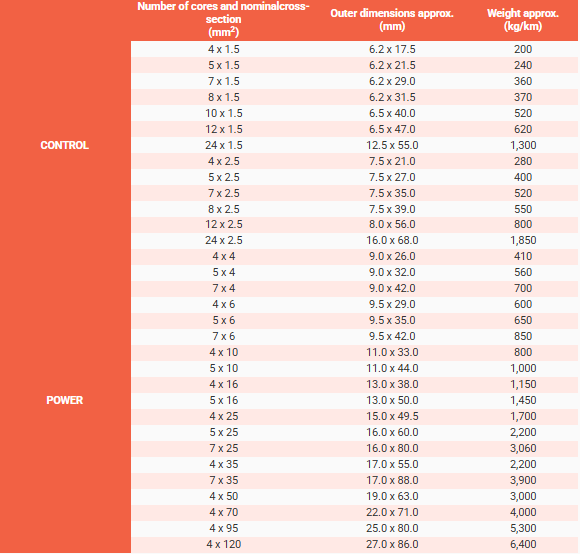
The following data provides the detailed technical parameters for the RHEYFLAT®-N NGFLGOEU-J.
Construction Standards
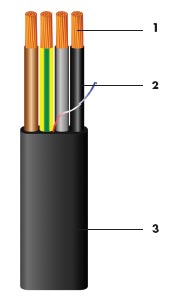
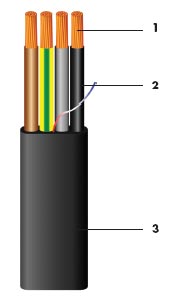
Conductor: Manufactured from flexible plain copper stranded wire. For cross-sectional areas up to and including 25 mm², the construction is extra flexible Class 6 stranding. For sizes 35 mm² and above, flexible Class 5 stranding is used. The design complies with standards IEC 60228 and DIN VDE 0295.
Insulation: Composed of EPR rubber compound identified as Type 3GI3, manufactured in accordance with DIN VDE 0207 Part 20.
Outer Sheath: Formed from rubber compound Type 5GM3, supplied in black colour. The material specification follows DIN VDE 0207 Part 21.
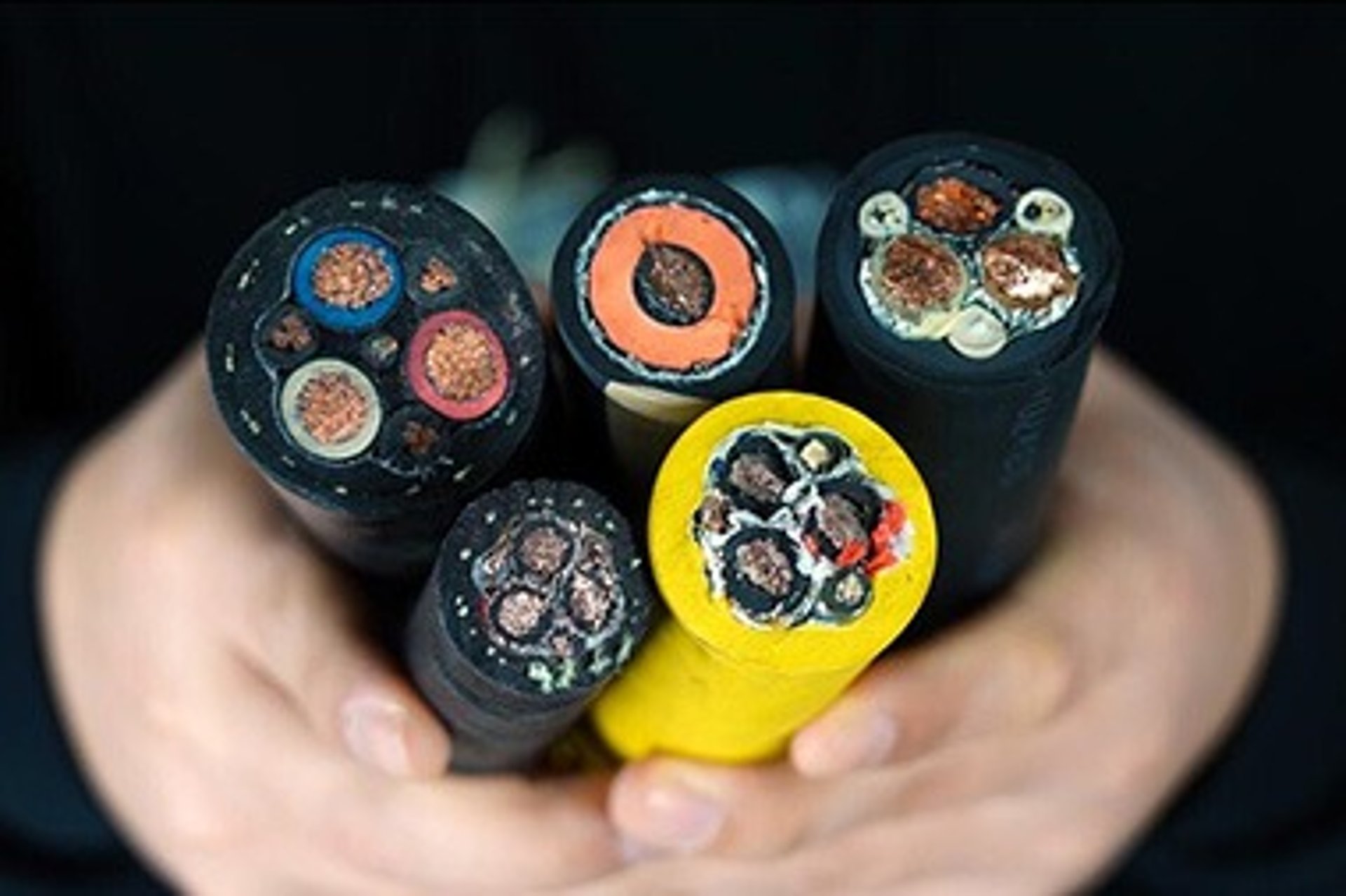
Core Identification: The colour coding follows DIN VDE 0293-308. Four-core cables are marked Green/Yellow, Brown, Black, and Grey. Five-core versions include Blue in addition to Green/Yellow, Brown, Black, and Grey. For cables with five or more cores, the identification consists of black cores printed with white numbers, accompanied by a Green/Yellow protective conductor.
Overall Standard: The complete cable design and testing adhere to DIN VDE 0250 Part 809.
Performance Characteristics
Rated Voltage: Uo/U = 300/500 V
Max Operating Voltage: 500 V for AC systems and 750 V for DC systems
Test Voltage: 2,000 V AC
Conductor Temperature (Service): Maximum +90°C
Conductor Temperature (Short Circuit): Maximum +250°C
Ambient Temperature Range: -50°C to +80°C for fixed installation, and -35°C to +80°C for mobile operation
Max Tensile Stress: 15 N/mm² under static conditions and 30 N/mm² under dynamic conditions
Max Speed: Capable of handling speeds up to 180 m/min
Properties: Oil resistant, UV resistant, ozone resistant, and flame retardant
Dimensional
Applications and Practical Implementation
Understanding the technical specifications is one thing, but applying them correctly in the field is where value is created. The RHEYFLAT®-N NGFLGOEU-J is designed specifically for applications involving high mechanical stress and frequent movement restricted to one plane.
Port and Stevedoring Operations
In South African ports like Durban and Ngqura, RMG and STS cranes operate around the clock. The flat cable design is ideal for festoon systems where cables must travel long distances horizontally. The low profile of the flat cable allows it to run neatly in tracks and trolleys without twisting or tangling, which is a common headache with round cables. The ability to handle speeds up to 180 m/min ensures that the cable keeps up with the fastest container handling equipment, maintaining operational efficiency.
Steel Plants and Heavy Industry
In steel rolling mills and processing lines, the environment is hot, dirty, and dangerous. The 5GM3 sheath provides essential protection against mechanical impact, hot splashes, and chemical spills. The EPR insulation maintains its properties even when ambient temperatures are high, ensuring that power delivery remains consistent during peak production runs. The cable’s resistance to oil and grease means it is suitable for use near hydraulic systems and gearboxes where contamination is a constant risk.
Conveyor Systems and Material Handling
Long conveyor belts require reliable power and control along their entire length. The flat shape allows for easy installation and fixing, and the durable construction means less maintenance intervention in hard-to-reach areas. Whether installed outdoors in the sun or indoors in dusty conditions, the cable’s UV and ozone resistance ensures long-term reliability.
Frequently Asked Questions
Is this cable suitable for direct burial or underwater installation?
The RHEYFLAT®-N NGFLGOEU-J is designed for festoon systems, cable chains, and exposed mobile applications. While it is water resistant and suitable for outdoor use, it is not specifically designed for permanent direct burial or submersion without additional protection. For such specific installation methods, consultation with the engineering team is recommended.
How does the total cost compare to standard round cables?
While the initial purchase price may be higher than generic round cables, the total cost of ownership is significantly lower. With a fatigue life 2 to 3 times longer, reduced downtime, and lower maintenance replacement costs, this cable pays for itself quickly. In industrial applications, the cost of stopping production far exceeds the price difference in cabling.
What is the expected service life in a typical crane application?
Service life depends on factors such as bending radius, travel length, speed, and environment. However, under correct installation and standard operating conditions, users can expect a service life significantly exceeding that of standard flexible cables. The combination of EPR insulation and 5GM3 sheath ensures that the material properties remain stable for many years.
Does the flat cable require special installation techniques or tools?
Installation is straightforward, but attention should be paid to the recommended minimum bending radii. The flat profile actually simplifies installation in cable carriers and festoon arms as the cables do not spin or rotate. Standard cable glands and termination techniques suitable for rubber cables are applicable.
Conclusion
The choice between a standard round cable and an engineered solution like the RHEYFLAT®-N NGFLGOEU-J is ultimately a choice between short-term cost and long-term reliability. In the demanding environments of South African ports, steel mills, and heavy industry, failure is not an option.
Through the innovative use of flat geometry, advanced EPR insulation chemistry, and the robust mechanical protection of the 5GM3 halogenated rubber sheath, this cable addresses the root causes of cable failure. It offers superior fatigue life, better thermal management, excellent chemical resistance, and electrical stability. It is a product designed by engineers who understand the harsh realities of industrial operations.
By selecting the RHEYFLAT®-N NGFLGOEU-J, you are not just buying a cable; you are investing in the continuous operation of your machinery and the safety of your personnel.
If you require further technical information, pricing, or wish to place an order, please do not hesitate to contact the Feichun Cables engineering team. We are ready to support your projects with expert advice and high-quality products.
Email: Li.wang@feichuncables.com
Email Address: Li.wang@feichuncables.com
© 2025. All rights reserved.
One-click to Quickly Contact
Products
Contact
Company
Location:
Building A Private Science and Technology Park, Hefei Economic and Technological Development Zone, Anhui Province, China
Heat Resistant Cable
WhatsApp: +86 17333223430
Social Media: