Anhui Feichun Special Cable Co.,Ltd Email: Li.wang@feichuncables.com

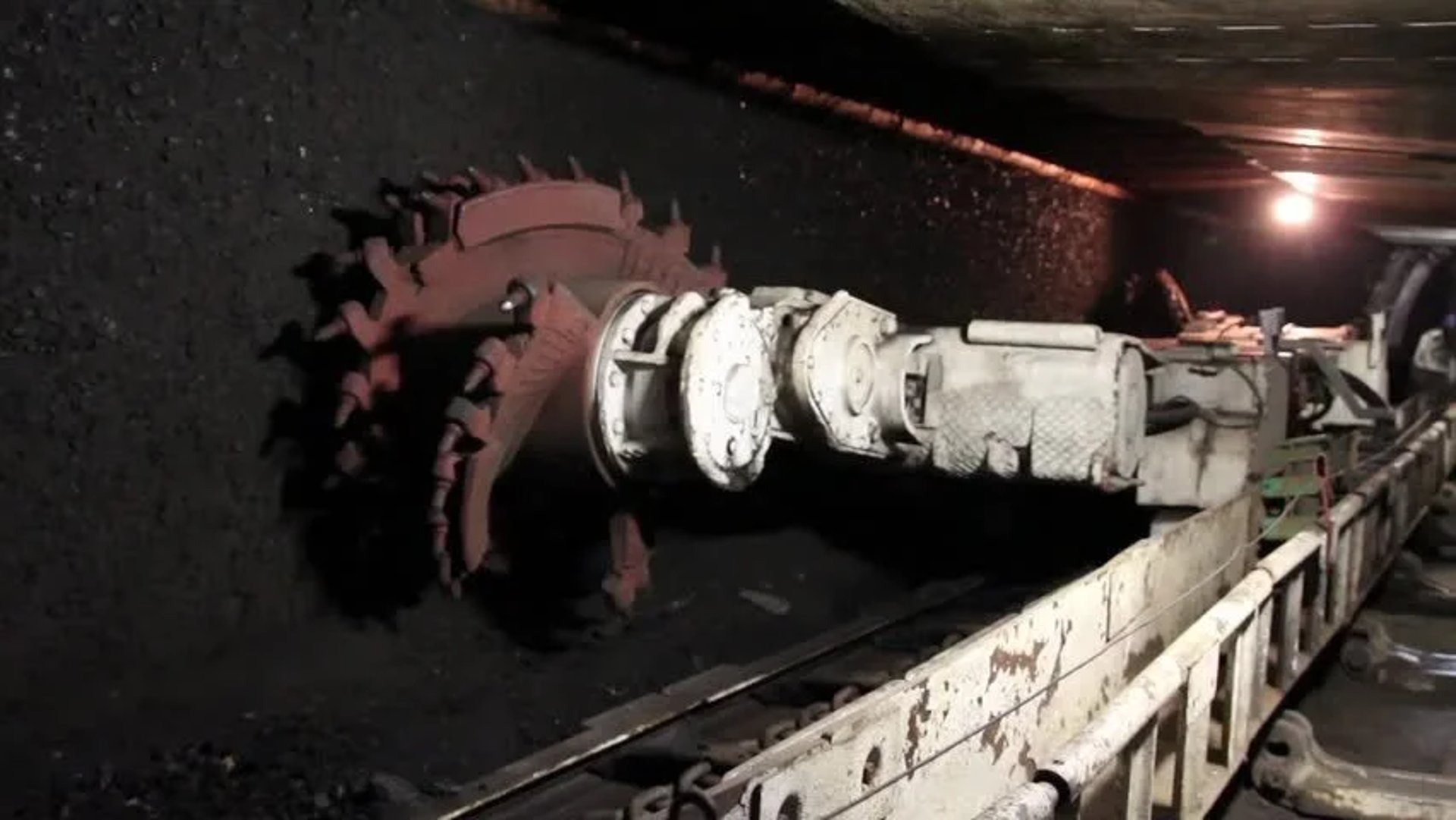
Why South African Mines Are Turning to AS/NZS Type 245 (1.1–6.6 kV) Cables — The Full Engineering Guide
Discover why AS/NZS Type 245 mining cables (1.1–6.6 kV) are becoming the preferred choice for South African longwall shearers and continuous miners. Learn about structure, specs, applications, standards, troubleshooting, and a real case study from Mpumalanga.
Li. Wang
12/5/20256 min read
Why Type 245 Cables Matter in South Africa
If you spend enough time inside a South African underground mine—whether it’s a longwall coal operation in Mpumalanga, a chrome mine in North West, or a platinum mine in Limpopo—one pattern becomes obvious:
Only the toughest, most flexible, and electrically stable trailing cables survive.
The demands placed on mining power cables in South Africa are brutal:
Constant bending and reeling
Exposure to moisture, mud, dust and hydrocarbons
Tight haulage spaces
Abrasion from rock and machinery
High current loads
Mandatory earth-fault monitoring
For machines like:
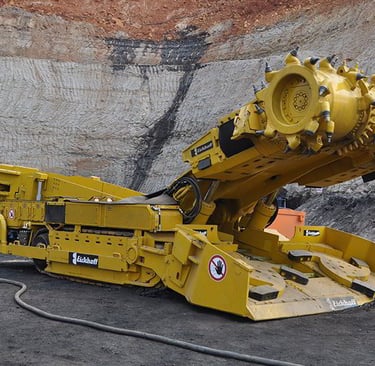
Longwall shearers
Continuous miners
Shuttle cars
Hydraulic systems
Longwall panline and auxiliary equipment
…the cable is as important as the machine itself. A single trailing-cable failure can cost a mine dozens of production hours—translating to millions of rand in lost coal, ore or metal output.
This is why many South African mines increasingly prefer AS/NZS Type 245 (1.1–6.6 kV) trailing cables—originally developed in Australia for high-stress longwall conditions, but now recognised globally for their flexibility, ruggedness and electrical reliability.
What Is AS/NZS Type 245 Mining Cable?
Definition
Under AS/NZS 1802:2003, Type 245 is defined as a very flexible trailing and reeling cable designed for mobile mining machinery.
Voltage Ratings
Type 245 comes in three controlled voltage classes:
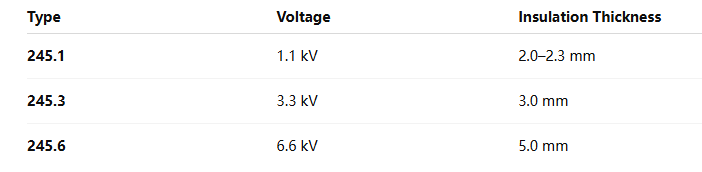
Type 245.1 → 1.1 kV
Type 245.3 → 3.3 kV
Type 245.6 → 6.6 kV
These ratings match the requirements of high-power underground equipment common in South Africa.
Why It Is Categorised as “Very Flexible”
The flexibility comes from:
High-strand-count tinned copper conductors
Rubber-based EPR insulation
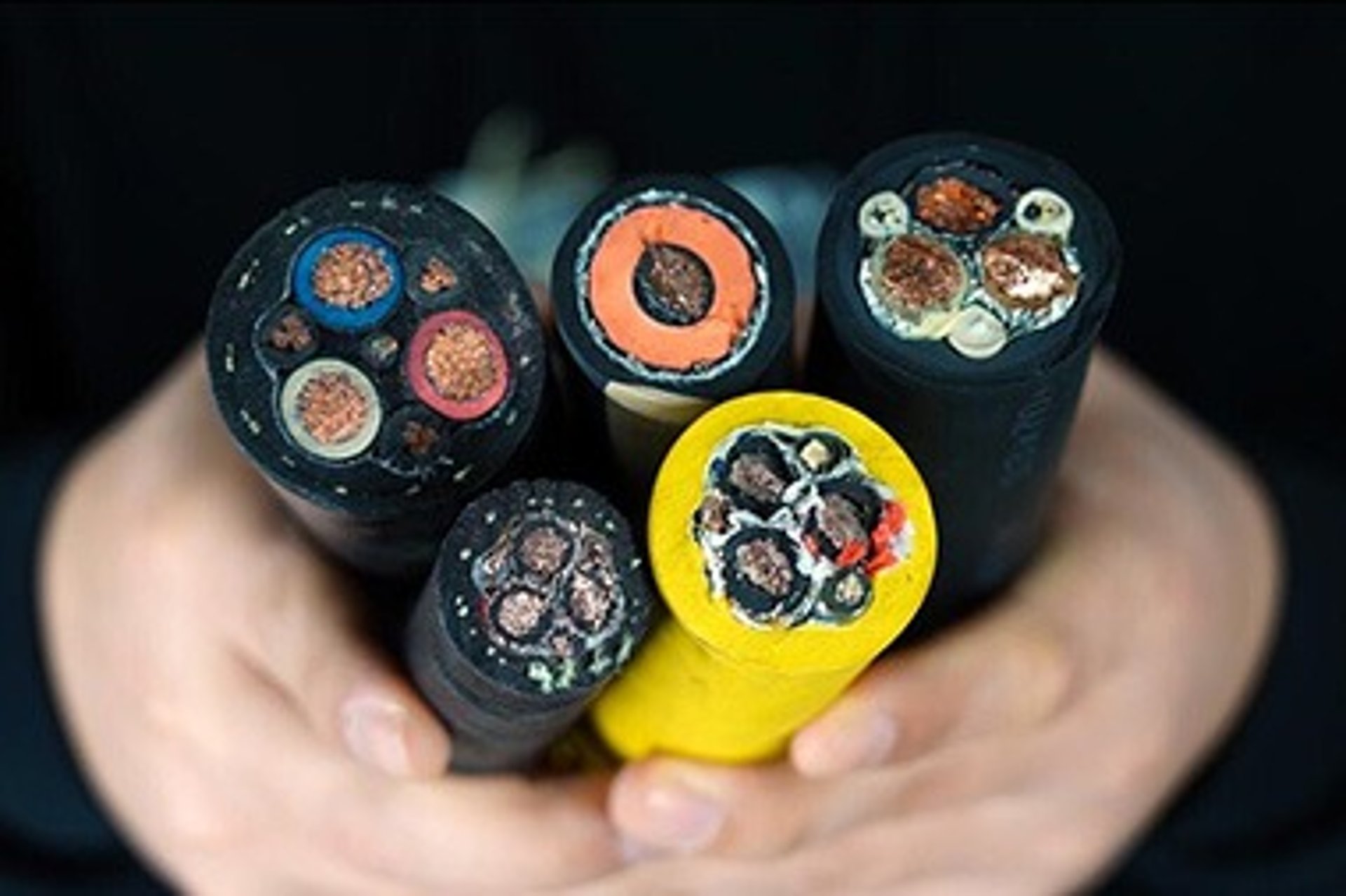
A cradle-style cable architecture
Textile reinforcement reducing torsional stress
Interstitial earth conductors that bend fluidly
Central pilots that extend and stretch without breaking
This design allows Type 245 to handle:
Constant back-and-forth movement
Tight bends
High tensile loads
Abrasion from floor drag
Reeling and unreeling cycles
Central Pilot Conductors
Type 245 includes three extensible pilot conductors, used for:
Earth continuity monitoring
Control circuits for longwall safety systems
Shutdown protection during earth faults
Interfacing with existing South African longwall automation systems
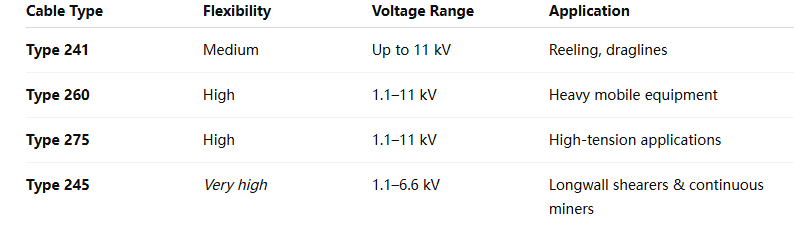
Comparison with Other AS/NZS Cable Types
Type 245 is specifically optimised for longwall dynamics where cable flex-life and electrical stability are critical.
Standards & Compliance Requirements
Applicable Standards
Type 245 cables are manufactured according to:
AS/NZS 1802:2003
Mining and earth-moving machinery trailing and reeling cables — the main governing standard for Type 245.
AS/NZS 1125
Copper conductors (stranding, resistance, laying).
AS/NZS 3808
Insulation and sheathing compounds.
AS/NZS 5000.1
General electrical installation requirements.
These standards ensure:
Correct electrical stress control
Mechanical resilience
Reliable earth-fault monitoring
Flame retardancy and safety
Safety Requirements for South African Mines
South African mines follow:
DMRE (Department of Mineral Resources and Energy) guidelines
MHSA (Mine Health and Safety Act)
Local site-specific electrical codes
Key compliance requirements:
✔ Flame retardancy
No cable may propagate fire underground.
✔ Insulation integrity
High dielectric strength & resistance to contaminants.
✔ Reliable earth-fault detection
Mandatory for coal mines.
✔ Mechanical resilience
Tensile, torsion and impact resistance tested.
Because of these demands, South African longwall operations frequently import AS/NZS Type cables—especially Type 245—due to their superior performance.
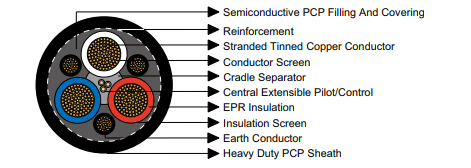
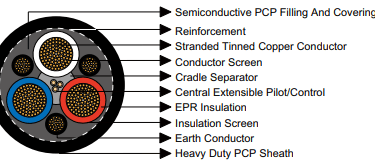
Construction of AS/NZS Type 245 Cable
Below is a professional, engineering-grade breakdown.
Conductors
Flexible stranded tinned annealed copper
Multi-strand for ultra-high flexibility
Tinning prevents corrosion in wet, acidic or saline mine conditions
Excellent thermal and electrical performance
Conductor Screening
Required for 3.3 kV and above:
A semiconductive compound
Equalises electric field distribution
Prevents partial discharge
Increases insulation lifespan under high voltage stress
Insulation — EPR
Ethylene Propylene Rubber (EPR) provides:
High dielectric strength
Excellent thermal performance (up to 90°C)
Moisture resistance
Hydrocarbon resistance
Crack resistance under repeated bending
EPR is a key reason Type 245 outperforms PVC-based mining cables.
Insulation Screen
A semiconductive elastomer applied over the EPR:
Smooths electric stress
Reduces corona effect
Ensures safe grounding during faults
Cradle Separator & Overall Core Screen
Semiconductive PCP (polychloroprene)
Maintains conductor spacing
Provides mechanical protection
Prevents screen damage during bending
Offers short-circuit containment
Interstitial Earth Conductors
Placed between power cores:
Flexible tinned copper
PCP semiconductive covering
Maintains earth path even under severe mechanical stress
These conductors are essential for South African safety regulations.
Central Extensible Pilots
Three pilots—each EPR insulated.
Used for:
Earth continuity monitoring
Control and signalling circuits
Machine protection systems
Longwall shutdown automation
Textile Reinforcement
Type 245 features an open-weave textile braid:
Provides torsion resistance
Reduces sheath tearing
Improves cable flex-life
Adds tensile strength
Sheath Materials
Standard sheath:
Heavy-duty PCP
Optional sheaths:
CPE (chlorinated polyethylene)
CSP (chlorosulphonated polyethylene)
These alternatives improve:
UV resistance
Acid resistance
Hydrocarbon resistance
Heat resistance
Technical Specifications & Electrical Parameters
Conductor Sizes
From 16–150 mm², depending on:
Voltage rating
Current requirements
Machine power rating
High-strand-count design ensures exceptional flexibility.
Insulation Thickness (by voltage)
Earth & Pilot Specifications
Earth: 69/0.25 to 375/0.30
Pilot: 28/0.25 with 0.8 mm insulation
Sheath Thickness & Diameter
Sheath: 4.1–8.0 mm
Overall diameter: 42.6–85.8 mm
Weight
Ranges 235–1210 kg per 100 m.
Electrical Performance Highlights
Voltage: 1.1 kV / 3.3 kV / 6.6 kV
High dielectric strength due to EPR
Continuous operating temp: 90°C
Excellent partial-discharge resistance
Applications in Mining & Heavy Industry
Longwall Shearer Cables
Type 245 is the primary global standard for:
Longwall shearers
AFC (armoured face conveyors)
Roof supports
Stage loaders
Flex-life is critical because the cable is dragged along the panline thousands of times per shift.
Continuous Miners
Reliable power delivery to:
Cutting heads
Traction drives
Conveyor systems
Hydraulic power modules
Longwall Auxiliary Systems
Type 245 is frequently used for:
Pumps
Ventilation fans
Roof bolters
Shuttle cars
Feeder breakers
Underground & Surface Mines
Suitable for:
Coal (Mpumalanga, Limpopo)
Platinum (Bushveld Complex)
Gold (Gauteng)
Chrome (North West)
Manganese (Northern Cape)
Mpumalanga Longwall Coal Mine
Background
A large longwall operation in Mpumalanga struggled with:
Frequent trailing-cable failures
Poor insulation quality from imported low-budget cables
Earth-fault alarms stopping the shearer
Productivity losses of 30+ hours per month
Problems Identified
Insulation breakdown due to weak materials
Earth continuity loss from pilot fatigue
Mechanical abrasion caused by panline friction
Sheath tearing under torsion
Intervention
The mine replaced its inferior cables with:
AS/NZS Type 245.3,
95 mm² conductors,
3.3 kV rating,
Reinforced installation using strain-relief clamps and roller systems
Results After 6 Months
Cable failures reduced by 43%
Monthly downtime reduced by 30 hours
Maintenance costs dropped significantly
Earth-fault monitoring became stable
Shearer performance improved due to consistent power supply
Why Type 245 Performed Better
EPR insulation resisted moisture and heat
Textile reinforcement prevented torsion damage
High-quality pilot system eliminated false earth alarms
Robust sheath withstood drag and abrasion
Advantages of AS/NZS Type 245 Cables
✔ Engineered for dynamic mining conditions
Designed for constant movement and tight bending radii.
✔ Excellent electrical stress control
Semiconductive screening ensures stable performance.
✔ High mechanical durability
Resistant to:
Tension
Compression
Torsion
Abrasion
Impact
✔ Superior chemical and moisture resistance
The EPR + PCP combination withstands:
Oil
Water
Hydrocarbons
Acids and alkalis
✔ Reliable safety systems
Pilot conductors ensure:
Continuous earth monitoring
Rapid fault detection
Machine protection
Installation, Handling & Maintenance Tips
Proper Installation
Use correct roller or hook systems
Avoid dragging the cable over sharp edges
Maintain correct bend radius
Handling in Wet Underground Areas
Prevent the cable from lying in stagnant water
Use strain-relief clamps to reduce tension
Routine Testing
Insulation resistance (Megger test)
Earth continuity loop test
Pilot circuit continuity test
Visual inspection for:
Sheath damage
Hot spots
Exposed screens
Crushed areas
Recommended Inspection Intervals
Daily operator checks
Weekly electrician inspections
Monthly detailed technical evaluation
Common Problems & Troubleshooting
Mechanical Damage
Caused by:
Shuttle car impacts
Panline friction
Over-tensioning
Detection:
Hot spots
Damaged outer sheath
Visible screen material
Earth Continuity Alarm Issues
Common causes:
Pilot conductor fatigue
Incorrect terminations
Overheating
Triggered by:
Overloading
Poor ventilation
Bundled cable routes
Premature Insulation Failure
Often linked to:
Non-EPR insulation used in counterfeit cables
Excessive heat
Moisture ingress
FAQ
What is the difference between Type 245.1, 245.3 and 245.6?
Only the voltage rating differs: 1.1 kV, 3.3 kV, 6.6 kV.
Can Type 245 be used for reeling?
Yes, but mainly for medium-duty reeling; continuous reeling may require Type 241 or Type 260.
What makes Type 245 better than PVC trailing cables?
EPR insulation = higher dielectric strength, better flexibility, better heat resistance.
How do I select the correct conductor size?
Match conductor cross-section to the machine's full-load current + distance + voltage drop limits.
Is Type 245 compatible with modern longwall safety systems?
Yes. The pilot conductors integrate seamlessly with SA longwall control units.
How often should the cable be tested?
Weekly electrically, daily visually.
Does the cable meet South African flame retardancy rules?
Yes, when manufactured to AS/NZS 1802 and tested to IEC/AS flame standards.
What is the typical service life underground?
Anywhere from 8 to 24 months, depending on handling and mining conditions.
Conclusion
AS/NZS Type 245 cables stand out as one of the most reliable, flexible and high-performance trailing cables available for South African longwall and continuous mining machines.
They deliver:
Superior mechanical toughness
Outstanding electrical integrity
Reliable pilot circuits
Long service life
High resilience in the tough conditions of SA coal and hard-rock mines
For mines looking to reduce downtime, avoid safety shutdowns, and maintain stable power delivery to high-demand mobile equipment, Type 245 (1.1–6.6 kV) remains one of the best-engineered solutions available.
Email Address: Li.wang@feichuncables.com
© 2025. All rights reserved.


One-click to Quickly Contact
Products
Contact
Company
Location:
Building A Private Science and Technology Park, Hefei Economic and Technological Development Zone, Anhui Province, China
Heat Resistant Cable
WhatsApp: +86 17333223430
Social Media: