Anhui Feichun Special Cable Co.,Ltd Email: Li.wang@feichuncables.com
Why This Cable Never Gets Tired: The Hidden Power of HIFLEX LiPC(DY)C11Y in South Africa’s Toughest Automation Systems
Discover why the HIFLEX LiPC(DY)C11Y high-flex encoder/feedback cable is a top choice in South African drag chain systems. Learn its technical parameters, cable structure, EMC performance, PUR sheath benefits, and real SA case studies for mining, automation, and robotics.
Li. Wang
11/27/20255 min read

Introduction
Walk into any modern South African factory—whether it’s a Johannesburg packaging plant, a Durban automotive line, or a Rustenburg mineral processing facility—and you’ll find machines moving with incredible speed and accuracy. Robotic arms swing thousands of times per hour, conveyor belts run 24/7, and sensors continuously report back to control systems with pinpoint accuracy.
But behind every movement, every position reading, and every feedback loop, there’s one quiet component working harder than the rest:
➡️ The drag-chain high-flex encoder/feedback cable.
And among them, the HIFLEX LiPC(DY)C11Y has earned a reputation for being “the cable that does not get tired.”
This article dives deep into:
What makes a cable genuinely high-flex
The complete technical parameters
Cable structure and materials
Application scenarios in South Africa
Real case studies
Expert-level explanations and FAQs
By the end, you’ll know exactly why engineers across South Africa rely on this cable for accuracy, durability, and peace of mind.
What Makes a Drag Chain Cable Truly “High-Flex”?
In high-speed automated systems, the cable is not merely a conductor—it’s a mechanical component.
Every second, drag chain cables experience:
Constant bending
Repetitive sliding
Torsion and vibration
Sudden acceleration and deceleration
Exposure to oil, dust, and cleaning chemicals
In South African industries—especially mining, automotive manufacturing, and food/beverage processing—the operating environment can be brutal:
Coarse dust from ore processing
Abrasive sand in outdoor installations
High humidity in coastal plants
Heavy EMC interference from motors
Harsh lubricants and hydraulic oils
To survive thousands of bending cycles per hour, a cable must have:
✔ Ultra-fine stranded conductors
✔ Tough yet flexible insulation
✔ EMC-optimised shielding
✔ A sliding-ready, abrasion-resistant outer sheath
✔ High resistance to chemicals and oils
The HIFLEX LiPC(DY)C11Y is specifically engineered for this mission.
Technical Specifications of HIFLEX LiPC(DY)C11Y
This section gives an engineering-level breakdown of the cable’s performance.
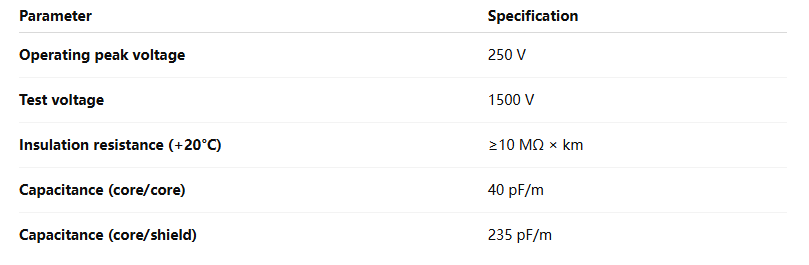
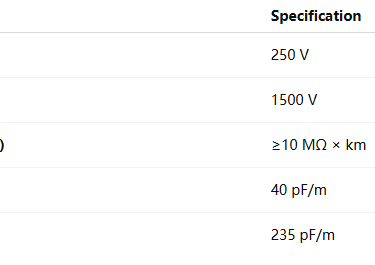
Electrical Performance
Why this matters:
Low capacitance ensures stable encoder signals over long runs—critical for fast-moving systems.
High insulation resistance prevents signal drift and noise.
1500 V test voltage demonstrates strong insulation integrity.
In plants where dozens of drives, VSDs, and motors operate simultaneously (common in SA automotive and mining operations), EMC reliability is essential. The cable is designed with this in mind.
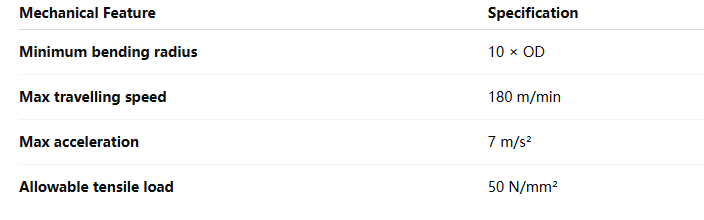
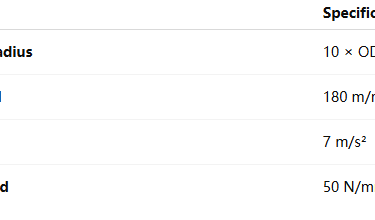
Mechanical Performance
Real-world meaning:
The cable can handle very fast drag chain cycles, such as in packaging or pick-and-place robots.
High acceleration tolerance makes it suitable for dynamic servo and encoder systems.
The bending radius is carefully optimised to prevent premature conductor fatigue.
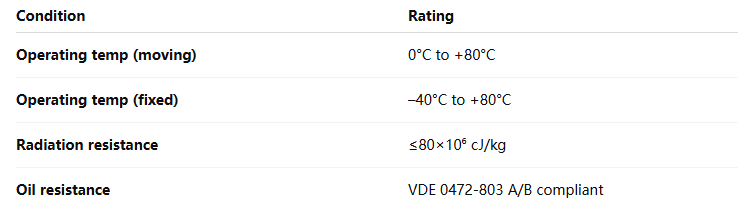
Environmental Performance
Why this is perfect for SA conditions:
SA temperature ranges—from cold Free State mornings to hot Mpumalanga mines—fit within the cable’s window.
Resistance to hydraulic oils is essential in mining and heavy industry.
Radiation tolerance is useful in specialised mineral processing environments.
Cable Structure in Detail (Professional Engineering Breakdown)
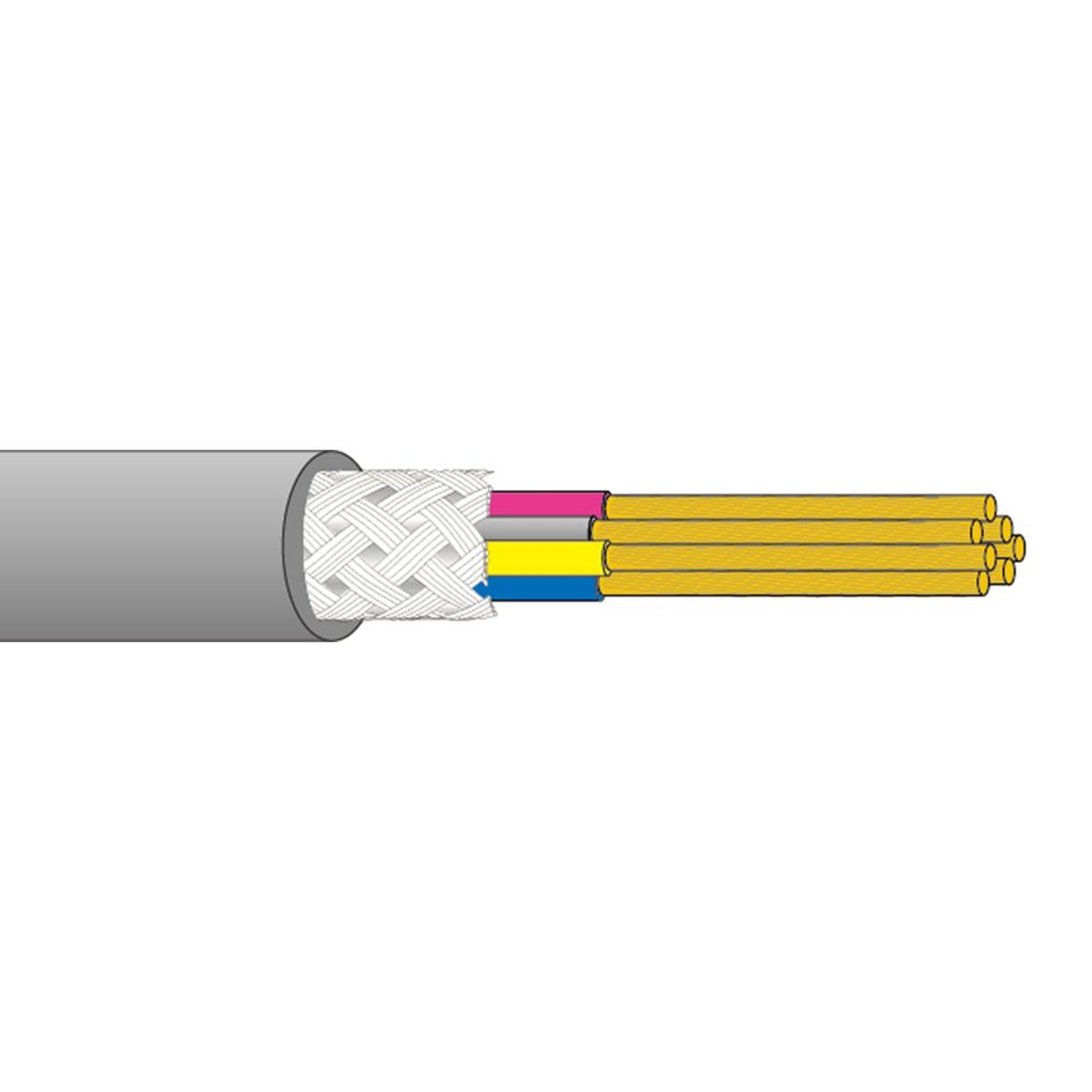
The cable’s reliability comes from carefully engineered internal design.
Ultra-Fine Stranded Copper Conductors
The conductor designs are optimised for repeated flexing:
0.14 mm² = 18 × 0.10 mm
0.50 mm² = 16 × 0.20 mm
1.00 mm² = 32 × 0.20 mm
These extremely fine strands bend without micro-cracking, preventing premature failure.
TPE Insulation and Core Pairing
Each core is insulated with high-grade TPE, chosen for:
Flexibility
Thermal stability
dielectrical strength
Core identification:
0.14 mm² pairs
Yellow + green
Grey + pink
Red + blue
1.0 mm² pair
White + brown
Twisted Pairs:
Twisting is essential for noise-free signal transmission, especially for:
Encoders
Feedback sensors
Low-voltage instrumentation
High-Density Tinned Copper Braided Shield
Coverage: 85%
This protects against EMI from:
High-power motors
VSDs
Inductive loads
Welding equipment
Crushers and feeders (mining)
The tinned braid also provides corrosion resistance—important in coastal or humid environments.
Non-Woven Wrapping Layer
This layer reduces internal friction, extending service life in drag chains.
Special PUR Outer Sheath (Black RAL 9015)
This is one of the cable’s greatest strengths.
PUR advantages:
High sliding capability inside drag chains
Excellent oil and chemical resistance
High wear resistance
UV stability
Impact resistance
Compared with PVC or TPE sheaths, PUR lasts significantly longer in:
Mining plants
Automotive assembly lines
Food processing equipment
Port automation systems
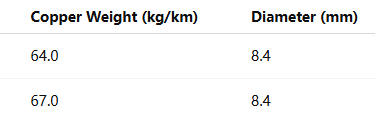
Dimensional Data and Mass
These designs are common in encoder and feedback loops where both signal and auxiliary power cores are required.
Key Properties and Advantages
Exceptional Flex Life
The combination of ultra-fine copper, TPE insulation, and PUR sheath ensures the cable withstands millions of bending cycles.
High EMC Reliability
The 85% tinned braid ensures precise feedback even in:
Large conveyor plants
Smelters
Mineral processing lines
Metalworking factories
Chemical, Oil, and Weather Resistance
Ideal for SA’s:
Mining oils
Hydraulic systems
Dusty outdoor operations
High-humidity coastal zones
Stable, Predictable Signal Transmission
Low capacitance + twisted pairs = accurate encoder readings.
Applications in South Africa
The cable is widely used in dynamic equipment across SA.
Industrial Automation
CNC machining centres
Pick-and-place robots
High-speed packaging machines
Automated conveyors
Automotive Manufacturing
Used in plants such as:
Rosslyn (Pretoria) – BMW, Nissan
Gqeberha (Port Elizabeth) – VW
East London – Mercedes-Benz
These plants rely heavily on drag chain systems for robotic welding, painting, and assembly.
Mining and Mineral Processing
Perfect for:
Ore sorting sensors
Conveyor tracking systems
Automated sampling machines
Crushers with feedback loops
Smart mineral processing lines
Logistics and Warehousing
AS/RS shuttles
Sorting conveyors
Robotics for parcel handling
Johannesburg Packaging Plant
Background
A high-speed packaging plant in Johannesburg was experiencing:
Intermittent encoder signal losses
Frequent cable replacements
Downtime costing tens of thousands of rand per month
Root Cause
PVC-sheathed cables were failing due to:
Friction in the drag chain
EMC interference
Mechanical fatigue from rapid cycles
The HIFLEX Solution
The plant replaced the cables with HIFLEX LiPC(DY)C11Y.
Results After 3 Months
✔ Encoder errors dropped drastically
✔ Signal stability improved
✔ Maintenance downtime reduced by 40%
✔ Drag chain cycles increased significantly without insulation wear
Engineers' Feedback
“Once we switched to the PUR-sheathed HIFLEX cable, the machine stopped giving random position errors. It simply works.”
How South African Engineers Should Select a High-Flex Encoder Cable
Key factors:
Movement Profile
Length of drag chain
Bending radius
Cycle frequency
Temperature
Outdoor installations
Hot mining environments
Chemical Exposure
Lubricants
Hydraulic oils
Coolants
EMC Conditions
Strong interference requires high-coverage shields
Cable Length
Capacitance affects encoder performance
Manufacturer Credibility
A proven cable reduces downtime and saves long-term costs.
Installation and Handling Guidelines
Respect the Minimum Bending Radius
Never exceed 10 × OD.
Provide Proper Slack
Avoid stretching or tension.
Avoid Sharp Edges
Use protective ducts where necessary.
Keep Drag Chains Clean
Dust or debris increases friction.
Routine Inspections
Early signs of wear:
Flattened sheath
Discolouration
Exposed braid
Frequently Asked Questions (FAQ)
Can this cable handle 24/7 continuous flexing?
Yes. It is designed for millions of cycles in high-speed drag chain systems.
Is the 85% shielding enough for environments with heavy motors?
Absolutely. It exceeds typical shielding needs in SA mining and automotive plants.
Can the cable be used outdoors in high-UV regions like Northern Cape?
Yes. The PUR sheath offers excellent UV and weather resistance.
Is it resistant to hydraulic and mining oils?
Yes, fully compliant with VDE 0472-803 A/B.
What is the typical service life?
This depends on the drag chain length and cycle rate, but users report significantly longer lifetimes than PVC/TPE cables.
How does it compare to PVC-sheathed cables?
PVC is cheaper but fails much faster. PUR outperforms PVC in flexibility, oil resistance, and abrasion.
Is it suitable for long encoder cable runs?
Yes, its low capacitance supports stable signals over extended distances.
Conclusion
South Africa’s industries—from mining to automotive to logistics—rely on precision, speed, and reliability. A small cable failure can halt an entire assembly line or conveyor system.
The HIFLEX LiPC(DY)C11Y stands out because it offers:
Mechanical durability
Excellent EMC protection
Outstanding chemical and oil resistance
High flexibility for extreme motion
Proven real-world performance in SA plants
For engineers seeking long-lasting, reliable performance in drag-chain applications, this cable is a true industry-grade solution that delivers stability, accuracy, and operational continuity.

Email Address: Li.wang@feichuncables.com
© 2025. All rights reserved.
One-click to Quickly Contact
Products
Contact
Company
Location:
Building A Private Science and Technology Park, Hefei Economic and Technological Development Zone, Anhui Province, China
Heat Resistant Cable
WhatsApp: +86 17333223430
Social Media: