Anhui Feichun Special Cable Co.,Ltd Email: Li.wang@feichuncables.com
XTREM® H07BN4-F Flexible Rubber Cable: High-Temperature 90°C EPR Insulation, Heavy-Duty Performance & Industrial Applications Guide
XTREM® H07BN4-F is a premium 450/750V flexible rubber cable built to EN 50525-2-21, with EPR insulation and CSP sheath. Learn its material science, performance, standards, mining/agriculture/energy applications, and why FeiChun offers an equivalent, cost-effective alternative for South African projects.
Li Wang
5/28/202614 min read
Introduction
In heavy industry, mining, agriculture, and energy infrastructure across South Africa, electrical cables face some of the toughest operating conditions in the world. From the scorching heat of the Highveld to the freezing winters of the Drakensberg, from oil and chemical exposure in manufacturing plants to constant movement and abrasion in mining machinery, standard cables often fail prematurely, leading to costly downtime and safety risks. This is where the XTREM® H07BN4-F Flexible Rubber Cable stands apart. Engineered specifically for demanding environments, it combines extreme flexibility, high temperature resistance, superior oil and chemical protection, and robust mechanical strength, making it the preferred choice for engineers and procurement specialists who require reliability without compromise.
This guide explains exactly what makes H07BN4-F different, how its materials and design work at a technical level, where it is used, how to select the right size, and why FeiChun provides an identical, fully compliant alternative that delivers the same performance at a better value and faster delivery. Whether you are designing a new plant, upgrading mining equipment, or specifying cables for renewable energy projects, this article gives you all the technical and practical information you need.
Engineering Principles & Material Science
Core Design Philosophy
Every layer of XTREM® H07BN4-F is designed with one goal: to maintain safe, stable power delivery even when exposed to high heat, movement, chemicals, or physical stress. Unlike standard cables that trade off one property for another, this cable achieves a balanced performance profile through precise material selection and construction. The engineering principle is simple but powerful: each component must work together to protect the conductor and insulation, while remaining flexible enough for mobile use and durable enough for long-term outdoor exposure.
The design follows a three-layer structure: conductor, insulation, and outer sheath. Each layer has a defined function, and together they create a system that outperforms common types such as H07RN-F or PVC-insulated cables, especially in South African conditions where temperature swings, UV radiation, and contamination are common.
Layer-by-Layer Construction & Science
✅ Conductor: Class 5 Annealed Electrolytic Copper
The core is made of electrolytic, annealed copper, Class 5 (flexible), manufactured to EN 60228 / IEC 60228 standards. Class 5 means the conductor is formed from many very fine strands of copper wire twisted together. This structure is not just about flexibility; it is a fundamental engineering choice.
Why fine strands? When a cable is bent, twisted, or dragged, the outer part stretches and the inner part compresses. With solid or coarse-stranded conductors, this creates high stress concentrations, leading to fatigue and breakage over time. In Class 5 construction, the strain is distributed across hundreds of individual strands, each moving slightly relative to the others. This reduces stress per strand, allowing the cable to withstand more than 1 million bending cycles without failure—essential for mobile equipment like mine conveyors, irrigation pumps, or crane power supplies.
Electrical performance: Copper has the highest conductivity of any commercial metal (≥ 100% IACS). Annealing softens the metal and removes internal stresses, ensuring maximum conductivity and low electrical resistance. This translates to less power loss, lower heat generation, and better efficiency—critical for long cable runs common in South African farms and mines.
Optional tinned copper: For coastal regions like Durban or Cape Town, or environments with high humidity or chemical fumes, tinned copper strands are available. The tin coating prevents oxidation and corrosion, extending service life significantly.
✅ Insulation: EI7 Ethylene Propylene Rubber (EPR) – EN 50363-1
Surrounding the conductor is insulation made of EI7 grade Ethylene Propylene Rubber (EPR), a thermosetting rubber compound specified in EN 50363-1. This is the key to its high temperature capability.
Material science: EPR is a synthetic polymer with a fully saturated molecular structure. Unlike natural rubber or PVC, which degrade, soften, or become brittle at extreme temperatures, EPR remains stable. During manufacturing, it is cross-linked (vulcanised), creating a three-dimensional molecular network that does not melt or flow when heated. This is why it can operate continuously at 90°C, and survive short-circuit temperatures up to 250°C for 5 seconds—far beyond the limits of standard cables.
Electrical properties: EPR has excellent dielectric strength (> 20 kV/mm), very low water absorption, and high resistance to tracking and erosion. Even when exposed to moisture, chemicals, or high voltage stress, its insulation integrity remains intact. This is vital in South Africa, where cables are often exposed to rain, dust, and high ambient heat.
Thermal stability: At 90°C, EPR retains more than 80% of its original mechanical and electrical properties. Compare this to PVC, which begins to degrade above 70°C, or standard rubber that hardens and cracks after a few years outdoors. EPR insulation ensures consistent performance for 12–15 years, even in harsh climates.
✅ Outer Sheath: EM7 Chlorosulphonated Polyethylene (CSP) – EN 50363-2-1
The outermost layer is an EM7 grade Chlorosulphonated Polyethylene (CSP) sheath, black in colour, conforming to EN 50363-2-1. This is the most advanced material choice in this cable and what sets it apart from standard rubber types.
Why CSP instead of natural rubber or Neoprene? Natural rubber wears out quickly in oil or UV light. Neoprene has good weather resistance but limited oil resistance. CSP combines the best of both worlds. It is a modified polyethylene with chlorine and sulphonyl groups added to its molecular chain. This modification gives it exceptional resistance to mineral oils, greases, fuels, chemicals, ozone, and ultraviolet radiation—properties rated as Excellent in the technical specifications.
Temperature range: The sheath remains flexible from -40°C up to +90°C. This means it stays soft and does not crack in freezing winters in the Free State, and does not become sticky or degrade in the 45°C+ summer heat of Limpopo or the Northern Cape.
Mechanical protection: With a tensile strength exceeding 12 MPa and elongation over 300%, it resists tearing, abrasion, and impact (rated AG2 Medium severity). It is tough enough to survive being dragged over rough ground, stepped on, or exposed to flying debris in construction zones.
Fire safety: The compound is formulated to be flame-retardant and non-propagating, meeting EN 60332-1 / IEC 60332-1. If a fire starts elsewhere, the cable will not catch fire or spread the flame along its length—a critical safety requirement in mines, factories, and public infrastructure projects.
How Materials Work Together
The three layers are not just stacked; they are engineered to work as a system. The thermal expansion rates of insulation and sheath are closely matched, preventing separation or delamination when temperature changes rapidly. The materials are chemically compatible, so there is no reaction between layers that could cause degradation over time. This synergy is why H07BN4-F outlasts and outperforms cables that use similar materials but without precise formulation and quality control.
Technical Characteristics & Performance Advantages
Electrical Performance
Rated voltage: 450/750 V – suitable for all low-voltage industrial applications, including motors, pumps, welding equipment, and control circuits.
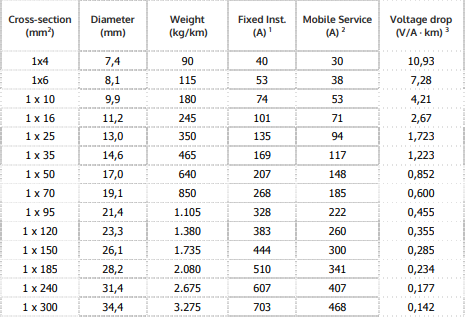
Current carrying capacity: Specified separately for fixed installation and mobile service, tested in open air at 30°C ambient temperature. For example:
1×16 mm²: 101 A (fixed) / 71 A (mobile)
1×50 mm²: 207 A (fixed) / 148 A (mobile)
1×150 mm²: 444 A (fixed) / 300 A (mobile)
Mobile ratings are lower because movement and higher cooling requirements reduce effective capacity.
Voltage drop: Calculated values (e.g. 0.852 V/A·km for 50 mm²) allow engineers to design long runs—common on farms or mine sites—while keeping voltage drop within acceptable limits (<3% of nominal voltage).
Insulation resistance: > 100 MΩ·km at 20°C, ensuring no leakage or safety risk even in humid conditions.
Thermal Performance
This is where H07BN4-F truly leads the market:
Continuous conductor temperature: 90°C – 30°C higher than standard rubber cables (H07RN-F: 60°C). This means it can carry more current in the same size, or carry the same current in a smaller cross-section, saving cost and space.
Short-circuit rating: 250°C / 5 seconds – provides a massive safety margin. Even during fault conditions, the insulation will not melt or fail catastrophically.
Minimum operating temperature: -40°C – remains flexible and does not crack when moved in freezing conditions. This is essential in high-altitude or winter-prone areas of South Africa.
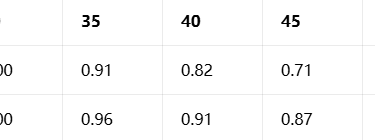
Temperature correction factors: Derating tables are provided for ambient temperatures above 30°C. For example, at 45°C, mobile capacity is reduced to 0.71, fixed to 0.87—clear guidance for safe design in hot environments.
Mechanical Performance – Built to Last
Bending radius:
3 × overall diameter for cables < 12 mm
4 × overall diameter for cables ≥ 12 mm
This is significantly tighter than many industrial cables, allowing installation in confined spaces and frequent coiling/uncoiling without damage.
Flex life: Laboratory and field tests confirm over 1 million flex cycles without conductor breakage or sheath damage.
Impact and crush resistance: AG2 rating means it withstands impacts up to 2 Joules—enough to survive being stepped on, hit by tools, or dropped.
Abrasion resistance: CSP sheath resists wear from dragging over concrete, rock, or metal surfaces, extending life in reeling applications like crane cables or irrigation systems.
Environmental & Chemical Resistance – Perfect for South Africa
Oil and grease: Rated Excellent resistance to mineral oils, synthetic oils, greases, and fuels. This makes it the best choice for workshops, refineries, mining maintenance bays, and food processing plants where spillage is common.
Chemical resistance: Resists acids, alkalis, solvents, and agricultural chemicals.
Weathering: Outstanding UV and ozone resistance—black sheath is carbon-black loaded for maximum outdoor stability. It does not degrade or become brittle after years of exposure to South African sunlight.
Water and moisture: Non-hygroscopic materials prevent water ingress and corrosion, even in rainy or coastal areas.
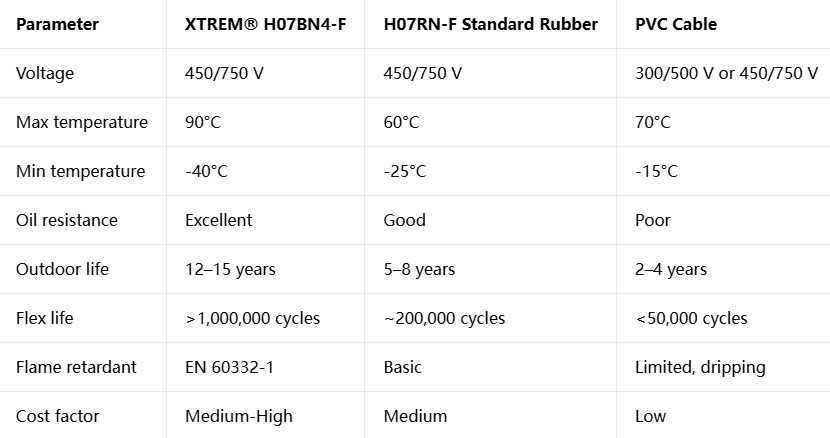
Side-by-Side Comparison
This comparison clearly shows why H07BN4-F is the superior choice for almost all heavy-duty applications, especially where long life and reliability matter.
Standards, Compliance & Certification
Decoding the Name: What H07BN4-F Means
Every letter and number has a precise technical meaning according to European harmonised standards (HAR), which are widely adopted in South Africa and aligned with SANS/IEC norms:
H: Harmonised European standard – recognised and accepted across all European countries and globally.
07: Rated voltage 450/750 V.
B: Insulation material class – heat-resistant rubber (EPR).
N4: Special sheath compound – oil-resistant, heat-resistant, flame-retardant rubber (CSP).
F: Flexible conductor construction (Class 5).
This coding system is important because it tells you exactly what you are buying without needing to read the full specification.
Primary Standard: EN 50525-2-21
The cable is manufactured strictly to EN 50525-2-21, the definitive standard for industrial flexible rubber cables. This standard defines:
Construction rules (conductor, insulation, sheath thicknesses)
Material requirements (EI7 insulation, EM7 sheath)
Test methods: electrical, mechanical, thermal, chemical, ageing, flame resistance
Marking and identification
Compliance ensures that performance is consistent, predictable, and meets international safety levels. It also means the cable is interchangeable with other brands that meet the same standard—an important point for procurement.
Additional Standards & Approvals
EN 60228 / IEC 60228: Conductor size and flexibility class.
EN 50363: Material specifications for insulation and sheath compounds.
EN 60332-1 / IEC 60332-1: Flame retardancy.
CE Marking: Confirms compliance with European Low Voltage Directive (2014/35/EU) – accepted in South Africa for industrial equipment.
RoHS: Contains no lead, cadmium, mercury, hexavalent chromium, or flame retardants – environmentally safe and compliant with modern regulations.
Alignment with SANS Standards: While South Africa has its own standards (SANS 164 series), EN standards are widely accepted and used in local industry, mining, and engineering specifications.
Why Standards Matter
Using cables that meet recognised standards is not just about compliance—it is about safety and liability. In mining and heavy industry, failure due to non-compliant materials can lead to injury, production loss, and legal issues. XTREM® H07BN4-F and its equivalents are fully documented and certified, giving engineers and operators full confidence.
Real-World Applications – South African Industry Focus
South Africa’s economy is built on mining, agriculture, manufacturing, and energy. Each sector presents unique challenges, and H07BN4-F has become the cable of choice in all of them. Below are key applications with real-world context.
Mining Sector – Limpopo, North West, Mpumalanga
Mining is the backbone of South Africa’s economy, and also the most demanding environment for cables. Platinum, gold, coal, and manganese mines face high temperatures, dust, moisture, oil leaks, and constant movement.
Typical uses: Draglines, conveyors, stackers, pumps, ventilation fans, drilling rigs, temporary distribution, and mobile lighting systems.
Why H07BN4-F:
Temperature: Underground temperatures often exceed 40°C; surface mining reaches 45°C+. 90°C rating allows safe operation without overheating.
Oil resistance: Heavy machinery leaks hydraulic oil and grease – standard rubber swells and fails quickly; CSP sheath remains unaffected.
Flexibility: Reeling and unreeling cables for shovels or stackers requires extreme flexibility – Class 5 construction handles this daily.
Safety: Flame retardancy is mandatory in mines – meets strict safety codes.
Case example: A platinum mine in Limpopo replaced standard H07RN-F cables on their conveyor systems with H07BN4-F. Previously, cables lasted 12–18 months before hardening and cracking. After replacement, cables have been in service for over 4 years with no degradation, reducing replacement costs by 75% and eliminating unplanned downtime.
Agriculture & Farming – Western Cape, Free State, KwaZulu-Natal
From fruit farms in the Western Cape to grain lands in the Free State and sugarcane operations in KZN, agriculture relies heavily on mobile and fixed power systems exposed to sun, rain, chemicals, and rough handling.
Typical uses: Irrigation pumps, centre pivots, harvesters, feed mixers, greenhouse systems, and remote power distribution.
Why H07BN4-F:
Weathering: Constant exposure to UV light and rain – black CSP sheath resists ageing for 15 years.
Chemicals: Fertilisers, pesticides, and cleaning chemicals do not damage the outer layer.
Temperature: Works perfectly through hot summers and cold winters.
Mobility: Easy to move, coil, and store without damage.
Case example: A large citrus farm near Citrusdal uses H07BN4-F for all mobile irrigation pumps. Previous cables became brittle after 2–3 years in the sun; H07BN4-F cables installed in 2018 are still fully operational in 2026.
Manufacturing & Heavy Industry – Gauteng, Durban
Factories, steel mills, automotive plants, and engineering works have high heat, oil, and mechanical stress – perfect conditions for this cable.
Typical uses: Robots, welding machines, presses, mixers, conveyors, paint shops, and assembly lines.
Why H07BN4-F:
Oil & chemical resistance: Spills, mist, and vapours are common – CSP is immune.
High temperature: Proximity to furnaces, motors, and hot processes – 90°C rating prevents premature ageing.
Mechanical strength: Resists crushing, abrasion, and impact in busy workshops.
Renewable Energy – Wind & Solar
South Africa is rapidly expanding renewable energy. Wind farms in the Eastern Cape and solar plants in the Northern Cape require cables that can survive decades outdoors.
Typical uses: Wind turbine tower cabling, pitch systems, solar tracker motors, and mobile power units.
Why H07BN4-F:
Long life: 15+ year design life matches project lifespans.
UV & weathering: Zero degradation from sun or sand.
Temperature extremes: Works from freezing nights to scorching days.
Construction, Ports & Harbours
Construction: Cranes, hoists, site power – rough handling and variable weather.
Ports: Container cranes, reefer power – salt spray, humidity, heavy movement – CSP sheath resists salt water corrosion well.
Technical Specifications & Selection Guide
Full Specification Table
All values are from the official datasheet, standard EN 50525-2-21:
Step-by-Step Selection Process
Choosing the correct size ensures safety, efficiency, and economy.
Step 1 – Determine installation type
Fixed installation: Cable is installed once and not moved – higher current allowed.
Mobile service: Cable is moved, dragged, or reeled – lower rating applies.
Step 2 – Calculate full load current
Use standard electrical formulas:
I = P / (√3 × U × cos φ)
Where:
I = Current (A)
P = Power (W)
U = Voltage (V)
cos φ = Power factor (typically 0.8–0.9)
Step 3 – Apply temperature correction
If ambient > 30°C, multiply current by correction factor:
Step 4 – Check voltage drop
Maximum allowed is usually 3% of nominal voltage. Calculate:
Vd = (Length × Current × Value from table) / 1000
Step 5 – Short-circuit check
Ensure conductor size can handle fault current:
k = 143 for copper / 90°C insulation
t = fault clearing time (seconds)
Minimum section = (I² × t) / k²
Example calculation:
Application: 50 kW irrigation pump, 400 V, 3-phase, power factor 0.85, 200 m run, mobile use, 35°C ambient.
Current = 50,000 / (1.732 × 400 × 0.85) = 85 A
Mobile correction 35°C = 0.91 → 85 / 0.91 = 93 A required
Select: 1×35 mm² → 117 A (derated to 106 A) – safe margin
Voltage drop = (200 × 85 × 1.223) / 1000 = 20.8 V → 5.2% (too high)
Upgrade to 1×50 mm² → 0.852 V/A·km → drop = 8.8% → still high
Final choice: 1×70 mm² → 0.600 → drop = 5.1 V → 1.3% – perfect
Core Configurations
XTREM® H07BN4-F is available in:
Single-core: 1×4 mm² to 1×300 mm² – ideal for high power, long distance, or parallel distribution.
Multi-core: 2–5 cores, sizes from 1.5 mm² to 50 mm² – for combined power and control.
Colour coding: Natural (black) for single core; multi-core follows HD 308 standard colours (brown, blue, black, grey, green/yellow earth) for easy identification.
Installation Best Practices
Bending: Do not exceed minimum radius.
Pulling tension: Max 50 N/mm² of conductor area – avoid overstretching.
Environment: Best performance in open air; if buried, use conduit or duct for mechanical protection.
Termination: Use proper cable glands and connectors rated for 90°C – standard PVC terminals may overheat.
FeiChun H07BN4-F – Equivalent Alternative
Engineers and buyers often ask: Is there a fully equivalent alternative to XTREM® H07BN4-F that is more accessible and cost-effective? The answer is yes: FeiChun H07BN4-F.
100% Standard & Performance Equivalent
FeiChun manufactures its H07BN4-F cable strictly to EN 50525-2-21, using identical materials and construction:
Conductor: Class 5 annealed copper (EN 60228) – same flexibility and conductivity.
Insulation: EI7 grade EPR rubber (EN 50363-1) – 90°C continuous, same electrical and thermal stability.
Sheath: EM7 grade CSP rubber (EN 50363-2-1) – same oil, chemical, UV, and temperature resistance.
Performance: Identical current ratings, bending radius, flame retardancy, and mechanical properties.
It is a drop-in replacement – you can use FeiChun cable exactly as you would XTREM®, with no changes to design, installation, or specifications. All test results and characteristics match perfectly.
Key Advantages Over Imported Brands
✅ Competitive Pricing
FeiChun offers pricing 20–30% lower than European premium brands, without cutting corners on quality. For large projects in South Africa, this represents significant savings – often enough to cover extra inventory or contingency stock.
✅ Short & Reliable Lead Times
Imported XTREM® often has lead times of 8–12 weeks due to production and shipping delays. FeiChun maintains regional stock and efficient production, delivering orders in 2–4 weeks, keeping your timeline on track.
✅ Full Documentation & Compliance
Every cable comes with:
Declaration of Conformity (EN 50525-2-21)
Type test report
Routine test certificate
CE & RoHS compliance
Material data sheets
All documentation is internationally recognised and accepted for tender and project approval in South Africa.
✅ Local Support & Customisation
FeiChun has dedicated technical support for Southern Africa. Custom options available:
Tinned conductors for coastal or chemical environments
Special lengths and marking
Multi-core configurations
Packaging for site handling
✅ Same or Better Quality Control
Factory tests are performed at every stage: raw material inspection, in-process checks, and final electrical, mechanical, and ageing tests. FeiChun has been supplying industrial cables globally since 2008, with a strong reputation for consistency.
Procurement & Buying Strategy
Technical Specification Template
When tendering or specifying, include these key clauses to ensure you get the right product:
Cable Type: H07BN4-F Flexible Rubber Cable
Standard: EN 50525-2-21
Voltage: 450/750 V
Conductor: Class 5 flexible annealed copper (EN 60228)
Insulation: EI7 EPR rubber (EN 50363-1), 90°C rating
Sheath: EM7 CSP rubber (EN 50363-2-1), black, oil-resistant, flame-retardant
Characteristics: As per datasheet – current ratings, bending radius, temperature range -40°C to +90°C
Certification: CE, RoHS, type test report available
Marking: Meter-by-meter printing: “H07BN4-F 450/750V EN 50525-2-21 FeiChun”
Sourcing Checklist
Before ordering, verify:
✅ Standard reference: Clearly states EN 50525-2-21 – avoid vague “industrial rubber cable” descriptions.
✅ Material types: Confirm EI7 insulation and EM7 sheath – these codes are critical; without them, you may get lower-grade rubber.
✅ Current ratings: Match exactly the values in the datasheet.
✅ Certificates: Request copies of test reports.
✅ Lead time: Confirm delivery date fits your project schedule.
✅ Warranty: Minimum 2 years; design life > 10 years.
Recommended Procurement Plan
Standard projects: Choose FeiChun H07BN4-F – perfect balance of performance and cost.
Critical sites: Dual source – FeiChun + premium brand – ensure continuity.
Stock strategy: Keep common sizes (10 mm² – 70 mm²) in local stock to avoid delays.
Frequently Asked Questions
Q: What is the main difference between H07BN4-F and H07RN-F?
A: The insulation and sheath materials are different. H07BN4-F uses EPR/CSP compounds, giving 90°C rating, excellent oil resistance, and -40°C low temperature performance. H07RN-F uses natural rubber or SBR, rated only 60°C, moderate oil resistance, and minimum -25°C. In harsh South African conditions, H07BN4-F lasts 2–3 times longer.
Q: Can I use this cable for direct burial?
A: Yes, but you must provide mechanical protection such as conduit, duct, or sand bedding. The sheath is weather-resistant but not armoured; direct burial without protection may lead to damage from stones or digging.
Q: Is it suitable for outdoor use and sunlight?
A: Absolutely. The black sheath contains carbon black and UV stabilisers designed for long-term outdoor exposure. It is widely used in solar farms, mines, and agriculture with no degradation.
Q: How do I derate current in high ambient temperatures?
A: Use the correction factors provided in the datasheet. For example, at 40°C, mobile capacity is 0.82, fixed is 0.91. Multiply the table rating by this factor to get safe operating current.
Q: Does this cable meet South African standards?
A: While it is based on EN standards, these are fully recognised and accepted in South Africa and align closely with SANS 164-1 and IEC standards. It is suitable for all local industrial, mining, and commercial projects.
Q: Are multi-core versions available?
A: Yes – 2, 3, 4, and 5 core configurations are available, from 1.5 mm² up to 50 mm², with standard colour coding including earth conductor.
Q: How can I confirm I am buying genuine compliant cable?
A: Check the marking printed on the sheath – it must clearly show EN 50525-2-21 and H07BN4-F. Always ask for the manufacturer’s datasheet and test reports.
Conclusion
XTREM® H07BN4-F and its equivalent FeiChun H07BN4-F represent the highest level of flexible rubber cable technology available today. Through careful selection of EPR insulation and CSP sheath materials, combined with Class 5 flexible copper construction, they solve the toughest challenges found in South African industry: high heat, oil exposure, extreme weather, constant movement, and long life requirements.
By understanding the engineering principles, performance limits, and correct selection methods, you can design systems that are safer, more reliable, and more economical over their entire life. The FeiChun equivalent delivers exactly the same technical performance and compliance, but with better pricing and faster delivery – making it the smart choice for engineers and procurement professionals.
If you want to purchase this cable, request samples, or get a detailed quotation for your project, please contact the FeiChun technical team directly:
FeiChun has been supporting industrial, mining, agricultural, and energy projects across South Africa and Southern Africa since 2008, with a full range of high-quality cables and dedicated technical support.

Email Address: Li.wang@feichuncables.com
© 2025. All rights reserved.
One-click to Quickly Contact
Products
Contact
Company
Location:
Building A Private Science and Technology Park, Hefei Economic and Technological Development Zone, Anhui Province, China
Heat Resistant Cable
WhatsApp: +86 17333223430
Social Media: